Within Radiation Claim
Could Blood Tests Have Confirmed Radiation Sickness?
Repeated lymphocyte, neutrophil and platelet measurements could support a whole-body exposure estimate, but no complete series has been publicly released.
On this page
- Blood changes expected after major exposure
- Why repeated tests matter more than one result
- What medical values remain undisclosed
Page outline Jump by section
Introduction
Within the debate over whether the Cash–Landrum witnesses experienced radiation sickness, one of the most important pieces of missing medical evidence is a complete series of timed blood counts. Modern radiation medicine does not diagnose acute radiation syndrome (ARS) from symptoms alone. Instead, clinicians combine the clinical picture with repeated complete blood counts (CBCs), especially measurements of absolute lymphocyte, neutrophil and platelet levels taken over hours and days after the suspected exposure. The pattern of change is often more informative than any single laboratory result because ionising radiation produces characteristic time-dependent effects on the bone marrow. Publicly available accounts of the Cash–Landrum case do not include such a documented serial blood-count record, leaving an important gap in assessing whether the reported illnesses followed the biological pattern expected after a significant whole-body radiation exposure.[cdc.gov]cdc.govAcute Radiation Syndrome: Information for Clinicians | Radiation Emergencies | CDCApril 23, 2024…
Could Blood Tests Have Confirmed Radiation Sickness?
A single abnormal blood test cannot establish radiation injury. White blood cell counts vary for many reasons, including viral infections, bacterial illness, stress, medications such as corticosteroids, chronic medical conditions and laboratory variation. Radiation physicians therefore look for a characteristic sequence of changes rather than an isolated abnormal value.[REMM]remm.hhs.govREMMManaging Acute Radiation Syndrome (ARSRadiation Emergency Medical Management…
In suspected whole-body radiation exposure, clinicians obtain an early CBC with differential and then repeat it at closely timed intervals. The most informative early marker is the absolute lymphocyte count because lymphocytes are among the most radiosensitive circulating blood cells. Following a sufficiently large whole-body exposure, their numbers typically decline in a predictable fashion, allowing physicians to estimate an approximate absorbed dose before more specialised testing becomes available.[cdc.gov]cdc.govAcute Radiation Syndrome: Information for Clinicians | Radiation Emergencies | CDCApril 23, 2024…
This approach is standard enough that the US Centers for Disease Control and Prevention (CDC), the Radiation Emergency Medical Management (REMM) programme and the International Atomic Energy Agency (IAEA) all recommend repeated blood sampling as part of the initial evaluation of suspected ARS.[cdc.gov]cdc.govAcute Radiation Syndrome: Information for Clinicians | Radiation Emergencies | CDCApril 23, 2024…
Blood Changes Expected After Major Exposure
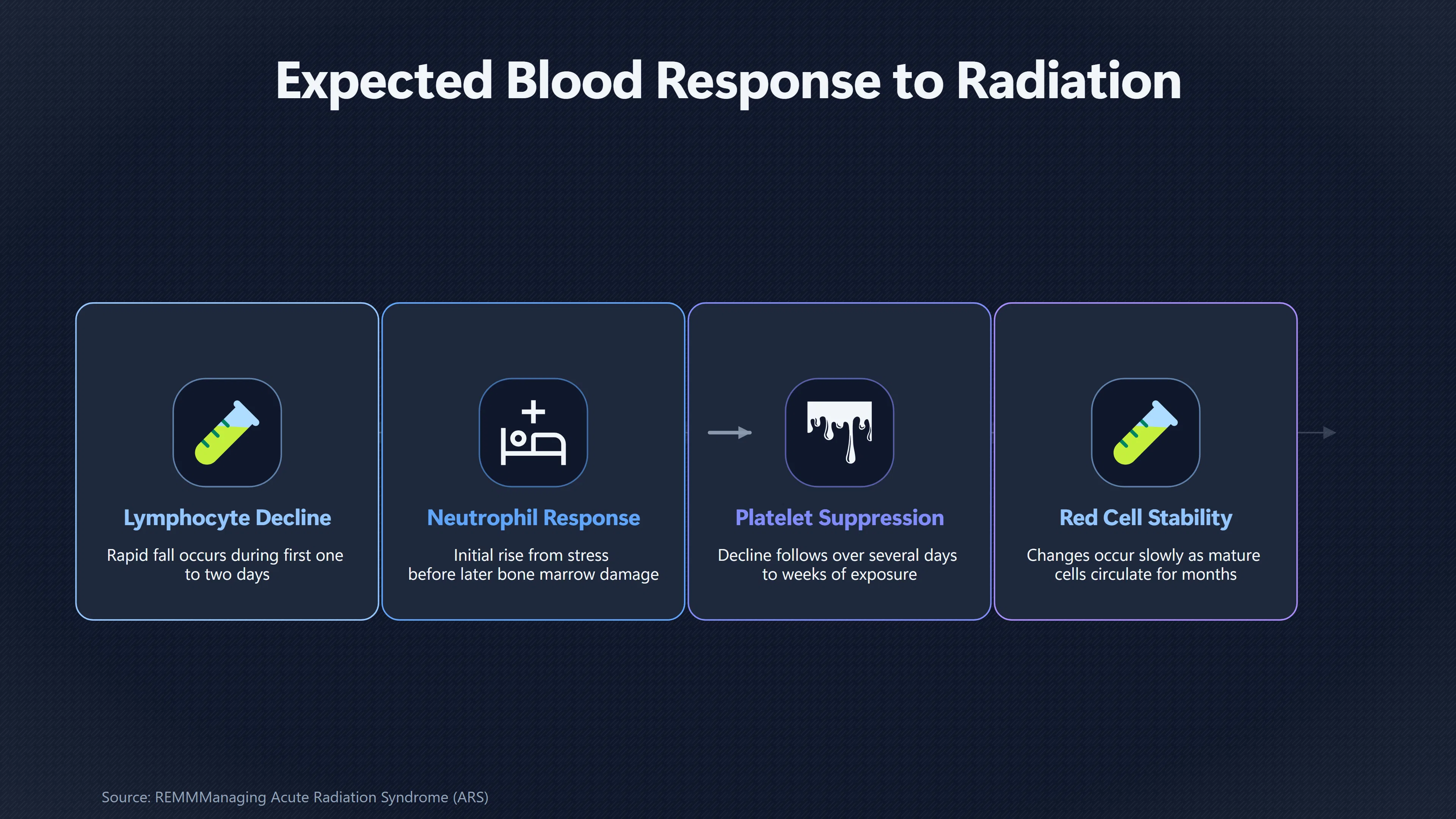
Radiation damages rapidly dividing cells within the bone marrow. The resulting blood abnormalities emerge over time rather than all at once, making chronology essential.
Typical trends include:
- Lymphocytes: Usually the earliest and most useful marker. A rapid fall during the first one to two days suggests increasing whole-body dose.
- Neutrophils: Their behaviour is more complicated. Counts may initially rise because of stress responses before later falling as bone marrow damage becomes apparent.
- Platelets: These generally decline later than lymphocytes, often over several days to weeks, increasing the risk of bleeding if marrow injury is severe.
- Red blood cells: These usually change much more slowly because mature red cells circulate for months.[hhs.gov]remm.hhs.govREMMManaging Acute Radiation Syndrome (ARSRadiation Emergency Medical Management…
No single threshold proves radiation sickness. Instead, physicians compare the timing and rate of decline against established radiation response curves, while considering symptoms and any known exposure history.

Why Repeated Tests Matter More Than One Result
Serial measurements allow doctors to answer questions that one laboratory value cannot.
First, they establish whether blood cells are changing in a direction consistent with radiation injury. A normal early lymphocyte count may become significant if it falls rapidly over the next several hours, whereas a single low count with no documented trend is much harder to interpret. The CDC therefore recommends repeated CBCs—often every two to three hours during the initial assessment period after a known recent exposure—to evaluate lymphocyte depletion kinetics.[CDC]cdc.govAcute Radiation Syndrome: Information for Clinicians | Radiation Emergencies | CDCApril 23, 2024…
Second, the pattern helps estimate dose. Radiation emergency medicine uses the rate of lymphocyte decline as one form of biological dosimetry when no physical dosimeter is available. The classic Andrews lymphocyte nomogram and later biodosimetry methods compare sequential lymphocyte measurements with known dose-response relationships to estimate likely whole-body exposure. These estimates guide prognosis and treatment decisions.[cdc.gov]cdc.govAcute Radiation Syndrome: Information for Clinicians | Radiation Emergencies | CDCApril 23, 2024…
Third, repeated testing helps distinguish radiation injury from alternative explanations. Acute infections, inflammatory illnesses and medications may alter white blood cell counts, but they usually do not reproduce the characteristic sequence of lymphocyte depletion followed by later neutrophil and platelet suppression expected after substantial whole-body irradiation. Because neutrophils can initially increase after severe stress or trauma, interpreting them without serial follow-up may even be misleading.[REMM]remm.hhs.govREMMManaging Acute Radiation Syndrome (ARSRadiation Emergency Medical Management…
What Medical Values Remain Undisclosed
Public summaries of the Cash–Landrum medical record describe hospitalisation, reported skin problems and subsequent illness, but they do not include a complete chronological series of CBC results showing lymphocyte, neutrophil and platelet counts measured across the critical hours and days after the alleged exposure.
Without that information, outside reviewers cannot determine whether:
- lymphocyte counts showed the expected early depletion;
- later neutrophil and platelet changes followed the recognised progression of bone marrow injury;
- the laboratory findings were internally consistent with a particular absorbed radiation dose; or
- the blood abnormalities were more compatible with another medical condition.[CDC]cdc.govAcute Radiation Syndrome: Information for Clinicians | Radiation Emergencies | CDCApril 23, 2024…
Similarly, no publicly released dose reconstruction based on serial blood counts has been presented for the case. Modern radiation accident investigations generally combine laboratory trends with physical dose reconstruction, exposure history and, when feasible, cytogenetic biodosimetry using chromosome analysis. Publicly available Cash–Landrum documentation does not include that complete evidential chain.[cdc.gov]cdc.govAcute Radiation Syndrome: Information for Clinicians | Radiation Emergencies | CDCApril 23, 2024…
Why This Gap Matters to the Medical Debate
The absence of published serial blood-count data does not prove that the witnesses were not exposed to radiation. Equally, it does not support the conclusion that they were. It means that one of the principal objective tools used in radiation medicine cannot be independently evaluated from the public record.
This distinction is important because the reported symptoms—such as nausea, skin changes and later hair loss—are not unique to radiation exposure. Radiation specialists rely on timed biological markers precisely because symptoms alone have limited diagnostic specificity. A documented sequence of blood counts consistent with recognised lymphocyte depletion kinetics would have substantially strengthened the medical case for significant whole-body irradiation. Conversely, the absence of such a pattern would have weighed against that diagnosis. Since no complete series has been publicly released, the question remains unresolved on the available medical evidence.[cdc.gov]cdc.govAcute Radiation Syndrome: Information for Clinicians | Radiation Emergencies | CDCApril 23, 2024…
Amazon book picks
Further Reading
Books and field guides related to Could Blood Tests Have Confirmed Radiation Sickness?. Use these as the next step if you want deeper reading beyond the article.
Radiobiology for the Radiologist
In print since 1972, this seventh edition of Radiobiology for the Radiologist is the most extensively revised to date. It consists of two...
Medical Effects of Ionizing Radiation
"The new edition of this monograph features renowned experts who offer the most current information and reliable guidance on all aspects...
Medical Management of Radiation Accidents
Although radiation accidents are rare and often complex in nature, they are of great concern not only to the patient and involved medical...

Basic clinical radiobiology
First published 2009. Subjects: Radiotherapy, Radiobiology, Neoplasms, Cell Survival, Radiation effects.
eBay marketplace picks
Marketplace Samples
Live-tested eBay searches with available results related to this page.
Selected fromUFO art print oneBay.co.uk.

Current eBay listing
UFO Over Forest Framed Wall Art Poster Canvas Print Picture

Current eBay listing
UFO ABDUCTION OVER THE OCEAN -DEEP FRAMED CANVAS WALL ART PRINT

Current eBay listing
UFO ALIEN POSTER ART PRINT - FRAMED OPTIONS - CHOOSE SIZE! B

Endnotes
1.
Source: cdc.gov
Link:https://www.cdc.gov/radiation-emergencies/hcp/clinical-guidance/ars.html
Source snippet
Acute Radiation Syndrome: Information for Clinicians | Radiation Emergencies | CDCApril 23, 2024...
Published: April 23, 2024
2.
Source: remm.hhs.gov
Title: REMMManaging Acute Radiation Syndrome (ARS)
Link:https://remm.hhs.gov/ars.htm
Source snippet
Radiation Emergency Medical Management...
3.
Source: www-pub.iaea.org
Title: Publications EPR-Medical
Link:https://www-pub.iaea.org/MTCD/Publications/PDF/EPR-Medical%20%282024%29_web.pdf
Source snippet
IAEA PublicationsEPR-Medical...
4.
Source: cdc.gov
Link:https://www.cdc.gov/radiation-emergencies/hcp/clinical-guidance/determining-deaths.html
Source snippet
Clinical Guidance for Determining Deaths from a Radiation Emergency | Radiation Emergencies | CDC...
5.
Source: remm.hhs.gov
Title: REMMHematopoietic Subsyndrome of Acute Radiation Syndrome (ARS)
Link:https://remm.hhs.gov/hemeguidelines.htm
Source snippet
Radiation Emergency Medical Management...
6.
Source: cdc.gov
Title: evaluation and management
Link:https://www.cdc.gov/radiation-emergencies/hcp/nuclear-detonations/evaluation-and-management.html
Source snippet
Emergency Department: Evaluation and Management of Affected Patients | Radiation Emergencies | CDCJanuary 31, 2025 — January 31, 2025 EME...
Published: January 31, 2025
7.
Source: youtube.com
Link:https://www.youtube.com/watch?v=ANs6fbSbw4s
Source snippet
Exposure Algorithm...
8.
Source: youtube.com
Link:https://www.youtube.com/watch?v=Nhp6V7Kxm28
Source snippet
Acute Radiation Syndromes (CNS vs GI vs Hemopoietic)...
9.
Source: pmc.ncbi.nlm.nih.gov
Link:https://pmc.ncbi.nlm.nih.gov/articles/PMC3810609/
Source snippet
PubMed Central (PMC)Assessment of Biodosimetry Methods for a Mass-Casualty Radiological Incident: Medical Response and Management Conside...
11.
Source: remm.hhs.gov
Link:https://remm.hhs.gov/aboutlymphocytedepletion.htm
Additional References
12.
Source: youtube.com
Title: The Cash-Landrum UFO Mystery
Link:https://www.youtube.com/watch?v=P2HsOUTzyWA
Source snippet
Full Guide to Acute Radiation Sickness (ARS) Symptoms & Treatment...
13.
Source: youtube.com
Title: Acute Radiation Syndromes (CNS vs GI vs Hemopoietic)
Link:https://www.youtube.com/watch?v=bk1JUKJle6I
Source snippet
The Cash-Landrum UFO Mystery...
14.
Source: youtube.com
Title: Full Guide to Acute Radiation Sickness (ARS) Symptoms & Treatment
Link:https://www.youtube.com/watch?v=Blqsx2c4ty4
15.
Source: pubmed.ncbi.nlm.nih.gov
Link:https://pubmed.ncbi.nlm.nih.gov/17036617/
16.
Source: pubmed.ncbi.nlm.nih.gov
Link:https://pubmed.ncbi.nlm.nih.gov/26011498/
17.
Source: pmc.ncbi.nlm.nih.gov
Link:https://pmc.ncbi.nlm.nih.gov/articles/PMC3863169/
18.
Source: pmc.ncbi.nlm.nih.gov
Link:https://pmc.ncbi.nlm.nih.gov/articles/PMC4482456/