Within Cash Landrum
Do Missing Records Suggest a Cover Up?
Supporters interpret absent records as possible concealment, while skeptics see the same absence as a failure of the military-operation theory.
On this page
- The classified mission interpretation
- Why absence is not positive evidence
- What records would change the debate
Page outline Jump by section
Introduction
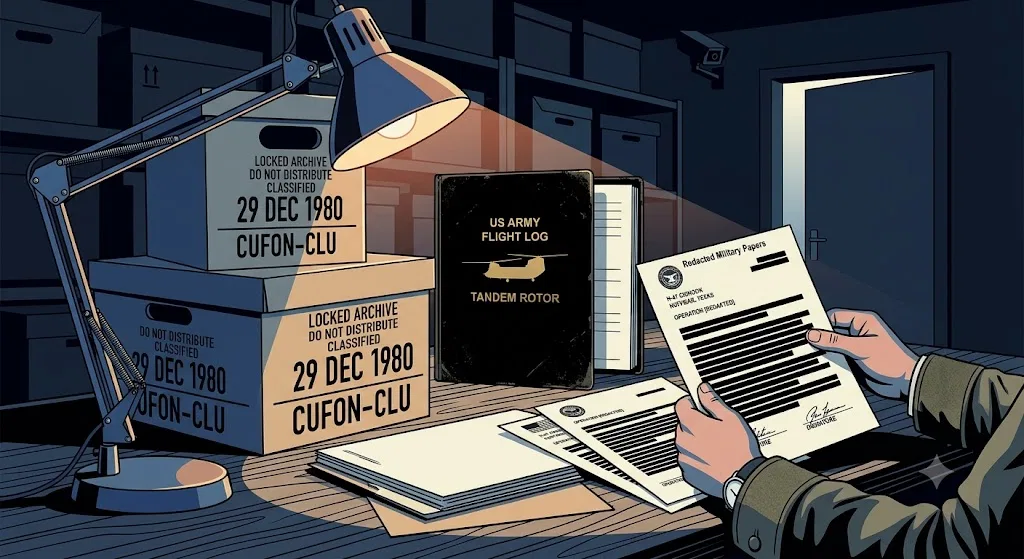
The missing-records argument is central to the Cash–Landrum incident because the witnesses did not merely report an unexplained object. They described a large formation of military-style helicopters, including twin-rotor aircraft resembling CH-47 Chinooks, accompanying it near Huffman, Texas, on 29 December 1980. An operation involving roughly two dozen heavy helicopters should ordinarily have required crews, fuel, maintenance, command approval and coordination. Yet no publicly available flight logs, radar traces, unit histories or named participants have confirmed that such a mission occurred.
Supporters of a government-secrecy theory interpret this documentary silence as possible evidence that the operation was classified and its paper trail concealed or compartmentalised. Sceptics draw almost the opposite conclusion: if an operation of the reported scale cannot be connected to any military unit after decades of investigation, the helicopter count, identification or entire military-operation interpretation may be wrong. The absence of records therefore creates suspicion, but it does not resolve the case.
The classified-mission interpretation
The secrecy theory begins with the specificity of the helicopter testimony. During an August 1981 interview at Bergstrom Air Force Base, Betty Cash said she counted 23 helicopters and described them as having two rotors. She initially asserted that she had seen United States Air Force markings, although further questioning revealed uncertainty about exactly what lettering or symbol she had observed. Vickie Landrum was more cautious: she identified the general twin-rotor shape but said she had not seen a service name on the aircraft.[Cufon]cufon.orgTRANSCRIPT of taped interview held at Bergstom Air Force Base Law Library Building 2102, 17 August 1981, between Betty Cash, Vicki Landru…
That distinction matters. A tandem-rotor silhouette is strongly associated with the Boeing CH-47 Chinook, but recognising an aircraft type is not the same as identifying its operator. In 1980, Chinooks could be flown by regular Army, Army Reserve or National Guard organisations, and a civilian witness observing illuminated aircraft at night might not reliably distinguish markings, colours or exact variants. The witnesses’ account supports the inference that they believed they saw military helicopters; it does not independently establish which organisation controlled them.
Nevertheless, advocates of concealment argue that the scale of the reported formation is difficult to reconcile with an accidental or purely civilian presence. Dispatching approximately 20 heavy helicopters would normally involve several institutional layers:
- an operational tasking or exercise schedule;
- aircraft and crew assignments;
- pre-flight and post-flight maintenance entries;
- fuel and servicing records;
- communications with command or air-traffic authorities;
- records at the departure and recovery locations;
- and, potentially, radar or security reports if an unknown object was involved.
The failure to locate this expected trail provides the mechanism behind the secrecy theory. Rather than alleging that every ordinary record disappeared independently, supporters suggest that the mission may have belonged to a classified programme whose records were held outside normal unit channels, given an innocuous cover description or withheld from investigators without the necessary clearance.
This possibility cannot be excluded simply because officials from individual services denied ownership. Classified military work is compartmentalised: officials may have access only to information required for their duties, and a truthful statement that their organisation had no relevant aircraft or programme would not necessarily cover every special-access activity elsewhere in government. That is a structural possibility, however, not evidence that such a compartment actually existed in the Cash–Landrum case.
What the government investigation established
The available record shows that the government did not remain entirely silent. Air Force legal personnel interviewed Cash, Landrum and Colby in August 1981 after the witnesses sought compensation. The interview preserved detailed testimony about the object, the helicopters and the alleged injuries, but the officers were handling a claims matter rather than conducting a full accident investigation with authority across every military service.[Cufon]cufon.orgTRANSCRIPT of taped interview held at Bergstom Air Force Base Law Library Building 2102, 17 August 1981, between Betty Cash, Vicki Landru…
The most substantial known official inquiry was conducted through the US Army Inspector General’s office by Lieutenant Colonel George Sarran. Published accounts of that inquiry state that Sarran regarded the principal witnesses, and a police officer and his wife who also reported helicopters, as credible. At the same time, he found no evidence connecting the reported aircraft to the United States armed forces.[Wikipedia]WikipediaCash–Landrum incidentThe Cash–Landrum Incident was an unidentified flying object sighting in the United States in 1980, which witnesses c…
That finding is narrower than either side of the debate sometimes presents it. It did not prove that no helicopters were present. Nor did it establish that records had been destroyed. It meant that the inquiry did not identify a military organisation responsible for the aircraft described by the witnesses.
The later civil lawsuit produced another institutional test. Cash and the Landrums sought damages from the federal government, but their case was dismissed after they failed to demonstrate that the object or helicopters were owned or operated by a federal agency. Military representatives denied possessing the reported diamond-shaped craft and denied that their personnel had conducted the alleged helicopter operation. The dismissal therefore rested on an evidential failure to establish government responsibility; it was not a judicial finding that the encounter itself was fabricated or that no unidentified object had been present.[Now Declassified]nowdeclassified.comcash landrum incident 1980Government Lawsuit | Now DeclassifiedMay 1, 2025 — the craft departed, 23 military-style twin-rotor helicopters were observed — later ind…
The litigation also illustrates a problem for the claimants. A court could not infer federal ownership merely because witnesses thought the helicopters looked military. The plaintiffs needed affirmative evidence linking the aircraft to a government agency. The missing operational records were therefore not just an historical mystery: they were the evidential gap that prevented the case from proceeding.
Why absence is not positive evidence
Missing records can be consistent with concealment, but consistency is not proof. The same documentary absence fits several competing explanations, some of which require no conspiracy.
The witnesses may have overestimated the number of helicopters. Counting moving aircraft at night is difficult, particularly when the observer is frightened, viewing them intermittently and travelling along a winding road. Cash herself acknowledged that the estimates varied. A smaller number of aircraft might have generated fewer records and could have been associated with an unrelated exercise or transit.[Cufon]cufon.orgTRANSCRIPT of taped interview held at Bergstom Air Force Base Law Library Building 2102, 17 August 1981, between Betty Cash, Vicki Landru…
The aircraft may have been misidentified. The witnesses’ twin-rotor description is significant, but details about markings were less secure under questioning. Bright lights, distance and stress could have affected recognition. If some objects counted as helicopters were lights, repeated views of the same aircraft or another type of aircraft, searches restricted to Chinook units would fail.
Investigators may have searched the wrong organisations or record systems. Military aviation records are not held in one universal file. Individual flight records, organisational records, maintenance documents, operations logs and National Guard records may be stored separately and retained for different periods. Archival guidance notes that flight information can appear in personnel files or in microfilmed organisational records, demonstrating how fragmented the relevant paper trail can be even for ordinary military activity.[Cufon]cufon.orgFlight RecordsAir Force officer flight records and flight training records may be located within the service record; however, they a…
Routine records may not have survived. The incident was not reported through military channels as an aviation emergency on the night it allegedly occurred. By the time sustained inquiries began, documents with short administrative retention periods may already have been discarded. A missing record decades later is therefore not necessarily a record that was deliberately removed.
No military operation may have occurred. This is the sceptical interpretation with the greatest explanatory economy. If the reported formation was misperceived, exaggerated or reconstructed imperfectly after the event, the lack of flight logs and unit confirmation is exactly what would be expected. Sceptical analyses have consequently treated the documentary void as a weakness in the military-craft theory rather than as indirect confirmation of it.[Wikipedia]WikipediaCash–Landrum incidentThe Cash–Landrum Incident was an unidentified flying object sighting in the United States in 1980, which witnesses c…
The key logical point is that a cover-up hypothesis can absorb almost any failure to find evidence: a denial becomes evidence of secrecy, an empty archive becomes evidence of removal, and an unsuccessful investigation becomes evidence that investigators lacked clearance. Such a theory is difficult to disprove, but that also makes it weak as a testable explanation unless it predicts a specific document, unit or institutional inconsistency that can be independently checked.
The scale problem cuts both ways
The alleged size of the helicopter formation is the strongest intuitive argument for secrecy and the strongest practical argument against it.
For supporters, numerous aircraft and crews mean numerous potential witnesses. They reason that the visual account is too elaborate to dismiss and that only a tightly controlled classified operation could explain why no participant has been publicly identified. Reports attributed to other local observers, including Dayton police officer Lamar Walker and his wife, are used to argue that helicopter activity was not confined to the memories of Cash and the Landrums. The Army inquiry reportedly treated these additional witnesses as credible but still failed to identify a military source.[Wikipedia]WikipediaCash–Landrum incidentThe Cash–Landrum Incident was an unidentified flying object sighting in the United States in 1980, which witnesses c…
For sceptics, however, a formation of approximately 23 Chinooks would be extraordinarily difficult to hide indefinitely. It would involve dozens of aircrew and potentially a much larger ground-support team. Unless the aircraft were already concentrated nearby, their mobilisation would also affect base operations, fuel stocks, maintenance schedules and local noise. Concealing the purpose of a mission might be feasible; erasing every trace of the aircraft’s movement and preventing all participants from speaking for more than four decades would be a considerably larger undertaking.
This does not make concealment impossible. Governments have successfully protected classified programmes for years, especially where personnel know only part of an operation. But secrecy becomes harder as the number of people, organisations and observable consequences grows. The reported scale therefore cannot be used only as evidence for a major operation; it must also be weighed as a challenge to the proposition that the operation left no recoverable trace.
Denial, compartmentalisation and proof
Official denial is often treated too simply in discussions of the case. There are at least three different propositions that might be denied:

- a particular service operated helicopters near Huffman;
- the federal government possessed the reported diamond-shaped object;
- any government component knew what caused the incident.
A denial of one proposition does not automatically answer the others. An Army official might accurately report finding no Army mission while lacking information about another service. An Air Force official might truthfully deny possession of a diamond-shaped aircraft while helicopters were responding to an unknown object rather than transporting it. Conversely, a broad theory of hidden inter-agency control cannot be presumed merely because individual denials leave logical gaps.
The wording and institutional basis of each denial therefore matter more than its mere existence. Useful questions include who conducted the search, which commands and units were contacted, what date ranges were examined, whether National Guard organisations were included, and whether the inquiry checked operations records rather than simply asking senior headquarters whether they recognised the allegation.
The public summaries of the investigation do not provide a complete, auditable record of every repository searched. That limitation gives secrecy advocates reasonable grounds to say the inquiry was not exhaustive. It does not give them grounds to assert that investigators discovered a classified mission and suppressed it. The present evidence supports a finding of incomplete verification, not demonstrated obstruction.
What records would change the debate
The secrecy question is capable of becoming more testable if it is framed around specific records rather than general suspicion. Several discoveries would materially strengthen the military-operation interpretation.
A dated unit operations log showing multiple Chinooks dispatched to the Huffman, New Caney or Dayton area on the evening of 29 December 1980 would establish that relevant aircraft were active, even if the mission description were redacted.
Crew or maintenance records identifying an unusual night flight, emergency launch or concentrated use of aircraft would provide an independent institutional trace. Because aviation documentation can be distributed between personnel and organisational collections, a meaningful search would need to cover both rather than rely on a single headquarters response.[Cufon]cufon.orgFlight RecordsAir Force officer flight records and flight training records may be located within the service record; however, they a…
Contemporaneous radar or air-traffic records could test whether a large group of aircraft crossed controlled airspace. A radar return would not by itself identify a classified object, but a correlated formation at the reported time and location would sharply reduce the likelihood that the helicopter account was entirely mistaken.
A named crew member or ground technician able to provide verifiable details would be especially important. Useful testimony would need more than a retrospective claim: it should identify a unit, aircraft tail numbers, a departure location, fellow personnel or documents that could be independently checked.
Inspector General working papers could clarify the reach of Sarran’s inquiry. Contact lists, memoranda, replies from commands and descriptions of the databases or files examined would show whether the investigation was broad enough to make the absence of a match significant.
A formal records-disposition trail could also resolve part of the argument. Evidence that relevant logs once existed but were destroyed under routine retention rules would weaken claims of deliberate erasure, while proof that files were removed outside normal procedures would strengthen them.
Evidence cutting in the opposite direction would be equally valuable. Complete records from the plausible Chinook units showing their aircraft elsewhere, undergoing maintenance or unavailable that night would make the reported large formation harder to sustain. A reconstruction demonstrating that no nearby unit could have assembled the claimed number of aircraft within the relevant period would not disprove every possible helicopter sighting, but it would substantially weaken the organised military-escort theory.

The most defensible assessment
The Cash–Landrum record contains a real institutional anomaly: witnesses described a conspicuous military-style operation, yet no publicly verified operational record has been tied to it. Government personnel interviewed the witnesses, the Army Inspector General investigated the helicopter allegation, and the dispute reached federal court. None of those processes produced affirmative proof of government ownership or control.[cufon.org]cufon.orgTRANSCRIPT of taped interview held at Bergstom Air Force Base Law Library Building 2102, 17 August 1981, between Betty Cash, Vicki Landru…
That unresolved gap justifies continued archival interest, particularly in Army, National Guard and organisational aviation records. It does not, by itself, demonstrate a cover-up. Missing evidence has evidential weight only when researchers can show that a particular record should have existed, should have survived, was held by a named office and is now absent under suspicious circumstances.
Until such a link is established, two interpretations remain viable. A classified or poorly disclosed operation could have escaped the enquiries made at the time. Alternatively, the absence of flight logs, radar confirmation, unit records and identifiable crews may indicate that the reported helicopter operation did not occur as described. The responsible conclusion is therefore narrower than either “the government concealed it” or “nothing happened”: the public record has not confirmed the military operation, and the reason for that failure remains unresolved.
Amazon book picks
Further Reading
Books and field guides related to Do Missing Records Suggest a Cover Up?. Use these as the next step if you want deeper reading beyond the article.
UFOs and Government: A Historical Inquiry
Governments around the world have had to deal with the UFO phenomenon for a good part of a century. How and why they did so is the subjec...

The CIA and the Cult of Intelligence
First published 1974. Subjects: United States, United States. Central Intelligence Agency, CIA, Inlichtingendiensten, Spionage.
The Puzzle Palace: A Report on America's Most Secret Agency
In this remarkable tour de force of investigative reporting, James Bamford exposes the inner workings of America's largest, most secretiv...
Legacy of Ashes: The History of the CIA
All-powerful, brilliant, decisive, ruthlessly effective — this is the image of the CIA as portrayed in countless films and novels. It is...
eBay marketplace picks
Marketplace Samples
Live-tested eBay searches with available results related to this page.
Selected fromclassified project patch oneBay.co.uk.

Endnotes
1.
Source: cufon.org
Link:https://www.cufon.org/cufon/cashlani.htm
Source snippet
TRANSCRIPT of taped interview held at Bergstom Air Force Base Law Library Building 2102, 17 August 1981, between [Betty Cash]({{ 'betty-cash/' | relative_url }}), Vicki Landru...
Published: August 1981
2.
Source: cufon.org
Link:https://www.cufon.org/cufon/cashlani2.htm
Source snippet
Cash?, just for the record.... I mean I didn't say a word, we was just talking about uh... the shape of a helicopter and everything, it...
3.
Source: cufon.org
Link:https://www.cufon.org/cufon/cashlani.pdf
Source snippet
Cash, Vicki Landrum, [Colby Landrum]({{ 'colby-landrum/' | relative_url }}) and representatives of the United States Air Force in the... Let the record reflect that we're having...
4.
Source: Wikipedia
Link:https://en.wikipedia.org/wiki/Cash%E2%80%93Landrum_incident
Source snippet
Cash–Landrum incidentThe Cash–Landrum Incident was an unidentified flying object sighting in the United States in 1980, which witnesses c...
5.
Source: cufon.org
Link:https://cufon.org/CRG/CRG/Flight.html
Source snippet
Flight RecordsAir Force officer flight records and flight training records may be located within the service record; however, they a...
6.
Source: cufon.org
Link:https://www.cufon.org/CRG/memo/1865120.html
7.
Source: cityoflondon.police.uk
Link:https://www.cityoflondon.police.uk/news/city-of-london/news/2026/august/driver-warning-issued-as-crash-for-cash-evolves-and-puts-identity-data-at-risk/
8.
Source: cufon.org
Link:https://www.cufon.org/cufon/robertdod.htm
9.
Source: cufon.org
Link:https://cufon.org/cufon/malmstrom/malm1.htm
10.
Source: cufon.org
Title: The Ice Documents Press Conference
Link:https://www.cufon.org/cufon/presconf.htm
12.
Source: cufon.org
Title: foia 003
Link:https://www.cufon.org/cufon/foia_003.htm
13.
Source: cufon.org
Title: cufon o
Link:https://www.cufon.org/cufon/cufon-o.htm
14.
Source: cufon.org
Title: cufon o C
Link:https://www.cufon.org/cufon/cufon-o-C.htm
15.
Source: cufon.org
Link:https://www.cufon.org/CRG/CRG/Sf813.html
16.
Source: cufon.org
Link:https://www.cufon.org/CRG/CRG/Sos.html
17.
Source: cufon.org
Link:https://www.cufon.org/CRG/CRG/Legaldem.html
18.
Source: cufon.org
Link:https://www.cufon.org/cufon/foia_007.htm
19.
Source: cufon.org
Link:https://cufon.org/CRG/memo/1865107b.html
20.
Source: cufon.org
Title: wash faa
Link:https://www.cufon.org/cufon/wash_nat/wash_faa.htm
21.
Source: cufon.org
Link:https://www.cufon.org/cufon/robert.htm
22.
Source: nowdeclassified.com
Title: cash landrum incident 1980
Link:https://www.nowdeclassified.com/guides/cash-landrum-incident-1980
Source snippet
Government Lawsuit | Now DeclassifiedMay 1, 2025 — the craft departed, 23 military-style twin-rotor helicopters were observed — later ind...
Published: May 1, 2025
23.
Source: wikidisc.org
Title: Betty Cash | Wiki Disc
Link:https://www.wikidisc.org/wiki/Betty_Cash
24.
Source: nowdeclassified.com
Link:https://www.nowdeclassified.com/guides
25.
Source: nowdeclassified.com
Link:https://www.nowdeclassified.com/guides/uap-foia-research-guide
26.
Source: nowdeclassified.com
Link:https://www.nowdeclassified.com/incidents/cash-landrum-1980
Additional References
27.
Source: electronicsandbooks.com
Link:https://electronicsandbooks.com/edt/manual/Magazine/M/MUFON%20UFO%20Journal/MUFON%20UFO%20Journal%20-%20October%201982.pdf
Source snippet
Electronics and BooksMUFON UFO JOURNALPENTAGON INVESTIGATES CASH-LANDRUM CASE... UFOs in general.... George Sarran from theDepartment o...
28.
Source: youtube.com
Link:https://www.youtube.com/watch?v=KiCgBn-Kbho
Source snippet
The Cash-Landrum Incident - Real Alien Encounter or Government Project?...
29.
Source: youtube.com
Title: The Cash-Landrum Incident
Link:https://www.youtube.com/watch?v=7BxT0WuEOn4
Source snippet
[Cash Landrum UFO incident]({{ 'cash-landrum-ufo-incident/' | relative_url }}) government secrecy military helicopters Cash-Landrum UFO Incident - UFO, Helicopters, $20 Million Lawsuit...
30.
Source: youtube.com
Title: Cash-Landrum UFO Incident
Link:https://www.youtube.com/watch?v=zNfOAtCgKI4
Source snippet
The Cash-Landrum incident: traumatized & physically ill after terrifying UFO encounter, Dec 29, 1980...
31.
Source: youtube.com
Title: The Cash-Landrum UFO Incident: Secret Nuclear Missile or Alien Encounter?
Link:https://www.youtube.com/watch?v=0rtq94uxG_w
Source snippet
Cash-Landrum UFO Incident - UFO, Helicopters, $20 Million Lawsuit...
32.
Source: youtube.com
Title: The Cash-Landrum Incident
Link:https://www.youtube.com/watch?v=SzzYIirmiLg
Source snippet
Radiation Poisoning...
33.
Source: archives.gov
Link:https://www.archives.gov/publications/prologue/1997/summer/military-agencies
34.
Source: war.gov
Link:https://www.war.gov/UFO/search/uap/
35.
Source: war.gov
Link:https://www.war.gov/ufo/pursue-initiative/
36.
Source: archives.gov
Link:https://www.archives.gov/research/guide-fed-records/groups/159.html