Within Legal Strategy
Could Government Immunity Have Blocked the Claim Anyway?
Broad attacks on secret-program decisions risked immunity, while narrow claims about ignored safety rules offered a more viable path.
On this page
- What the discretionary function exception protects
- Policy decisions versus routine operational negligence
- Why specific safety rule violations mattered
Page outline Jump by section
Introduction
Even if Betty Cash, Vickie Landrum and Colby Landrum had succeeded in proving that the unidentified object and accompanying helicopters were operated by the United States government, they still faced another formidable legal obstacle: the Federal Tort Claims Act’s discretionary-function exception. This provision preserves governmental immunity for claims that challenge policy-based decisions, even where those decisions allegedly cause injury. As a result, the plaintiffs’ litigation strategy needed to do more than identify a federal connection. It also had to frame the government’s conduct as negligent implementation of established safety duties rather than an attack on protected governmental decision-making. That distinction could have determined whether a court reached the merits of the case at all.[FindLaw]caselaw.findlaw.comUNITED STATES v. GAUBERT, 499 U.S. 315 (1991) | FindLawMarch 26, 1991…
Could Government Immunity Have Blocked the Claim Anyway?
The FTCA waives sovereign immunity only in carefully defined circumstances. One of its most important limitations is the discretionary-function exception in 28 U.S.C. § 2680(a), which shields the United States from liability for claims arising from governmental decisions involving judgment grounded in public policy. Courts have repeatedly explained that Congress adopted this exception to prevent judges from second-guessing executive and administrative policy choices through ordinary negligence lawsuits.[Department of Justice]justice.govDepartment of Justice Office of the Solicitor General | Snyder v. United StatesDepartment of JusticeOffice of the Solicitor General | Snyder v. United States - Opposition | United States Department of Justice…
For the Cash–Landrum litigation, this meant that identifying a federal aircraft or a classified operation would not automatically have opened the door to damages. The character of the alleged negligence mattered as much as the identity of the alleged wrongdoer.
What the discretionary-function exception protects
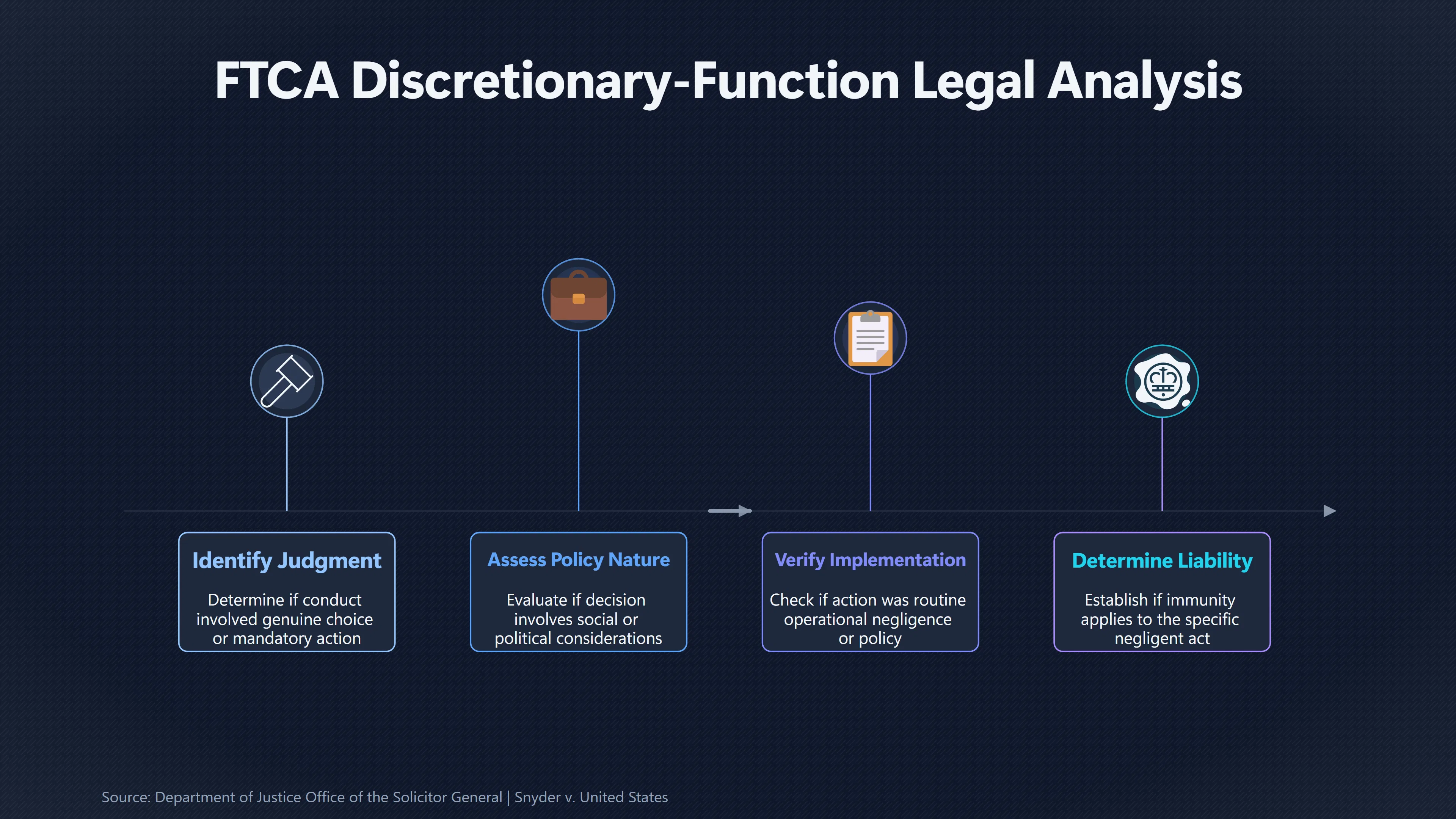
The exception protects governmental choices that require balancing public interests, resources or national priorities. Supreme Court decisions such as United States v. Varig Airlines, Berkovitz v. United States and United States v. Gaubert establish a two-part analysis that remains central to FTCA litigation.
First, courts ask whether the challenged conduct involved genuine judgment or choice. If a federal statute, regulation or mandatory policy required a specific course of action, there is no protected discretion because officials had no lawful option to do otherwise.
Secondly, if discretion existed, courts ask whether that judgment was the kind of policy decision that Congress intended to shield—typically one involving social, economic, political or governmental policy considerations. The focus is on the nature of the decision rather than the rank of the official making it.[findlaw.com]caselaw.findlaw.comUNITED STATES v. GAUBERT, 499 U.S. 315 (1991) | FindLawMarch 26, 1991…
This framework is significant because even operational personnel may be protected if their decisions implement policy-based judgments rather than violate mandatory rules.
Policy decisions versus routine operational negligence
For the plaintiffs, there was an important distinction between challenging a governmental programme itself and challenging the careless execution of that programme.
Had the lawsuit effectively alleged that the government negligently authorised, planned or conducted a secret aerospace or defence operation, the United States could have argued that such decisions necessarily involved protected policy judgments concerning national security, military planning and resource allocation. Courts have traditionally been reluctant to permit tort suits that require reviewing precisely those types of governmental choices.[FindLaw]caselaw.findlaw.comUNITED STATES v. GAUBERT, 499 U.S. 315 (1991) | FindLawMarch 26, 1991…
By contrast, routine operational negligence occupies a different category. If government employees fail to perform ordinary safety tasks, ignore mandatory procedures or negligently carry out an authorised mission, those failures may fall outside the discretionary-function exception because they concern implementation rather than protected policy.
The Supreme Court’s reasoning illustrates this distinction. In Indian Towing Co. v. United States, for example, once the government chose to operate a lighthouse, negligent maintenance of the light itself was not treated as a protected policy judgment. Likewise, Berkovitz held that officials who disregard mandatory regulatory requirements cannot invoke discretionary-function immunity simply because they are government employees. Gaubert later clarified that the key inquiry is whether the challenged conduct is susceptible to policy analysis, not whether it occurred at a so-called “planning” or “operational” level.[cornell.edu]law.cornell.eduLegal Information InstituteUNITED STATES, Petitioner, v. Thomas M. GAUBERT. | Supreme Court | US Law | LII / Legal Information InstituteM…
Why specific safety-rule violations mattered
This legal framework explains why a narrowly framed negligence theory would have been more promising than a broad challenge to an alleged secret programme.
If the plaintiffs had identified mandatory military or aviation safety requirements requiring, for example, minimum separation distances, emergency procedures, hazardous-material containment or public-road safety measures, they could have argued that federal personnel violated non-discretionary obligations. Under Berkovitz, failure to follow such mandatory directives is generally not protected by the discretionary-function exception because officials lack discretion to disregard binding rules.[Justia Law]supreme.justia.comJustia LawBerkovitz v. United States | 486 U.S. 531 (1988) | Justia U.S. Supreme Court Center…
The difficulty was evidentiary. The plaintiffs never established:
- which federal agency allegedly controlled the object or helicopters;
- which specific personnel were involved;
- what mandatory regulations governed the operation; or
- which identifiable safety requirements were allegedly breached.
Without those building blocks, the case risked appearing to challenge governmental decisions at a high level of abstraction rather than concrete operational negligence.
Why the immunity issue remained largely hypothetical
In practice, the Cash–Landrum lawsuit failed before the discretionary-function exception became the decisive issue. The government denied that any federal aircraft, personnel or equipment participated in the reported incident, and the plaintiffs were unable to produce sufficient evidence creating a genuine factual dispute over federal responsibility.
Because that threshold showing was lacking, the courts did not need to undertake a detailed discretionary-function analysis. Nevertheless, the exception illustrates how difficult the litigation would have remained even if federal involvement had been established. The plaintiffs would still have needed to persuade the court that their claim rested on negligent execution of mandatory safety duties rather than on protected governmental policy choices.
Viewed in that light, the discretionary-function exception represented a second layer of protection for the government. The first challenge was proving federal involvement at all; the second would have been demonstrating that the alleged negligence fell outside one of the FTCA’s most significant immunity provisions.[findlaw.com]caselaw.findlaw.comUNITED STATES v. GAUBERT, 499 U.S. 315 (1991) | FindLawMarch 26, 1991…
Amazon book picks
Further Reading
Books and field guides related to Could Government Immunity Have Blocked the Claim Anyway?. Use these as the next step if you want deeper reading beyond the article.
Administrative Law and Regulatory Policy
Help your students master the principles of administrative law in an era of change with this new edition of the renowned casebook ADMINIS...
The Forms and Functions of Tort Law
The perfect accompaniment to any torts casebook, The Forms and Functions of Tort Law covers all the major cases and issues in the standar...
The Federal Courts and the Federal System
This supplement brings the main casebook up to date with recent changes in the law.
The Rule of Law
'A gem of a book ... Inspiring and timely. Everyone should read it' Independent 'The Rule of Law' is a phrase much used but little examin...
eBay marketplace picks
Marketplace Samples
Live-tested eBay searches with available results related to this page.
Selected fromUFO poster oneBay.co.uk.



Endnotes
1.
Source: caselaw.findlaw.com
Link:https://caselaw.findlaw.com/court/us-supreme-court/499/315.html
Source snippet
UNITED STATES v. GAUBERT, 499 U.S. 315 (1991) | FindLawMarch 26, 1991...
Published: March 26, 1991
2.
Source: supreme.justia.com
Link:https://supreme.justia.com/cases/federal/us/486/531/
Source snippet
Justia LawBerkovitz v. United States | 486 U.S. 531 (1988) | Justia U.S. Supreme Court Center...
3.
Source: justice.gov
Title: Department of Justice Office of the Solicitor General | Snyder v. United States
Link:https://www.justice.gov/osg/brief/snyder-v-united-states-opposition
Source snippet
Department of JusticeOffice of the Solicitor General | Snyder v. United States - Opposition | United States Department of Justice...
4.
Source: justice.gov
Link:https://www.justice.gov/osg/brief/mitchell-v-united-states-opposition
Source snippet
United States - Opposition | United States Department of JusticeMarch 1, 2001 — The discretionary function exception to the FTCA, 28 U.S...
Published: March 1, 2001
5.
Source: law.justia.com
Link:https://law.justia.com/cases/federal/appellate-courts/ca6/22-6014/22-6014-2024-06-28.html
Source snippet
v. United States, No. 22-6014 (6th Cir. 2024):: JustiaJune 28, 2024 — 28 U.S.C. § 1346(b); Berkovitz by Berkovitz v. United States, 486...
Published: June 28, 2024
6.
Source: law.justia.com
Link:https://law.justia.com/cases/federal/appellate-courts/ca6/23-5439/23-5439-2024-06-28.html
Source snippet
Reliable Ins. Co. v. United States, No. 23-5439 (6th Cir. 2024):: JustiaJune 28, 2024 — § 2680). Once the “plaintiff has successfully in...
Published: June 28, 2024
7.
Source: law.justia.com
Link:https://law.justia.com/cases/federal/appellate-courts/F2/986/716/101162/
Source snippet
Baum; Margaret Leedy, Plaintiffs-appellants, v. United States of America, Defendant-appellee, v. Michael A. Massey, Third Party Defendant...
8.
Source: supreme.justia.com
Link:https://supreme.justia.com/cases/federal/us/499/315/
Source snippet
Gaubert | 499 U.S. 315 (1991) | Justia U.S. Supreme Court CenterMarch 26, 1991 — Page 499 U. S. 319 FHLB-D are within the "discretionary...
Published: March 26, 1991
9.
Source: justice.gov
Title: Office of the Solicitor General | Lewis v
Link:https://www.justice.gov/osg/brief/lewis-v-united-states-opposition
Source snippet
United States - Opposition | United States Department of JusticeThe judgment of the court of appeals was entered on November 20, 2003. Pe...
Published: November 20, 2003
10.
Source: youtube.com
Title: The Cash
Link:https://www.youtube.com/watch?v=t6sV0LIy7GI
Source snippet
LANDRUM INCIDENT | MOST CREDIBLE UFO CASE IN HISTORY...
11.
Source: law.cornell.edu
Link:https://www.law.cornell.edu/supremecourt/text/499/315
Source snippet
Legal Information InstituteUNITED STATES, Petitioner, v. Thomas M. GAUBERT. | Supreme Court | US Law | LII / Legal Information InstituteM...
12.
Source: law.cornell.edu
Title: 89 1793.ZC
Link:https://www.law.cornell.edu/supct/html/89-1793.ZC.html
Source snippet
Gaubert, 499 U.S. 315 (1991)March 26, 1991 — United States v. Gaubert (89-1793), 499 U.S. 315 (1991) Concurrence | Syllabus | Opinion...
Published: March 26, 1991
13.
Source: law.cornell.edu
Link:https://www.law.cornell.edu/supremecourt/text/486/531
Source snippet
UNITED STATES. | Supreme Court | US Law | LII / Legal Information InstituteJune 13, 1988 — II 7 The FTCA, 28 U.S.C. § 1346(b), generally...
Published: June 13, 1988
Additional References
14.
Source: youtube.com
Title: Did Aliens Cause This Family Health Problems? | Cash-Landrum Incident
Link:https://www.youtube.com/watch?v=cFz7hXTJDkU
Source snippet
Berkovitz v. United States Case Brief Summary | Law Case Explained...
15.
Source: youtube.com
Title: Berkovitz v. United States Case Brief
Link:https://www.youtube.com/watch?v=qe-xwh2-ups
Source snippet
Cestonaro v. United States Case Brief Summary | Law Case Explained...
16.
Source: youtube.com
Title: THE CASH LANDRUM INCIDENT | MOST CREDIBLE UFO CASE IN HISTORY
Link:https://www.youtube.com/watch?v=UzoOTCOUMKA
Source snippet
Did Aliens Cause This Family Health Problems? | Cash-Landrum Incident...
17.
Source: youtube.com
Title: Cestonaro v. United States Case Brief
Link:https://www.youtube.com/watch?v=V8BfUfwmWn8