Within Secret Aircraft
Could Jet Thrust Keep the Object Aloft?
A jet-powered craft could hover in theory, but the reported flame cycles, low altitude and missing blast effects create major technical problems.
On this page
- How much thrust a large hovering craft would need
- Why pulsing flame would threaten stability and control
- Expected noise, downwash and ground damage
Page outline Jump by section
Introduction
A jet-powered aircraft can, in principle, hover. Modern vertical take-off and landing (VTOL) aircraft, such as the Harrier and F-35B, demonstrate that sustained jet-borne flight is physically possible. However, applying that general principle to the Cash–Landrum incident is far more difficult than simply noting that jets can hover. The witnesses described a large diamond-shaped object remaining at roughly treetop height while repeatedly emitting intense flames downward, apparently descending as the flames diminished and climbing again when they intensified. They also reported extreme heat but gave little indication of the violent downwash, blast damage or continuous engine noise normally associated with a heavy jet-supported hover.
For the secret-aircraft explanation to work, one propulsion system must account simultaneously for hovering, cyclic flame bursts, exceptional radiant heat, apparent stability and the limited physical effects reported on the surrounding environment. When examined through the engineering of jet-supported flight, each of those requirements creates significant technical tension.
How much thrust would a large hovering craft require?
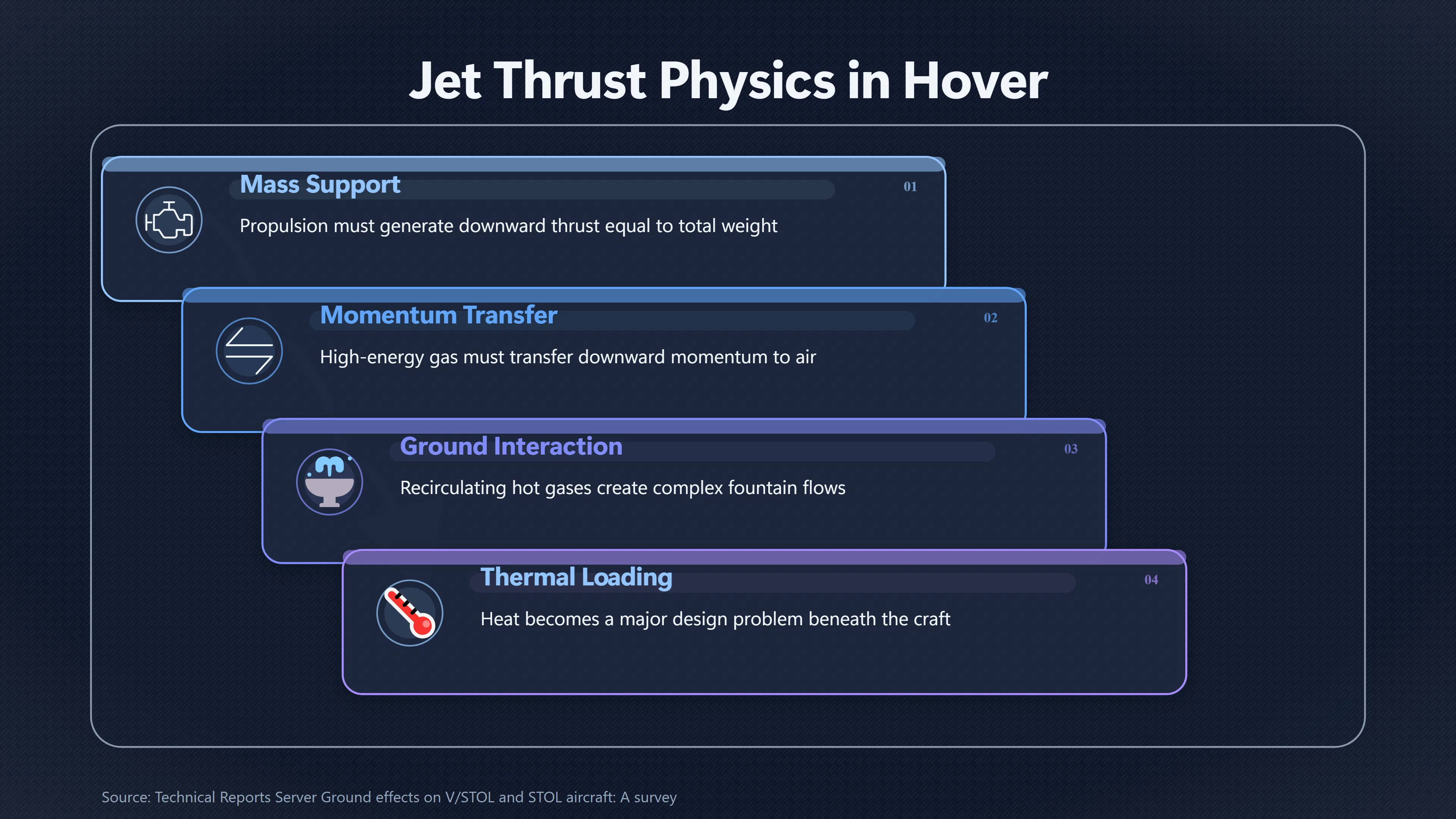
A hovering aircraft must generate downward thrust equal to its entire weight. Unlike a conventional aeroplane, there is no assistance from aerodynamic lift generated by forward speed. Every kilogram of mass must be supported directly by the propulsion system.
If the reported object was substantially larger than a road vehicle, as the witnesses described, the required thrust would have been enormous. Whether produced by turbojets, lift fans or vectored exhaust, that thrust must ultimately appear as a powerful stream of high-energy gas directed toward the ground.
Modern VTOL engineering shows the consequences:
- Exhaust velocities are extremely high.
- Large quantities of air are accelerated downward.
- Fuel consumption during hover is exceptionally heavy.
- Heat loading beneath the aircraft becomes a major design problem.
These are not incidental effects but unavoidable consequences of momentum conservation. An aircraft cannot hover by jet thrust without transferring an equivalent downward momentum to the surrounding air.
NASA’s long-running research into VTOL aircraft operating near the ground shows that hovering jets create complicated ground-effect aerodynamics, including strong downward jets, recirculating hot gases, “fountain” flows between exhaust streams and lift losses caused by the interaction between exhaust and the surface. These effects are substantial engineering challenges even for purpose-built aircraft.[NASA Technical Reports Server]ntrs.nasa.govTechnical Reports Server Ground effects on V/STOL and STOL aircraft: A surveyNASA Technical Reports ServerGround effects on V/STOL and STOL aircraft: A survey - NASA Technical Reports Server (NTRS)November 1, 1985…
Why pulsing flames create a control problem
One of the more unusual features of the Cash–Landrum description is the apparent relationship between flame emission and altitude. According to the witnesses, bursts of flame appeared beneath the object, after which it rose slightly. When the flames subsided, the object appeared to sink before repeating the cycle.
At first glance, this resembles thrust modulation. Increasing engine thrust would indeed increase lift, while reducing thrust would allow descent.
However, several technical problems emerge.
Hovering normally requires smooth thrust control
Jet-powered VTOL aircraft rely on continuous, finely controlled thrust adjustments rather than dramatic intermittent bursts. Even small thrust variations require rapid compensation to maintain position, attitude and stability.
Large visible pulses would produce repeated changes in:
- lift;
- pitching and rolling moments;
- exhaust pressure;
- engine temperatures; and
- structural loading.
Maintaining a stable hover while repeatedly cycling through obvious bursts of flame would demand an exceptionally sophisticated control system.
Visible flames do not necessarily indicate useful thrust
Large flames extending beyond an exhaust often indicate incomplete combustion or afterburning rather than efficient lifting force.
A hovering aircraft benefits from producing momentum, not theatrical flame. Long, bright exhaust plumes may increase visible radiation but are generally an inefficient way to support sustained hover because energy radiated as heat and light is not contributing effectively to lift.
This does not make the witnesses’ observations impossible, but it does mean that the reported appearance is not what engineers would normally expect from an aircraft optimised for controlled hovering.

The missing effects expected beneath a hovering jet
Perhaps the greatest difficulty for a pure jet-thrust explanation is not that hovering is impossible, but that certain expected side effects are either absent or only weakly reported.
Downwash
A heavy hovering aircraft produces intense downward airflow.
NASA, FAA and Vertical Flight Society research consistently shows that hovering aircraft generate powerful downwash and outwash capable of moving loose debris, producing hazardous winds and creating complex recirculating air patterns near the ground. These effects are sufficiently important that they remain an active area of research for both helicopters and modern eVTOL aircraft.[nasa.gov]ntrs.nasa.govTechnical Reports Server Ground effects on V/STOL and STOL aircraft: A surveyNASA Technical Reports ServerGround effects on V/STOL and STOL aircraft: A survey - NASA Technical Reports Server (NTRS)November 1, 1985…
The Cash–Landrum witnesses described overwhelming heat but did not consistently describe hurricane-like winds, trees being violently flattened or widespread debris being blasted away beneath the object.
Some local disturbance would certainly be expected, but a large jet-supported hover near treetop height would normally produce dramatic aerodynamic effects in addition to thermal ones.
Ground damage
Hot jet exhaust directed onto pavement or vegetation can scorch surfaces, damage asphalt, ignite combustible material or leave clear thermal signatures.
The witnesses reported intense radiant heating, yet publicly documented physical evidence of severe blast or burn damage at the location has remained limited and disputed.
The absence of widely documented environmental damage does not disprove the account, but it weakens a straightforward jet-hover interpretation.
Noise
Large turbojet engines are extraordinarily loud, especially during stationary hover.
Witnesses did report significant sound, but descriptions generally emphasised roaring and crackling rather than the sustained, overwhelming acoustic signature expected from a large aircraft continuously balancing on raw jet thrust.
Noise perception is inherently subjective, yet it remains another area where the reported behaviour does not align neatly with known VTOL aircraft.

Lessons from earlier VTOL experiments
Historical experimental aircraft demonstrate both the possibility and the difficulty of hovering unconventional vehicles.
The Avro Canada VZ-9 Avrocar, developed under military secrecy during the 1950s, attempted to achieve vertical flight using turbojet-driven lift directed beneath a circular airframe. Testing revealed severe stability problems, hot-gas recirculation, insufficient lift outside ground effect and significant control limitations. The programme never achieved its intended operational capability.[Air Force Museum]nationalmuseum.af.milOpen source on af.mil.
Its relevance to the Cash–Landrum case is not that the reported object was an Avrocar, but that one of the closest historical attempts at a jet-supported hovering “flying saucer” illustrates how difficult such flight proved in practice.
The engineering obstacles encountered included:
- unstable hover behaviour;
- exhaust recirculation reducing engine performance;
- sensitivity to ground effect;[legacy.vtol.org]legacy.vtol.orgSource details in endnotes.
- limited control authority; and
- poor efficiency outside very low altitude.
These are broadly consistent with the kinds of challenges modern VTOL designers continue to study.
Overall technical assessment
A jet-powered propulsion system is one of the few conventional mechanisms capable of producing both hovering flight and intense radiant heat. In that limited sense, it remains an understandable component of the secret-aircraft hypothesis.
The difficulty lies in reproducing the complete pattern reported by the witnesses. A large hovering jet-supported craft should have generated enormous downward momentum, severe blast effects, substantial environmental disturbance and highly stable continuous thrust control. Instead, the reported object combined repeated flame bursts, apparent hover stability, exceptional heat and relatively modest descriptions of downwash or ground damage.
None of these discrepancies individually rules out an experimental propulsion system. Taken together, however, they mean that a simple jet-thrust explanation does not comfortably fit the reported behaviour. Any classified aircraft hypothesis must therefore invoke either an unconventional propulsion arrangement, an incomplete or inaccurate witness description of the physical effects, or both.
Amazon book picks
Further Reading
Books and field guides related to Could Jet Thrust Keep the Object Aloft?. Use these as the next step if you want deeper reading beyond the article.
Introduction to Flight
Noted for its highly readable style, the new edition of this bestseller provides an updated overview of aeronautical and aerospace engine...
Principles of Helicopter Aerodynamics
Written by an internationally recognized teacher and researcher, this book provides a thorough, modern treatment of the aerodynamic princ...
Aircraft Propulsion
Updated edition of the successful textbook exploring cutting-edge developments in the field and Net-Zero aviation goals of 2050 Maintaini...
Jet Propulsion: A Simple Guide to the Aerodynamic and Thermod...
This book is an introduction to the design of modern civil and military jet engines using engine design projects.
eBay marketplace picks
Marketplace Samples
Live-tested eBay searches with available results related to this page.
Selected fromVTOL aircraft model oneBay.co.uk.

Endnotes
1.
Source: ntrs.nasa.gov
Title: Technical Reports Server [Ground effects]({{ ‘ground-effects/’ | relative_url }}) on V/STOL and STOL aircraft: A survey
Link:https://ntrs.nasa.gov/citations/19860003831
Source snippet
NASA Technical Reports ServerGround effects on V/STOL and STOL aircraft: A survey - NASA Technical Reports Server (NTRS)November 1, 1985...
Published: November 1, 1985
2.
Source: ntrs.nasa.gov
Title: Technical Reports Server A large-scale investigation of V/STOL ground effects
Link:https://ntrs.nasa.gov/citations/19840035242
Source snippet
large-scale investigation of V/STOL ground effects - NASA Technical Reports Server (NTRS)January 1, 1984 — A large-scale investigation of...
Published: January 1, 1984
3.
Source: legacy.vtol.org
Title: The Vertical Flight Society VFS
Link:https://legacy.vtol.org/what-we-do/infrastructure-initiatives/downwash-and-outwash-library?order=ASC&sort=source
Source snippet
The Vertical Flight SocietyVFS - Downwash and Outwash Library...
4.
Source: legacy.vtol.org
Title: The Vertical Flight Society VFS
Link:https://legacy.vtol.org/what-we-do/infrastructure-initiatives/downwash-and-outwash-library?order=DESC&sort=publicAvailability
Source snippet
The Vertical Flight SocietyVFS - Downwash and Outwash Library...
5.
Source: legacy.vtol.org
Title: 16, February
Link:https://legacy.vtol.org/what-we-do/infrastructure-initiatives/downwash-and-outwash-library?order=DESC&sort=source
Source snippet
Downwash and Outwash LibraryReducing the influence of helicopter rotor wash on fire behaviour | Alen Slijepcevic and Liam Fogarty | New Z...
6.
Source: legacy.vtol.org
Title: downwash and outwash library
Link:https://legacy.vtol.org/what-we-do/infrastructure-initiatives/downwash-and-outwash-library
7.
Source: legacy.vtol.org
Link:https://legacy.vtol.org/store/product/downwash-and-outwash-of-counterrotating-coaxial-rotors-hovering-inground-effect-19937.cfm
8.
Source: ntrs.nasa.gov
Link:https://ntrs.nasa.gov/citations/19660006071
9.
Source: nationalmuseum.af.mil
Link:https://www.nationalmuseum.af.mil/Visit/Museum-Exhibits/Fact-Sheets/Display/Article/195801/AFmuseum/avro-canada-vz-9av-avrocar/
10.
Source: Wikipedia
Title: Avro Canada VZ-9 Avrocar
Link:https://en.wikipedia.org/wiki/Avro_Canada_VZ-9_Avrocar
Additional References
11.
Source: doi.org
Link:https://doi.org/10.1242/JEB.008649
Source snippet
pany of BiologistsJanuary 15, 2008 — BIOMECHANICS OF FLIGHT| 15 January 2008 NEAR- AND FAR-FIELD AERODYNAMICS IN INSECT HOVERING FLIGHT...
Published: January 15, 2008
12.
Source: youtube.com
Link:https://www.youtube.com/watch?v=-OJCRT_4Slo
13.
Source: youtube.com
Link:https://www.youtube.com/watch?v=FM-OOo4Sw-o
14.
Source: youtube.com
Link:https://www.youtube.com/watch?v=Gu7eJE08hwo
15.
Source: youtube.com
Link:https://www.youtube.com/watch?v=LxOBe5I8U-U
16.
Source: youtube.com
Link:https://www.youtube.com/watch?v=_tAiSRs0IrM
17.
Source: elib.dlr.de
Title: deelectronic library
Link:https://elib.dlr.de/203770/
18.
Source: ufologie.patrickgross.org
Link:https://www.ufologie.patrickgross.org/htm/cashlandrumsarran01.htm