Within Hospital Records
Could Local Radiation Fit Betty Cash's Symptoms?
Local irradiation might explain skin and hair damage without classic marrow failure, but the surviving record lacks dose and exposure mapping.
On this page
- How local radiation injury differs
- Expected whole body exposure patterns
- Why dose distribution cannot be reconstructed
Page outline Jump by section
Introduction
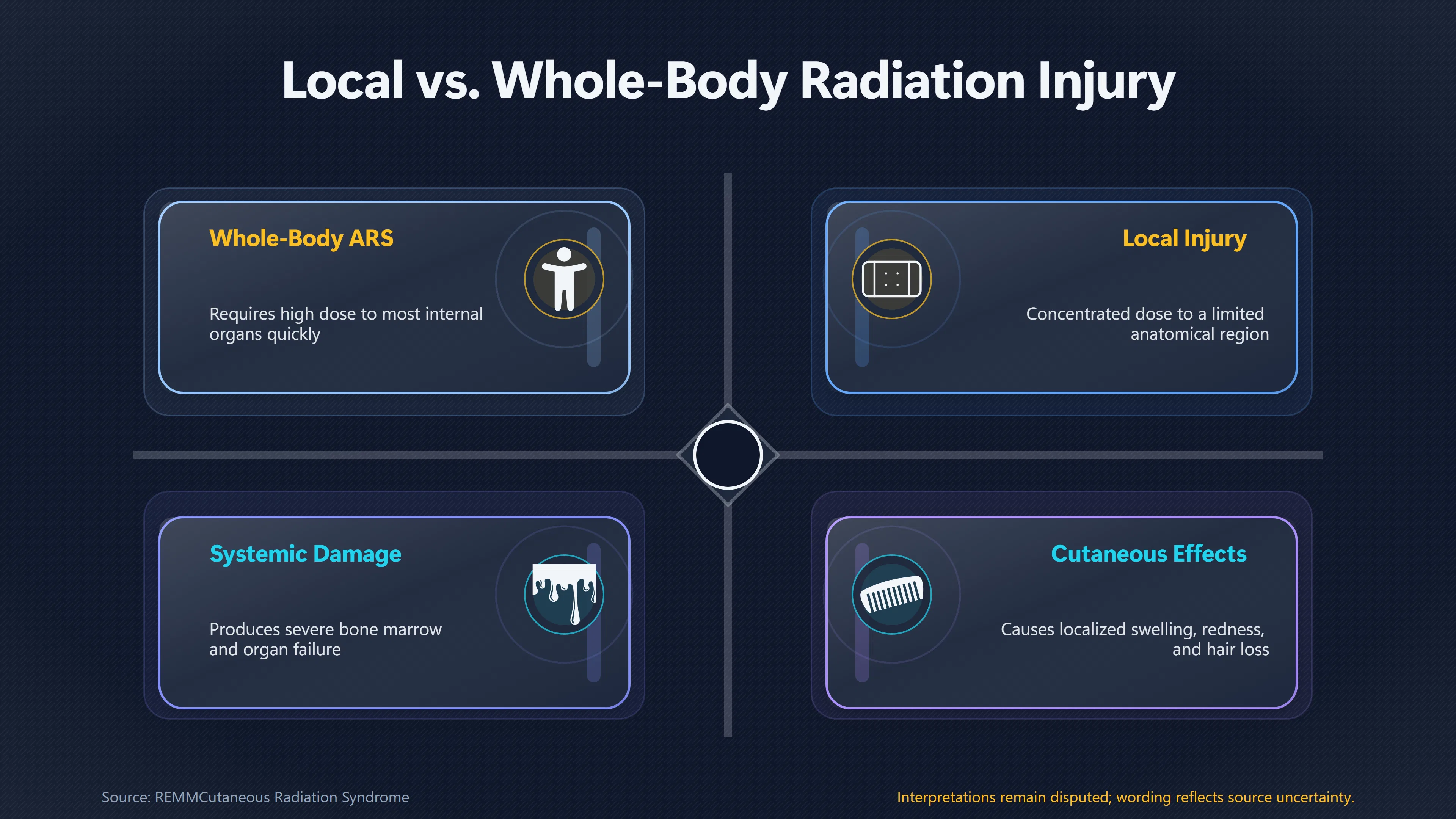
One of the central medical questions in the Cash–Landrum case is not simply whether Betty Cash experienced symptoms that can occur after radiation exposure, but whether those symptoms are more compatible with localised radiation injury or whole-body acute radiation syndrome (ARS). This distinction matters because severe skin injury, swelling and hair loss can occur after a concentrated dose to a limited area of the body without producing the characteristic blood-cell abnormalities and systemic organ damage expected after high-dose whole-body irradiation. Modern radiation medicine recognises these as related but distinct clinical patterns. Applying that distinction to Cash’s surviving medical record suggests that a local exposure mechanism is more medically plausible than classical whole-body ARS if ionising radiation were involved at all. However, the available evidence is insufficient to reconstruct where any dose was delivered, how intense it was, or even whether radiation was the cause.

How local radiation injury differs from whole-body exposure
Radiation injuries depend not only on the total amount of radiation absorbed but also on how that dose is distributed throughout the body.
Whole-body acute radiation syndrome develops only when a sufficiently high dose of penetrating radiation reaches most of the body’s internal organs over a short period. Damage to rapidly dividing cells—especially in the bone marrow, gastrointestinal tract and skin—produces a recognisable sequence of illness including early nausea or vomiting, followed by characteristic declines in blood-cell counts and, at higher doses, infection, bleeding and multiple organ complications.[CDC]cdc.govAcute Radiation Syndrome: Information for Clinicians | Radiation Emergencies | CDCApril 23, 2024…
By contrast, cutaneous radiation injury or local radiation injury results when a high dose is concentrated in a limited region. In these cases:
- redness and swelling may appear within hours or days;
- a symptom-free interval can follow;
- blistering, ulceration or delayed skin damage may emerge weeks later;
- hair follicles within the irradiated area may stop producing hair, causing localised epilation.
Importantly, these injuries can occur without classical acute radiation syndrome, because the rest of the body’s tissues receive little or no damaging dose. The US Centers for Disease Control and Prevention (CDC) specifically notes that cutaneous radiation injury can occur without ARS, particularly after partial-body exposures.[CDC]cdc.govCutaneous Radiation Injury (CRI): Information for Clinicians | Radiation Emergencies | CDCApril 17, 2024…
This distinction has become increasingly important in modern radiation emergency medicine because many accidental exposures involve only part of the body rather than uniform irradiation.
Could Betty Cash’s recorded symptoms fit local irradiation?
Several features documented during Cash’s hospitalisation have often been cited as compatible with local radiation injury.
The medical records describe marked swelling of the scalp, forehead and eyelids together with crusted scalp lesions and later pronounced hair loss. Modern descriptions of cutaneous radiation injury include oedema, erythema, delayed skin breakdown and epilation as recognised effects of substantial local doses. Hair loss commonly appears after a delay because radiation first damages actively dividing cells within hair follicles before visible shedding occurs.[CDC]cdc.govCutaneous Radiation Injury (CRI): Information for Clinicians | Radiation Emergencies | CDCApril 17, 2024…
The delayed timing of Cash’s alopecia therefore does not, by itself, argue either for or against radiation. It is consistent with the biological timing expected after significant skin irradiation, but it is also compatible with several non-radiation conditions affecting the scalp.
Equally significant is the apparent concentration of symptoms around the face and scalp. If radiation exposure had occurred from a directional source, a non-uniform dose could theoretically produce severe injury in one anatomical region while sparing much of the rest of the body. Such uneven dose distributions are well documented in industrial radiation accidents and radiotherapy misadministrations.[PubMed Central (PMC)]pmc.ncbi.nlm.nih.govPub Med Central (PMC)Cutaneous and Local Radiation InjuriesPubMed Central (PMC)Cutaneous and Local Radiation Injuries - PMC…
However, “compatible with” does not mean “diagnostic of”. Swelling, inflammatory skin changes and hair loss all have numerous alternative medical explanations, and none uniquely identify radiation as the cause.

Why the records do not resemble classical whole-body acute radiation syndrome
The strongest argument against interpreting Cash’s illness as straightforward whole-body ARS is not the presence of skin injury but the absence of several findings expected after a sufficiently large uniform dose.
Current clinical guidance defines ARS as requiring irradiation of all or most of the body by penetrating radiation delivered over a short time. Partial-body injuries frequently do not produce the classic syndrome because the bone marrow and other critical organs are spared.[CDC]cdc.govAcute Radiation Syndrome: Information for Clinicians | Radiation Emergencies | CDCApril 23, 2024…
Publicly available summaries of Cash’s hospital records do not document the hallmark laboratory pattern expected after clinically significant whole-body exposure, such as:
- progressive depression of white blood cell counts due to bone marrow injury;
- severe thrombocytopenia causing bleeding tendencies;
- dose estimation based on serial blood counts or chromosome analysis;
- diagnosis of acute radiation syndrome by treating physicians.[remm.hhs.gov]remm.hhs.govREMMCutaneous Radiation SyndromeRadiation Emergency Medical Management…
Instead, the contemporaneous dermatological assessment reportedly diagnosed cellulitis with secondary oedema rather than radiation injury. While that diagnosis could theoretically have been incorrect, it illustrates that clinicians treating Cash did not document unequivocal evidence of classical ARS in the surviving records.
This absence does not exclude every possible radiation scenario. It does, however, weaken the case for a high-dose uniform whole-body exposure of the type required to produce textbook radiation sickness.
Why the dose distribution cannot be reconstructed
The greatest obstacle to evaluating the radiation hypothesis is the lack of dosimetric evidence.
Modern investigations of suspected accidental radiation exposure attempt to estimate absorbed dose using multiple independent methods, including:
- serial complete blood counts;
- chromosome aberration (cytogenetic) analysis;
- physical dosimetry from the scene;
- mapping of skin injuries;[cdc.gov]cdc.govcutaneous radiation injurycutaneous radiation injury
- photographs documenting progression over time;
- measurements of contamination or radiation sources.[CDC]cdc.govAcute Radiation Syndrome: Information for Clinicians | Radiation Emergencies | CDCApril 23, 2024…
None of these allows retrospective reconstruction in the Cash–Landrum case because no verified radiation source was recovered, no exposure measurements were made at the scene, and no detailed dose map of Cash’s injuries exists in the surviving public record.
Even if one assumes radiation was responsible, fundamental questions remain unanswered:
- Was exposure confined to the head and upper body?
- Was one side of the body irradiated more heavily than the other?
- Was the radiation penetrating enough to reach internal organs?
- How long did exposure last?
- What absorbed dose, measured in gray (Gy), reached each tissue?
Without those parameters, no reliable medical dosimetry can be performed.
What this means for interpreting Cash’s illness
Viewed through modern radiation medicine, a localised exposure hypothesis is medically more compatible with Cash’s documented skin changes than a straightforward diagnosis of classical whole-body acute radiation syndrome. Local radiation injury can produce swelling, scalp damage and delayed hair loss without necessarily causing the profound bone marrow failure expected after high-dose whole-body irradiation.[cdc.gov]cdc.govCutaneous Radiation Injury (CRI): Information for Clinicians | Radiation Emergencies | CDCApril 17, 2024…
That observation should not be confused with proof that radiation occurred. The surviving evidence establishes neither the presence of an ionising radiation source nor the pattern of any absorbed dose. Instead, it narrows the medical discussion: if radiation played any role in Betty Cash’s illness, the available clinical record fits a partial-body or local injury model more readily than classical whole-body ARS, while leaving the underlying cause unresolved because the exposure itself cannot be reconstructed from the surviving documentation.
Amazon book picks
Further Reading
Books and field guides related to Could Local Radiation Fit Betty Cash's Symptoms?. Use these as the next step if you want deeper reading beyond the article.
Bad Science
Rating: 5.0/5 from 5 Google Books ratings
Have you ever wondered how one day the media can assert that alcohol is bad for us and the next unashamedly run a story touting the benef...
Radiation: What It Is, What You Need to Know
The essential guide to radiation: the good, the bad, and the utterly fascinating, explained with unprecedented clarity. Earth, born in a...
Medical Effects of Ionizing Radiation
"The new edition of this monograph features renowned experts who offer the most current information and reliable guidance on all aspects...
The Radium Girls
A New York Times, USA Today, Wall Street Journal, and Amazon Charts Bestseller! "The glowing ghosts of the radium girls haunt us still."...
eBay marketplace picks
Marketplace Samples
Live-tested eBay searches with available results related to this page.
Selected fromUFO poster oneBay.co.uk.




Endnotes
1.
Source: cdc.gov
Link:https://www.cdc.gov/radiation-emergencies/hcp/clinical-guidance/ars.html
Source snippet
Acute Radiation Syndrome: Information for Clinicians | Radiation Emergencies | CDCApril 23, 2024...
Published: April 23, 2024
2.
Source: cdc.gov
Link:https://www.cdc.gov/radiation-emergencies/hcp/clinical-guidance/cri.html
Source snippet
Cutaneous Radiation Injury (CRI): Information for Clinicians | Radiation Emergencies | CDCApril 17, 2024...
Published: April 17, 2024
3.
Source: remm.hhs.gov
Title: REMMCutaneous Radiation Syndrome
Link:https://remm.hhs.gov/cutaneoussyndrome.htm
Source snippet
Radiation Emergency Medical Management...
4.
Source: cdc.gov
Link:https://www.cdc.gov/radiation-emergencies/signs-symptoms/index.html
5.
Source: cdc.gov
Title: evaluation and management
Link:https://www.cdc.gov/radiation-emergencies/hcp/nuclear-detonations/evaluation-and-management.html
6.
Source: cdc.gov
Title: possible health effects
Link:https://www.cdc.gov/radiation-emergencies/signs-symptoms/possible-health-effects.html
7.
Source: cdc.gov
Title: cutaneous radiation injury
Link:https://www.cdc.gov/radiation-emergencies/signs-symptoms/cutaneous-radiation-injury.html
8.
Source: cdc.gov
Title: acute radiation syndrome
Link:https://www.cdc.gov/radiation-emergencies/signs-symptoms/acute-radiation-syndrome.html
9.
Source: cdc.gov
Title: health effects of radiation
Link:https://www.cdc.gov/radiation-health/about/health-effects-of-radiation.html
10.
Source: stacks.cdc.gov
Link:https://stacks.cdc.gov/view/cdc/50896
11.
Source: stacks.cdc.gov
Link:https://stacks.cdc.gov/view/cdc/23969
13.
Source: pmc.ncbi.nlm.nih.gov
Title: Pub Med Central (PMC)Medical management of the acute radiation syndrome
Link:https://pmc.ncbi.nlm.nih.gov/articles/PMC3863169/
Source snippet
PubMed Central (PMC)Medical management of the acute radiation syndrome - PMC...
14.
Source: pmc.ncbi.nlm.nih.gov
Title: Pub Med Central (PMC)Cutaneous and Local Radiation Injuries
Link:https://pmc.ncbi.nlm.nih.gov/articles/PMC8785213/
Source snippet
PubMed Central (PMC)Cutaneous and Local Radiation Injuries - PMC...
15.
Source: pubmed.ncbi.nlm.nih.gov
Link:https://pubmed.ncbi.nlm.nih.gov/24337304/
Source snippet
PubMed[Cutaneous radiation syndrome after accidental skin exposure to ionizing radiation] - PubMed...
16.
Source: pubmed.ncbi.nlm.nih.gov
Link:https://pubmed.ncbi.nlm.nih.gov/34488201/
17.
Source: pmc.ncbi.nlm.nih.gov
Link:https://pmc.ncbi.nlm.nih.gov/articles/PMC4617115/
18.
Source: pmc.ncbi.nlm.nih.gov
Link:https://pmc.ncbi.nlm.nih.gov/articles/PMC5718653/
19.
Source: pmc.ncbi.nlm.nih.gov
Link:https://pmc.ncbi.nlm.nih.gov/articles/PMC2819061/
20.
Source: pmc.ncbi.nlm.nih.gov
Link:https://pmc.ncbi.nlm.nih.gov/articles/PMC5723522/
21.
Source: pubmed.ncbi.nlm.nih.gov
Link:https://pubmed.ncbi.nlm.nih.gov/19667802/
22.
Source: ncbi.nlm.nih.gov
Link:https://www.ncbi.nlm.nih.gov/books/NBK221602/
Additional References
23.
Source: sciencedirect.com
Link:https://www.sciencedirect.com/science/article/abs/pii/S0951832026003522
Source snippet
or method - ScienceDirectAugust 1, 2026 — RELIABILITY ENGINEERING & SYSTEM SAFETY Date: August 2026 Article: 112538 Volume: Volume 272, P...
Published: August 1, 2026
24.
Source: sciencedirect.com
Title: REAL-TIME INVERSION OF RADIOACTIVE SOURCE DISTRIBUTION USING AIR DOSE RATE MEA
Link:https://www.sciencedirect.com/science/article/pii/S0951832026003522
Source snippet
surements via Least Absolute Shrinkage and Selection Operator Method - ScienceDirectMarch 6, 2026 — RELIABILITY ENGINEERING & SYSTEM SAFE...
Published: March 6, 2026
25.
Source: nature.com
Title: For a 2D function f(x, y), the Radon transform com
Link:https://www.nature.com/articles/s41598-026-48566-4
Source snippet
Radioluminescence 3D dose reconstruction for FLASH and conventional radiotherapy | Scientific ReportsApril 23, 2026 — MATERIALS AND METHO...
Published: April 23, 2026
26.
Source: youtube.com
Title: acute radiation syndrome stages
Link:https://www.youtube.com/watch?v=i7FiI-vhK5Y
Source snippet
This list includes direct documentaries examining the Cash-Landrum incident and its reported radiation symptoms, alongside a medical brea...
27.
Source: youtube.com
Title: THE CASH LANDRUM INCIDENT | MOST CREDIBLE UFO CASE IN HISTORY
Link:https://www.youtube.com/watch?v=UzoOTCOUMKA
Source snippet
Terrifying Texas UFO Encounter - The Cash Landrum Incident...
28.
Source: youtube.com
Title: Cash-Landrum UFO Encounter or Something Scarier?
Link:https://www.youtube.com/watch?v=j_3CfT4I9nk
Source snippet
THE CASH LANDRUM INCIDENT | MOST CREDIBLE UFO CASE IN HISTORY...
29.
Source: sciencedirect.com
Link:https://www.sciencedirect.com/science/article/pii/S0149197021004273
30.
Source: sciencedirect.com
Link:https://www.sciencedirect.com/science/article/abs/pii/S1879850025002814
31.
Source: youtube.com
Title: The Cash-Landrum UFO Mystery
Link:https://www.youtube.com/watch?v=P2HsOUTzyWA
Source snippet
Cash-Landrum UFO Encounter or Something Scarier?...
32.
Source: youtube.com
Title: Terrifying Texas UFO Encounter
Link:https://www.youtube.com/watch?v=RVeOy9W8EUE
Source snippet
acute radiation syndrome stages...