Within Court Dismissal
Why the Tort Claims Act Could Not Save the Lawsuit
The lawsuit required negligent conduct by a federal employee, not simply injuries linked to an unidentified object near military-style aircraft.
On this page
- What the federal liability law requires
- Why attribution was essential to jurisdiction
- Where the plaintiffs' legal chain broke
Page outline Jump by section
Introduction
The dismissal of the Cash–Landrum lawsuit did not rest on a judicial finding that the witnesses were uninjured or that they had fabricated their account. Instead, the decisive legal problem was that the plaintiffs attempted to sue the United States under the Federal Tort Claims Act (FTCA) without being able to prove that a federal employee or federal agency was responsible for the conduct that allegedly caused their injuries. Because the FTCA is only a limited waiver of the federal government’s sovereign immunity, it applies only when specific statutory requirements are met. Without evidence identifying a federal actor behind the reported object or accompanying helicopters, the court lacked the legal basis to impose liability on the United States.[Congress.gov]congress.govApril 17, 2023…
What the federal liability law requires
The FTCA allows individuals to seek compensation from the United States for certain injuries caused by the negligent or wrongful acts of federal employees acting within the scope of their official duties. Before Congress enacted the statute in 1946, the federal government generally could not be sued for ordinary negligence because of sovereign immunity. The FTCA created a carefully limited exception rather than a general right to sue the government.[Supreme Court]supremecourt.govSupreme Court No.Supreme Court No.
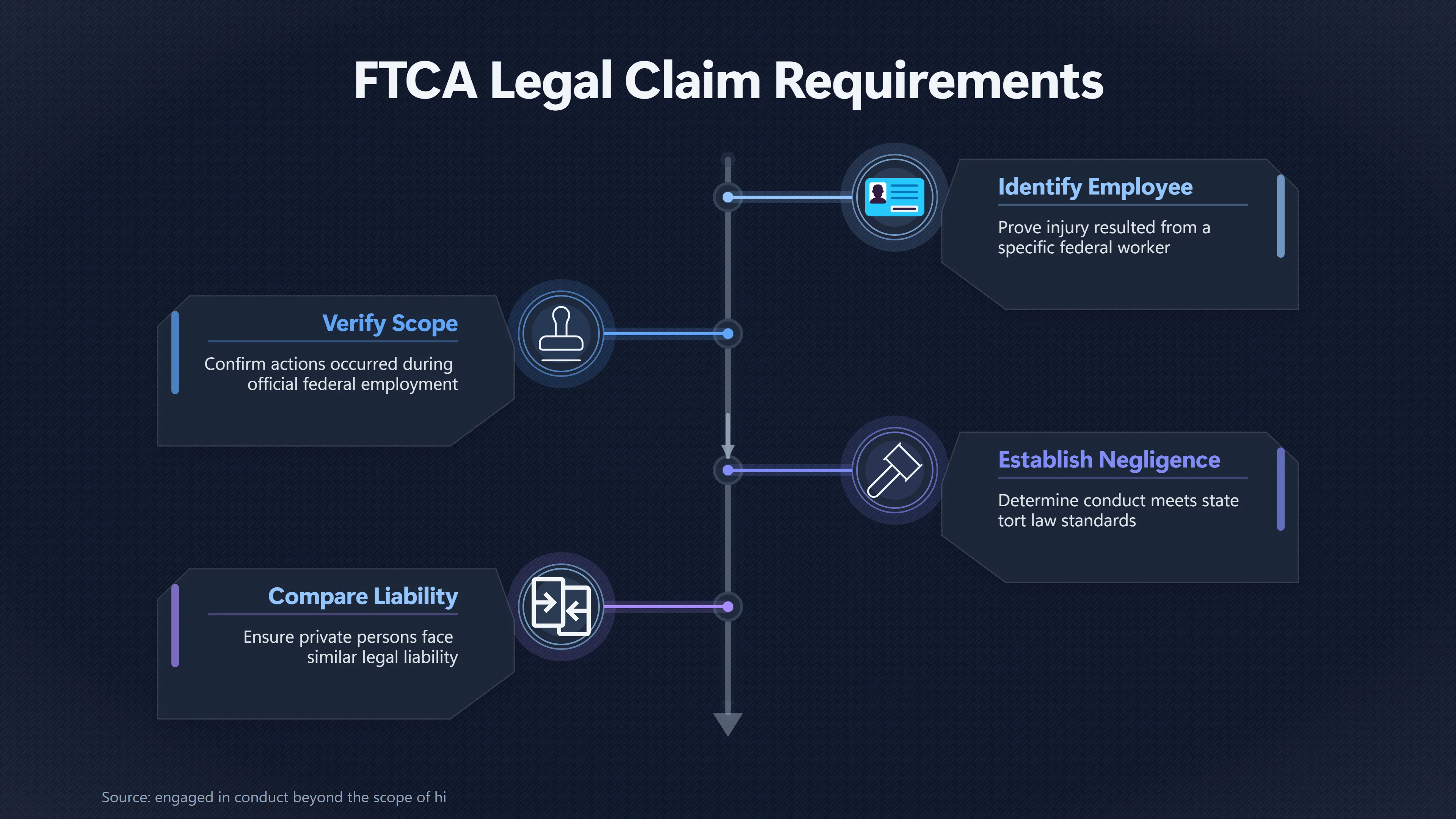
To establish an FTCA claim, a plaintiff must show several linked elements:
- The injury was caused by a federal employee.
- That employee was acting within the scope of federal employment.
- The conduct amounted to negligence or another actionable tort under the law of the state where it occurred.
- A private person in comparable circumstances could also be held liable under that state’s law.[Supreme Court]supremecourt.govSupreme Court No.Supreme Court No.
These requirements mean that the statute does not compensate every injury that merely appears connected with military equipment, government property or unexplained events. The government’s legal responsibility depends upon proving who committed the allegedly negligent act.
Why attribution was essential to jurisdiction
The Cash–Landrum plaintiffs argued that the reported diamond-shaped craft and numerous military-style helicopters indicated a secret government operation. Even if that theory had been plausible, the FTCA required more than suspicion or circumstantial appearance.
The legal chain depended upon identifying a federal employee or agency responsible for operating or controlling the equipment involved. Only then could the court examine whether negligence occurred and whether that negligence caused the claimed injuries.
This point is often misunderstood. The central jurisdictional question was not whether helicopters were present or whether witnesses sincerely believed they were military aircraft. Rather, the question was whether competent evidence established that the helicopters or the unidentified object belonged to, or were operated by, the United States government.
Without that attribution, there was no qualifying federal act on which the FTCA’s waiver of sovereign immunity could operate. The government’s immunity therefore remained intact.[Supreme Court]supremecourt.govSupreme Court No.Supreme Court No.
Where the plaintiffs’ legal chain broke
The plaintiffs’ evidence described what they believed they had observed: an intensely hot object, physical illness afterwards, and numerous tandem-rotor helicopters that appeared military in character.
However, observation alone did not establish legal responsibility.
The critical evidentiary gap included the absence of:
- identifiable federal aircraft records;
- operational or mission documentation;
- military orders placing federal aircraft at the scene;
- radar or tracking records linking the reported craft to a federal operation;
- testimony from government personnel admitting participation; or
- documentary evidence identifying the object as government property.
In response, the government submitted declarations from officials representing the military services and NASA denying that the reported object belonged to or was operated by their organisations. Those declarations were aimed at the narrow legal issue before the court: whether the United States could be connected to the alleged incident sufficiently to support FTCA jurisdiction. They did not purport to explain what the witnesses actually encountered. Instead, they denied the factual predicate necessary to impose liability upon the federal government.
As a result, the plaintiffs’ argument failed at its first legal step. If the alleged conduct could not be attributed to the United States, questions about negligence, breach of duty or damages never became legally decisive.
Why unidentified government-looking equipment was insufficient
The Cash–Landrum case illustrates an important distinction between factual suspicion and legal proof.
Military-style appearance is not equivalent to federal ownership. Aircraft may resemble military equipment, eyewitnesses can misidentify vehicles, and even accurate descriptions do not automatically establish which organisation operated them.
Under the FTCA, courts require evidence that links the alleged wrongful conduct to an identifiable federal employee acting within the scope of employment. Mere inference from appearance, rumour or speculation cannot satisfy that requirement because sovereign immunity is waived only within the precise limits established by Congress. Courts consistently interpret those limits strictly, recognising that jurisdiction exists only where the statutory conditions have been met.[congress.gov]congress.govApril 17, 2023…
For the Cash–Landrum plaintiffs, this meant that evidence of unusual aircraft activity—even if accepted as genuine—did not by itself establish the federal responsibility necessary for an FTCA action.
Why the dismissal was about legal authority, not the underlying mystery
The court’s dismissal is sometimes interpreted as a judicial rejection of the witnesses’ account. Legally, however, the decision was considerably narrower.
The FTCA did not fail because the reported injuries were automatically impossible or because the court resolved the broader question of what the witnesses saw. It failed because the plaintiffs could not satisfy the statutory requirement that their injuries resulted from negligent conduct attributable to a federal employee acting within the scope of federal employment.
That distinction remains significant in discussions of the Cash–Landrum incident. The federal court’s ruling addressed only whether the United States could be sued under the FTCA. It did not determine the identity of the reported object, resolve competing explanations for the encounter, or declare the witnesses’ account true or false. Instead, it concluded that the legal mechanism chosen by the plaintiffs could not overcome sovereign immunity without proof connecting the alleged conduct to the federal government.[Supreme Court]supremecourt.govSupreme Court No.Supreme Court No.
Amazon book picks
Further Reading
Books and field guides related to Why the Tort Claims Act Could Not Save the Lawsuit. Use these as the next step if you want deeper reading beyond the article.
Federal Jurisdiction
This premier treatise offers a powerful exploration of the underlying polices and the doctrine of federal jurisdiction. Erwin Chemerinsky...
The Law of Federal Courts
This text offers guidance on all aspects of jurisdiction and procedure in federal court litigation. Some of the topics discussed include:...
Examples & Explanations for Federal Courts
Award-winning author and professor, Laura E. Little, has updated her approachable and practical study guide to what is considered one of...

Suing Government: Citizen Remedies for Official Wrongs
First published 1983. Subjects: Administrative responsibility, Government liability, Remedies (Law), Etat, Responsabilite.
eBay marketplace picks
Marketplace Samples
Live-tested eBay searches with available results related to this page.
Selected fromUFO poster oneBay.co.uk.

Endnotes
1.
Source: congress.gov
Link:https://www.congress.gov/crs-product/R45732
Source snippet
April 17, 2023...
Published: April 17, 2023
2.
Source: congress.gov
Title: engaged in conduct beyond the scope of hi
Link:https://www.congress.gov/crs_external_products/R/HTML/R45732.web.html
Source snippet
April 17, 2023 — In such instances, the United States "remain[s] the federal defendant in the action unless and until the [d]istrict [c]o...
Published: April 17, 2023
3.
Source: youtube.com
Title: The Waitress Who Sued the U.S. Government Over a UFO Burn
Link:https://www.youtube.com/watch?v=_Epnzw3tHio
Source snippet
Federal Tort Claims Act - FTCA...
4.
Source: youtube.com
Title: Federal Tort Claims Act
Link:https://www.youtube.com/watch?v=gsCuy4esKpE
Source snippet
The Federal Tort Claims Act and Suing the U.S. Government | LawInfo...
5.
Source: supremecourt.gov
Title: Supreme Court No. 24-351
Link:https://www.supremecourt.gov/DocketPDF/24/24-351/363828/20250624154749691_24-351tsUnitedStates.pdf
6.
Source: law.cornell.edu
Link:https://www.law.cornell.edu/supremecourt/text/465/848
Source snippet
KOSAK, Petitioner, v. UNITED STATES. | Supreme Court | US Law | LII / Legal Information InstituteMarch 21, 1984 — 3 Petitioner was charge...
Published: March 21, 1984
7.
Source: casemine.com
Title: Cash v
Link:https://www.casemine.com/judgement/us/5914e815add7b0493491c392
Source snippet
United States | CIVIL NO.: WDQ-12-0563 | D. Md. | Judgment | Law | CaseMineDecember 10, 2012 — D. Federal Defendants' Motion to Dismiss o...
Published: December 10, 2012
Additional References
8.
Source: law.resource.org
Title: 927.F2d.445.89 15329
Link:https://law.resource.org/pub/us/case/reporter/F2/927/927.F2d.445.89-15329.html
Source snippet
2366 Palmroy P.K. BUSH, et al., Plaintiff, v. EAGLE-PICHER INDUSTRIES, INC., Defendant-Third-Party- Plaintiff-Appellee, v. UNITED STATES...
9.
Source: law.resource.org
Title: 712.F2d.490.82 1838
Link:https://law.resource.org/pub/us/case/reporter/F2/712/712.F2d.490.82-1838.html
Source snippet
SOVEREIGN IMMUNITY 51 The United States is protected from unconsented suit under the ancient common law doctrine of sovereign immunity. P...
10.
Source: law.resource.org
Title: 860.F2d.181.88 4119
Link:https://law.resource.org/pub/us/case/reporter/F2/860/860.F2d.181.88-4119.html
Source snippet
Improper Defendant 5 We affirm the district court's judgment for OSHA. OSHA is not the proper party to be sued under the FTCA. The lower...
11.
Source: youtube.com
Title: Berkovitz v. United States Case Brief
Link:https://www.youtube.com/watch?v=qe-xwh2-ups
Source snippet
Federal Tort Claims Act sovereign immunity lawsuit Federal Tort Claims Act - FTCA...
12.
Source: youtube.com
Title: The Federal Tort Claims Act and Suing the U.S. Government | Law Info
Link:https://www.youtube.com/watch?v=Sv9eX941F-8
Source snippet
Berkovitz v. United States Case Brief Summary | Law Case Explained...
13.
Source: youtube.com
Title: [Cash-Landrum UFO Incident]({{ ‘cash-landrum-ufo-incident/’ | relative_url }})
Link:https://www.youtube.com/watch?v=zNfOAtCgKI4
Source snippet
The Waitress Who Sued the U.S. Government Over a UFO Burn...
14.
Source: docs.justia.com
Link:https://docs.justia.com/cases/federal/appellate-courts/ca3/13-2816/3011744318
Source snippet
Wells Fargo Bank, et al:: Justia Dockets & FilingsSeptember 22, 2014 — §§ 1346(b)(1) and 2679(a). The injured party must bring suit with...
Published: September 22, 2014
15.
Source: docs.justia.com
Link:https://docs.justia.com/cases/federal/appellate-courts/ca5/05-50707/920060825
Source snippet
USA:: Justia Dockets & FilingsAugust 24, 2006 — Although the plaintiffs' claims sounded in negligence, the district court reasoned that...
Published: August 24, 2006
16.
Source: law.justia.com
Link:https://law.justia.com/cases/federal/appellate-courts/ca6/19-6347/19-6347-2020-09-03.html
Source snippet
Haaland, No. 19-6347 (6th Cir. 2020):: JustiaSeptember 3, 2020 — Instead, Defendants rely on the Federal Tort Claims Act (FTCA), 28 U.S...
Published: September 3, 2020
17.
Source: docs.justia.com
Link:https://docs.justia.com/cases/federal/district-courts/california/candce/3%3A2024cv04751/433771/38
Source snippet
v. United States of America:: Justia Dockets & FilingsApril 10, 2025 — See Dkt. 3 Nos. 20, 31. The government contended that jurisdictio...
Published: April 10, 2025