Within Secret Aircraft
Could a Failing Prototype Still Fly Away?
A malfunctioning prototype might explain erratic movement, yet surviving repeated thrust loss near trees would demand exceptional control.
On this page
- What the rise and fall cycle implies about lift failure
- Control problems near trees and a public roadway
- Why safe departure weakens the emergency narrative
Page outline Jump by section
Introduction
One proposed explanation for the Cash–Landrum incident is that the witnesses encountered a secret military prototype suffering a propulsion or control malfunction. This idea attempts to explain the reported fluctuations in altitude, intense downward flame and the appearance of multiple helicopters. However, the specific flight profile described by the witnesses creates a difficult engineering question: could a genuinely damaged experimental aircraft repeatedly lose lift at low altitude, recover, avoid trees and a public roadway, and then depart under its own power? Examining the reported manoeuvres against what is known about vertical-lift aircraft suggests that, while temporary thrust fluctuations are technically conceivable, the reported combination of instability and ultimate safe escape places significant strain on the emergency-prototype hypothesis.[SAE Mobilus]sae.orgvertical takeoff landing aircraft vertical takeoff landing ground effectsSAE Mobilus01-14-01-0001: Vertical Takeoff and Landing Aircraft, Vertical Takeoff and Landing Ground Effects - Journal ArticleAugust 20,…
What the rise-and-fall cycle implies about lift failure
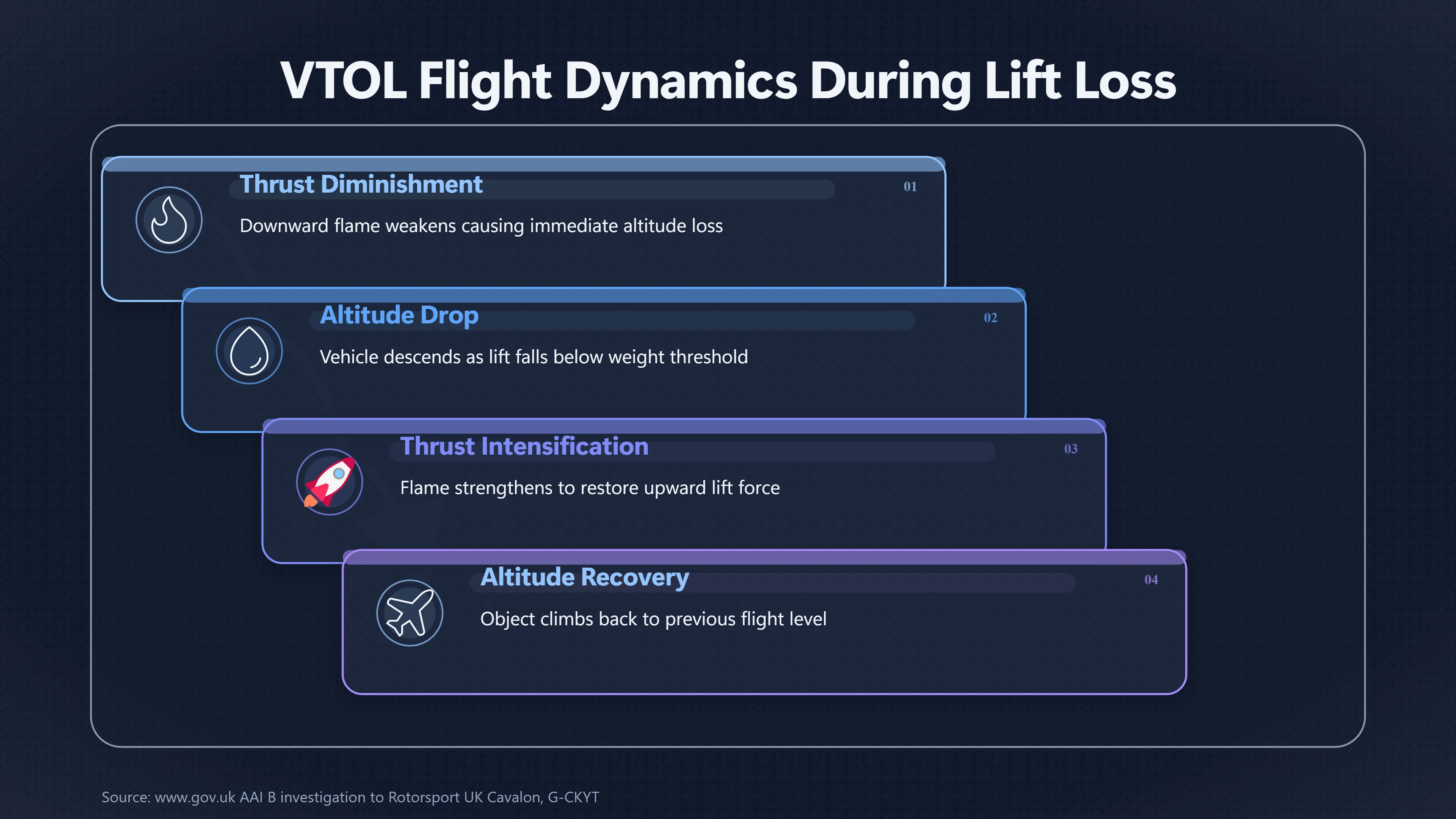
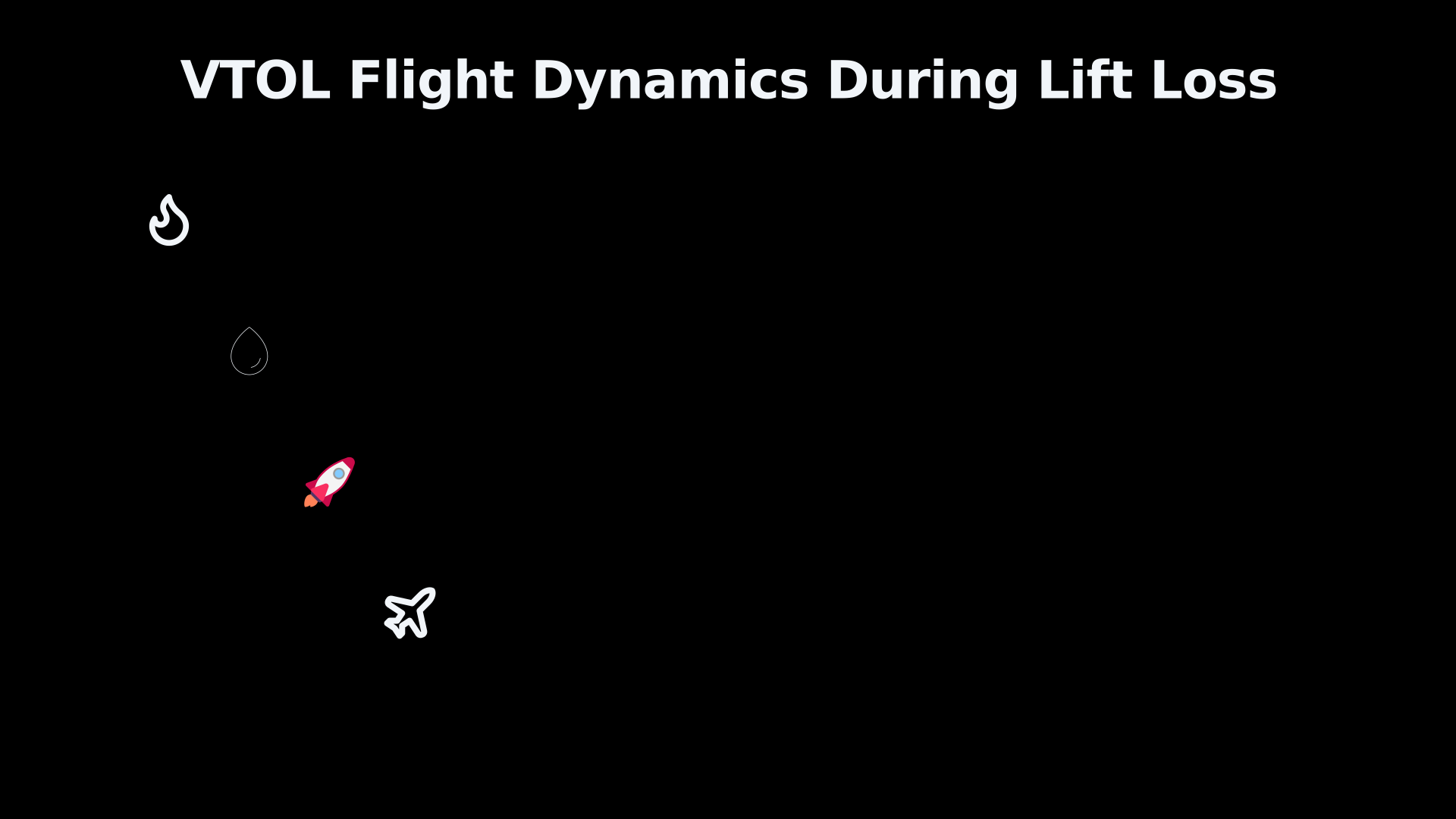
The witnesses described a repeating pattern rather than a single failure. According to their accounts, the object descended when its bright downward flame diminished, then climbed again when the flame intensified before repeating the cycle.
Taken literally, this resembles an aircraft operating near the minimum thrust needed to remain airborne. Any powered-lift aircraft—whether using jet exhaust, lift fans or another thrust-vectoring system—must continually produce lift equal to its weight. If thrust falls below that threshold, altitude decreases unless compensated almost immediately.[Cambridge University Press]cambridge.orgCambridge University PressControl of V/STOL aircraft | The Aeronautical Journal | Cambridge Core…
Modern studies of vertical-lift aircraft show that hover is among the most demanding flight regimes. Small changes in thrust or airflow can rapidly alter altitude and attitude, while maintaining stable hover typically requires continuous automatic control rather than manual correction alone.[SAE Mobilus]sae.orgvertical takeoff landing aircraft vertical takeoff landing ground effectsSAE Mobilus01-14-01-0001: Vertical Takeoff and Landing Aircraft, Vertical Takeoff and Landing Ground Effects - Journal ArticleAugust 20,…
This creates two competing interpretations:
- A propulsion fluctuation is technically plausible. Experimental aircraft can experience transient thrust variations or control anomalies without immediately crashing.
- Repeated oscillations are harder to explain. If the propulsion system repeatedly lost enough thrust to cause noticeable descent, each recovery would require rapid restoration of both lift and stability.
The reported behaviour therefore resembles an aircraft operating close to its performance limits rather than one experiencing a brief isolated engine hiccup.
Control problems near trees and a public roadway
The reported location makes the damaged-prototype explanation more demanding than it first appears.
The witnesses placed the object at relatively low altitude above a two-lane road bordered by trees. In such an environment, even a functioning vertical-lift aircraft faces limited margins for error. Hovering close to obstacles exposes aircraft to changing airflow patterns and requires constant control inputs to prevent drift, pitch or roll excursions. Research into VTOL aerodynamics demonstrates that proximity to terrain and nearby obstacles can significantly alter thrust effectiveness and stability, increasing pilot workload or demands on automatic flight-control systems.[Directory of Open Access Journals]doaj.orgOpen source on doaj.org.
If the prototype were genuinely suffering repeated propulsion degradation, several practical problems would arise:
- descending into the tree canopy would leave little room for recovery;
- lateral drift could quickly become hazardous over a public road;
- fluctuating thrust would complicate directional control as well as altitude control;
- each recovery would have to occur before obstacle clearance became critical.
Historical VTOL development illustrates why these issues matter. Numerous experimental vertical-lift programmes encountered severe stability problems during hover, particularly before sophisticated digital flight-control systems became available. Maintaining controlled hover was often one of the hardest engineering challenges rather than the easiest phase of flight.[cambridge.org]cambridge.orgCambridge University PressControl of V/STOL aircraft | The Aeronautical Journal | Cambridge Core…
Consequently, surviving several apparent lift-loss events in close proximity to trees would require either a highly capable control system, an exceptionally skilled crew, or a propulsion problem that was much less severe than the witness descriptions imply.

Why safe departure weakens the emergency narrative
The strongest difficulty for the malfunctioning-prototype explanation is not the reported instability itself but its ending.
According to the witnesses, the object eventually climbed away and departed rather than crashing or making an emergency landing. If the propulsion system had been on the verge of catastrophic failure, one might instead expect:
- an immediate precautionary landing;
- diversion to the nearest suitable recovery site;
- loss of the aircraft;[atsb.gov.au]atsb.gov.auSource details in endnotes.
- or assistance from accompanying aircraft during an emergency recovery.
Instead, the reported object ultimately regained sufficient performance to leave the area under its own power.
That does not entirely rule out a recoverable malfunction. Aviation history contains examples of aircraft suffering intermittent faults that temporarily disappear or become manageable. A transient fuel-feed problem, sensor malfunction or control-system fault can sometimes be stabilised long enough to reach a safer location. However, such events usually involve conventional forward flight rather than prolonged hovering at low altitude over obstacles, where available safety margins are substantially smaller.[Cambridge University Press]cambridge.orgCambridge University PressControl of V/STOL aircraft | The Aeronautical Journal | Cambridge Core…
If the object’s thrust losses were genuine, its eventual clean departure implies that the failure either resolved itself remarkably quickly or was never severe enough to threaten loss of the vehicle.
Does the reported flight support a damaged prototype?
From an engineering perspective, the damaged-prototype hypothesis remains possible but becomes increasingly demanding when the reported flight profile is examined in detail.
The witness descriptions are broadly compatible with the idea of fluctuating downward thrust, since decreases in lift would naturally produce descent and renewed thrust would restore altitude. That aspect of the narrative does not contradict basic powered-lift physics.[NASA Technical Reports Server]ntrs.nasa.govNASA Technical Reports ServerModel Tests of Jet Induced Lift Effects on a VTOL Aircraft in Hover - NASA Technical Reports Server (NTRS)…
The more difficult questions arise from the operational details:
- the aircraft reportedly remained controllable despite repeated lift fluctuations;
- it avoided collision with surrounding trees and terrain;
- it did not require an emergency landing;
- and it ultimately departed successfully.
Those features collectively weaken the idea of a prototype in serious distress. Rather than describing an aircraft on the edge of catastrophic failure, the reported behaviour would require either a relatively minor intermittent malfunction or an aircraft possessing exceptionally robust control authority despite apparent propulsion irregularities.
No declassified programme has yet been identified that convincingly matches both the reported flight behaviour and the wider circumstances of the Cash–Landrum incident. Likewise, no official investigation has produced evidence confirming that a secret military prototype suffered an accident in the area that night. As a result, the damaged-prototype explanation remains an interesting engineering interpretation of the witnesses’ observations rather than one supported by independent documentary evidence.[thisunexplaineduniverse.com]thisunexplaineduniverse.comJuly 28, 2026…
Amazon book picks
Further Reading
Books and field guides related to Could a Failing Prototype Still Fly Away?. Use these as the next step if you want deeper reading beyond the article.
Introduction to Flight
Noted for its highly readable style, the new edition of this bestseller provides an updated overview of aeronautical and aerospace engine...
Aircraft Control and Simulation
This second edition covers aerodynamics, the control systems and the mathematics involved in analysing the performance of aircraft not on...
Principles of Helicopter Aerodynamics
Written by an internationally recognized teacher and researcher, this book provides a thorough, modern treatment of the aerodynamic princ...
Skunk Works: A Personal Memoir of My Years at Lockheed
The former head of Lockheed's SKUNK WORKS reveals the amazing story of the secret aircraft that changed the course of history - from the...
eBay marketplace picks
Marketplace Samples
Live-tested eBay searches with available results related to this page.
Selected fromexperimental aircraft poster oneBay.co.uk.

Endnotes
1.
Source: saemobilus.sae.org
Link:https://saemobilus.sae.org/articles/vertical-takeoff-landing-aircraft-vertical-takeoff-landing-[ground-effects
Source snippet
SAE Mobilus01-14-01-0001: Vertical Takeoff and Landing Aircraft, Vertical Takeoff and Landing Ground Effects - Journal ArticleAugust 20...
2.
Source: cambridge.org
Link:https://www.cambridge.org/core/journals/aeronautical-journal/article/abs/control-of-vstol-aircraft/8F63391110FB6739D3966546B2C6ACBD
Source snippet
Cambridge University PressControl of V/STOL aircraft | The Aeronautical Journal | Cambridge Core...
3.
Source: ntrs.nasa.gov
Link:https://ntrs.nasa.gov/citations/19690012115
Source snippet
NASA Technical Reports ServerModel Tests of Jet Induced Lift Effects on a VTOL Aircraft in Hover - NASA Technical Reports Server (NTRS)...
4.
Source: saemobilus.sae.org
Link:https://saemobilus.sae.org/papers/experimental-investigation-half-ground-effects-hovering-rotor-aerodynamics-sm-2026-vlada-5207
Source snippet
SAE MobilusSM-2026-VLADA-5207: Experimental Investigation of Half-Ground Effects on Hovering Rotor Aerodynamics - Technical Paper...
5.
Source: thisunexplaineduniverse.com
Link:https://www.thisunexplaineduniverse.com/articles/cash-landrum-incident
Source snippet
July 28, 2026...
Published: July 28, 2026
6.
Source: ntrs.nasa.gov
Link:https://ntrs.nasa.gov/citations/19880004706
7.
Source: ntrs.nasa.gov
Link:https://ntrs.nasa.gov/citations/19780008103
8.
Source: proceedings.vtol.org
Link:https://proceedings.vtol.org/81/aerodynamics/investigation-of-modeling-approaches-to-high-fidelity-computational-predictions-of-tiltrotor—obstacle-aerodynamic-interactions
9.
Source: doaj.org
Link:https://doaj.org/article/08d4742d4f8a4f169079c70741234378
10.
Source: GOV.UK
Title: www.gov.uk AAI B investigation to Rotorsport UK Cavalon, G-CKYT
Link:https://www.gov.uk/aaib-reports/aaib-investigation-to-rotorsport-uk-cavalon-g-ckyt
11.
Source: atsb.gov.au
Link:https://www.atsb.gov.au/investigations/ao
Additional References
12.
Source: aliencouncil.com
Title: 00027 cash landrum 1980
Link:https://aliencouncil.com/cases/00027-cash-landrum-1980/
Source snippet
Cash–Landrum incident — 29 December 1980 · The CouncilJuly 16, 2026 — CASE #00027 · CASE OF RECORD CASH–LANDRUM INCIDENT — 29 DECEMBER 19...
Published: July 16, 2026
13.
Source: youtube.com
Title: Did Aliens Cause This Family Health Problems? | Cash-Landrum Incident
Link:https://www.youtube.com/watch?v=cFz7hXTJDkU
Source snippet
The Cash-Landrum Encounter: A Night of Unearthly Light...
14.
Source: youtube.com
Title: THE CASH LANDRUM INCIDENT | MOST CREDIBLE UFO CASE IN HISTORY
Link:https://www.youtube.com/watch?v=UzoOTCOUMKA
Source snippet
The UFO Cases Governments Couldn't Explain | Close Encounters 103...
15.
Source: reports.aerade.cranfield.ac.uk
Link:https://reports.aerade.cranfield.ac.uk/handle/1826.2/3893
16.
Source: thedebrief.org
Link:https://thedebrief.org/uap-incident-over-the-gulf-of-mexico-revealed-by-u-s-congressman-confirmed-in-newly-declassified-files-and-images/
17.
Source: transportation.army.mil
Link:https://transportation.army.mil/history/studies/flying_saucer.html?curius=3527
18.
Source: research-information.bris.ac.uk
Link:https://research-information.bris.ac.uk/en/publications/investigation-of-the-rotorobstacle-aerodynamic-interaction-in-hov/
19.
Source: youtube.com
Title: The Cash-Landrum UFO Mystery
Link:https://www.youtube.com/watch?v=P2HsOUTzyWA
Source snippet
Did Aliens Cause This Family Health Problems? | Cash-Landrum Incident...
20.
Source: af.mil
Title: Declassified document shows ‘real’ flying saucer > Air Force > Article Display
Link:https://www.af.mil/News/Article-Display/Article/110252/declassified-document-shows-real-flying-saucer/Article/110252/declassified-document-shows-real-flying-saucer/
21.
Source: thegalacticmind.com
Title: The Cash-Landrum Encounter and the Problem of Cause | The Galactic Mind
Link:https://www.thegalacticmind.com/the-cash-landrum-encounter-1980-dayton-huffman-texas/