Within Cash Landrum
What Did the Witnesses Need to Prove in Court?
The lawsuit depended on proving that federal personnel or equipment caused the injuries, not merely that an unexplained event occurred.
On this page
- The legal theory behind the complaint
- Ownership, negligence and causation
- Why injury alone was insufficient
Page outline Jump by section
Introduction
Betty Cash, Vickie Landrum and Colby Landrum could not win damages merely by proving that they became ill after an extraordinary encounter. Their Federal Tort Claims Act case required a much more exact chain of proof: a federal employee or federal-controlled instrumentality had to be responsible; that person or equipment had to be acting within federal employment; the conduct had to amount to negligence or another recognised wrong under Texas law; and that conduct had to cause the claimed injuries.
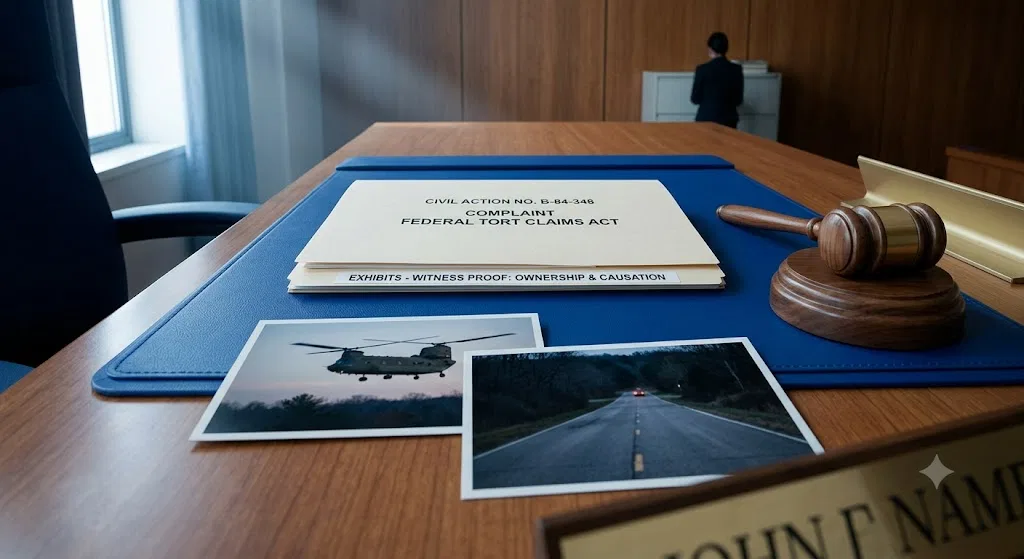
The witnesses’ lawyers therefore built the complaint around the reported military-style helicopters. Those aircraft offered the clearest possible bridge between the unidentified object and the United States government. Yet appearance was not ownership, proximity was not operational control, and illness following an incident was not legal proof of causation. When the government produced sworn denials of ownership and involvement, the plaintiffs lacked records, identified personnel or technical evidence strong enough to create a triable dispute. The lawsuit consequently failed before a court ever had to decide what the object was.
The legal theory behind the complaint
The Federal Tort Claims Act, or FTCA, is a limited waiver of the United States government’s sovereign immunity. It permits certain claims for money damages where injury is caused by the negligent or wrongful act of a federal employee acting within the scope of employment, and where a private person would be liable under the law of the state in which the event occurred. In the Cash–Landrum case, that meant the plaintiffs needed a viable Texas tort claim as well as evidence connecting the alleged wrongdoer to the federal government.[Legal Information Institute]law.cornell.eduLegal Information Institute28 U.SCode § 1346 - United States as defendant | U.S. Code | US Law | LII / Legal Information InstituteMay 2, 1996 — 28 U.S. Code § 1346 - Unit…
The Act did not provide a general compensation scheme for people injured during unexplained events. Nor did it make the government liable simply because military-looking aircraft were reportedly present. The practical theory had to be that federal personnel negligently operated, tested, escorted or controlled the heat-producing object, thereby exposing motorists on a public road to a foreseeable hazard.
That theory depended heavily on the witnesses’ description of numerous tandem-rotor helicopters resembling military CH-47 Chinooks. The helicopters were strategically important because the unidentified object itself supplied no visible institutional identity. If flight records, unit logs, crew testimony or official orders had linked the formation to a federal operation, the plaintiffs could then have argued that the object was being controlled, recovered or escorted by the same operation. Without such evidence, the helicopters remained an observation rather than proof of government responsibility.
The administrative stage already exposed this weakness. In a letter dated 2 September 1983, the Air Force denied the personal-injury claims after stating that its investigation had found no evidence of involvement by military personnel, equipment or aircraft. The letter also made clear that accepting and processing the claims did not concede the truth of the allegations. It treated the denial as the final administrative action and advised that a federal suit could be filed within six months.[Gary P. Posner]gpposner.comGary PPosnerORDER OF DISMISSAL CAME ON thig day the Motion to Digmigg and/or for Summary Judgment filed by the Onited States and the Court, hav…
That sequence mattered because the FTCA normally requires a claimant to present a claim to the appropriate federal agency before filing in court. A final written denial, or an agency’s failure to decide within six months, clears that procedural gateway. Satisfying it allows litigation to begin; it does not establish liability.[Legal Information Institute]law.cornell.eduLegal Information Institute28 U.SCode § 2675 - Disposition by federal agency as prerequisite; evidence | U.S. Code | US Law | LII / Legal Information Institute28 U.S. Cod…
What had to be proved in court
The plaintiffs’ burden can be understood as four connected questions. Failure at any one of them could defeat the case.
Was the responsible actor federal? The plaintiffs needed admissible evidence that the object, the helicopters or the people directing them belonged to or were controlled by the United States. A witness’s reasonable belief that an aircraft looked military could support an inference, but it was vulnerable without identifying numbers, photographs, radar data, flight plans, named crew members or unit records.
What was done negligently? Even proven federal ownership would not automatically establish fault. The complaint needed conduct that could be described as careless under an applicable Texas-law analogue: operating hazardous equipment too close to a public road, failing to secure an experimental vehicle, exposing bystanders to dangerous heat or radiation, or failing to warn or evacuate them.
Did that conduct cause the exposure? The plaintiffs had to connect the federal operation to the physical agent that allegedly harmed them. The reported object emitted intense heat and flame, while the helicopters were described as arriving or appearing around it. Unless the helicopters themselves caused the injuries, their presence could establish liability only indirectly, by proving federal control over the object.
Did the exposure cause the particular injuries? Medical records could demonstrate that symptoms and treatment were real. They still had to establish, to the civil standard of proof, that the encounter caused those conditions. Temporal sequence was helpful but not conclusive. Stronger proof would have included prompt exposure measurements, a medically supported dose reconstruction, characteristic physical damage, environmental contamination or expert testimony excluding plausible alternative causes.
The hardest problem was not necessarily proving that Cash was seriously unwell. It was joining every link into one evidential chain:
federal control → negligent operation → hazardous exposure → specific injury.
The case possessed allegations and medical consequences at opposite ends of that chain. Its central weakness lay in the links between them.
Ownership, negligence and causation
Military appearance did not prove federal ownership
The reported Chinook-like helicopters made federal involvement plausible enough to investigate, but an FTCA court required more than plausibility. Military aircraft might be operated by different services, reserve or National Guard units, contractors or foreign forces; a civilian witness might also misidentify an aircraft seen at night. The legal task was therefore to attribute the formation to a particular federal agency or employee.
The government answered that issue with affidavits from officials associated with NASA, the Air Force, the Navy and the Army. Its supporting papers asserted that the object described by the plaintiffs was not owned, operated, inventoried or controlled by the United States or its employees. On that basis, the government requested dismissal or summary judgment, arguing that no genuine dispute of material fact remained.[Gary P. Posner]gpposner.comGary PPosnerORDER OF DISMISSAL CAME ON thig day the Motion to Digmigg and/or for Summary Judgment filed by the Onited States and the Court, hav…
To resist summary judgment effectively, the plaintiffs needed counter-evidence rather than a stronger repetition of their account. Useful evidence might have included:
- a verified helicopter deployment in the region that night;
- maintenance, fuel or air-traffic records consistent with a large formation;
- testimony from a participating crew member or controller;
- documentary evidence of a military recovery or test programme;
- identifiable markings tied to a federal unit;
- radar or communications records showing coordinated aircraft activity.
No comparable evidential bridge appeared in the material before the court. The absence of public records did not logically prove that no classified operation occurred, but a claimant bears the burden of producing evidence. A hypothesis that records were secret could not itself substitute for the records, witnesses or admissions required to support the hypothesis.
Ownership alone would not have established negligence
Suppose the plaintiffs had proved that the helicopters belonged to the Army. That fact would still have left a decisive question unanswered: what negligent act did Army personnel commit?
An escorting force could have been responding to an unknown hazard rather than operating it. It might have arrived after the alleged exposure. Its personnel might have lacked control over the object. Alternatively, the government could have argued that operational choices were protected by the FTCA’s discretionary-function exception, which preserves immunity for conduct involving protected governmental judgement, even where discretion is alleged to have been abused.[Legal Information Institute]law.cornell.eduLegal Information Institute28 U.SCode § 2680 - Exceptions | U.S. Code | US Law | LII / Legal Information InstituteNovember 25, 2002 — 28 U.S. Code § 2680 - Exceptions | U…
The strongest plaintiff strategy would therefore have distinguished routine operational negligence from high-level policy. A claim that officials unwisely authorised a secret aerospace programme risked running into the discretionary-function exception. A narrower allegation—such as failure to follow a mandatory safety perimeter, negligent piloting or violation of a specific operating rule—would have been less abstract and potentially easier to compare with private-sector conduct.
That distinction mattered because the FTCA makes the United States liable in broadly the same manner as a private person under like circumstances. Courts look for an analogous private duty, not simply a rule that would make a public authority liable for exercising uniquely governmental powers.[Legal Information Institute]law.cornell.eduLegal Information Institute28 U.SCode § 1346 - United States as defendant | U.S. Code | US Law | LII / Legal Information InstituteMay 2, 1996 — 28 U.S. Code § 1346 - Unit…
Medical injury did not identify its legal cause
The illnesses were important to damages and causation, but they could not establish government ownership. Even persuasive evidence of burns, hair loss or other serious symptoms would prove only that injury occurred. It would not show who created the hazard, what physical mechanism produced it or whether any federal employee acted negligently.
The plaintiffs faced several nested causation questions. They had to show that the road encounter, rather than an unrelated condition, caused the illnesses; that the object emitted the relevant heat or radiation; and that the United States bore legal responsibility for the object. Uncertainty at each stage compounded the next.
This is why descriptions such as “consistent with radiation exposure” would have had limited value unless accompanied by evidence identifying an exposure type, likely dose and source. Compatibility is not attribution. Many symptoms can have more than one cause, while some radiation effects depend on dose, timing and distribution. The legal burden required a probability-based causal opinion, not simply confirmation that radiation was among the possibilities.
Why injury alone was insufficient
A tort lawsuit separates harm from liability. Harm concerns what happened to the claimants. Liability concerns whether the defendant committed a legally recognised wrong that caused it. The Cash–Landrum case is often misunderstood because those questions are collapsed into one.
The witnesses could be truthful about seeing an object, truthful about the helicopters and genuinely ill afterwards, yet still lose an FTCA case. None of those propositions, alone or together, necessarily proved that federal employees controlled the object or negligently exposed them. Conversely, dismissal did not require the court to determine that every part of their account was false.
The formal order entered on 21 August 1986 was brief. It stated that the court had considered the United States’ motion, supporting memorandum and subsequent pleadings, and dismissed Civil Action No. B-84-348 under Federal Rules of Civil Procedure 12(b)(1), 12(b)(6) and 56. Those rules respectively concern subject-matter jurisdiction, failure to state a legally sufficient claim, and summary judgment where no genuine dispute requiring trial remains. The order did not contain a detailed factual judgment identifying the object or explaining the witnesses’ illnesses.[Gary P. Posner]gpposner.comGary PPosnerORDER OF DISMISSAL CAME ON thig day the Motion to Digmigg and/or for Summary Judgment filed by the Onited States and the Court, hav…
That procedural posture limits what can responsibly be inferred from the outcome. The dismissal established that the plaintiffs had not produced a legally sufficient basis for holding the United States liable under the FTCA. It did not judicially authenticate an extraterrestrial craft, confirm a secret weapons programme or resolve the underlying sighting.
Where the strategy reached its limit
The lawsuit’s central strategic choice was understandable: use the helicopters to convert an unidentified encounter into a claim against an identifiable defendant. Without them, there was no evident route to the United States at all. But the strategy assumed that a reported formation of recognisably military aircraft could be translated into proof of federal ownership through investigation and discovery.
That translation never occurred. The government’s position was supported by institutional affidavits, while the plaintiffs could not identify an agency, unit, aircraft, crew or programme responsible for the event. The evidential imbalance was especially damaging at summary judgment, where a party opposing dismissal must point to evidence capable of supporting a verdict, not merely argue that government involvement remains possible.
Classification presented a genuine practical dilemma but not an evidential shortcut. A secret programme, by definition, may leave little accessible evidence. Yet courts cannot impose liability on the assumption that decisive proof exists behind a secrecy barrier. Plaintiffs would still need some independent foundation—documents, insiders, physical evidence, inconsistent official records or other admissible material—from which federal control could reasonably be inferred.
The Cash–Landrum litigation therefore illustrates a narrow but important lesson. The FTCA can compensate people harmed by federal negligence only when the government’s role can be proved with ordinary legal evidence. An unexplained injury may justify investigation. A credible witness account may support further inquiry. Neither is enough to obtain a judgment against the United States unless ownership, duty, breach and causation can be established as parts of the same case.
Amazon book picks
Further Reading
Books and field guides related to What Did the Witnesses Need to Prove in Court?. Use these as the next step if you want deeper reading beyond the article.
The Federal Courts and the Federal System
This supplement brings the main casebook up to date with recent changes in the law.
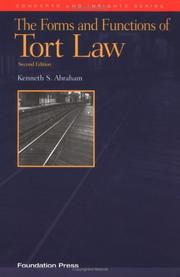
The Forms and Functions of Tort Law
The perfect accompaniment to any torts casebook, The Forms and Functions of Tort Law covers all the major cases and issues in the standar...
A Civil Action
This authoritative, in-depth, revealing, and wonderfully-written book tells the true story of an obsessed young lawyer who gave up everyt...
eBay marketplace picks
Marketplace Samples
Live-tested eBay searches with available results related to this page.
Selected fromUFO poster oneBay.co.uk.


Endnotes
1.
Source: gpposner.com
Title: Gary P
Link:https://gpposner.com/CL-Schuessler_book_pp.197%2C222%2C300%2C302.pdf
Source snippet
PosnerORDER OF DISMISSAL CAME ON thig day the Motion to Digmigg and/or for Summary Judgment filed by the Onited States and the Court, hav...
2.
Source: youtube.com
Title: The Cash
Link:https://www.youtube.com/watch?v=t6sV0LIy7GI
Source snippet
Landrum UFO Mystery...
3.
Source: youtube.com
Title: The Cash-Landrum UFO Mystery
Link:https://www.youtube.com/watch?v=P2HsOUTzyWA
Source snippet
Federal Tort Claims Act...
4.
Source: youtube.com
Title: Federal Tort Claims Act
Link:https://www.youtube.com/watch?v=QRS2iLPsdHA
Source snippet
HOW TO SUE THE FEDERAL GOVERNMENT? | LAWYER EXPLAINS...
5.
Source: youtube.com
Title: HOW TO SUE THE FEDERAL GOVERNMENT? | LAWYER EXPLAINS
Link:https://www.youtube.com/watch?v=TwymeQRJJQc
Source snippet
Federal Tort Claims Act...
6.
Source: youtube.com
Title: Federal Tort Claims Act
Link:https://www.youtube.com/watch?v=6SdUtDfZjVM
7.
Source: law.cornell.edu
Title: Legal Information Institute28 U.S
Link:https://www.law.cornell.edu/uscode/text/28/1346
Source snippet
Code § 1346 - United States as defendant | U.S. Code | US Law | LII / Legal Information InstituteMay 2, 1996 — 28 U.S. Code § 1346 - Unit...
Published: May 2, 1996
8.
Source: law.cornell.edu
Title: Legal Information Institute UNITED STATES V
Link:https://www.law.cornell.edu/supct/html/04-759.ZS.html
Source snippet
OLSONUNITED STATES V. OLSON LII Supreme Court UNITED STATES V. OLSON (04-759) 546 U.S. 43 (2005) 362 F.3d 1236, vacated and remanded. Syl...
9.
Source: law.cornell.edu
Title: Legal Information Institute28 U.S
Link:https://www.law.cornell.edu/uscode/text/28/2675
Source snippet
Code § 2675 - Disposition by federal agency as prerequisite; evidence | U.S. Code | US Law | LII / Legal Information Institute28 U.S. Cod...
10.
Source: law.cornell.edu
Title: Legal Information Institute28 U.S
Link:https://www.law.cornell.edu/uscode/text/28/2680
Source snippet
Code § 2680 - Exceptions | U.S. Code | US Law | LII / Legal Information InstituteNovember 25, 2002 — 28 U.S. Code § 2680 - Exceptions | U...
Published: November 25, 2002
11.
Source: law.cornell.edu
Link:https://www.law.cornell.edu/supremecourt/text/24-351
12.
Source: law.cornell.edu
Link:https://www.law.cornell.edu/supct/pdf/24-362.pdf
13.
Source: law.cornell.edu
Link:https://www.law.cornell.edu/supremecourt/text/24-362
14.
Source: law.cornell.edu
Link:https://www.law.cornell.edu/taxonomy/term/5458958/feed
15.
Source: law.cornell.edu
Link:https://www.law.cornell.edu/supct/cert/24-362
16.
Source: law.cornell.edu
Link:https://www.law.cornell.edu/supremecourt/text/19-546
17.
Source: law.cornell.edu
Link:https://www.law.cornell.edu/supremecourt/text/17-1201
18.
Source: law.cornell.edu
Link:https://www.law.cornell.edu/supct/pdf/17-1201.pdf
19.
Source: law.cornell.edu
Title: edu32 CFR Subpart I
Link:https://www.law.cornell.edu/cfr/text/32/part-842/subpart-I
20.
Source: law.cornell.edu
Title: federal tort claims act
Link:https://www.law.cornell.edu/index.php/category/keywords/federal_tort_claims_act
21.
Source: law.cornell.edu
Title: 04 848.ZD
Link:https://www.law.cornell.edu/supct/html/04-848.ZD.html
22.
Source: law.cornell.edu
Title: 04 848.ZS
Link:https://www.law.cornell.edu/supremecourt/text/04-848.ZS.html
23.
Source: law.cornell.edu
Link:https://www.law.cornell.edu/supct/pdf/04-759P.ZS
24.
Source: law.cornell.edu
Title: 03 339.ZC1
Link:https://www.law.cornell.edu/supct/html/03-339.ZC1.html
25.
Source: law.cornell.edu
Link:https://www.law.cornell.edu/supremecourt/text/510/471
26.
Source: law.cornell.edu
Link:https://www.law.cornell.edu/supremecourt/text/508/106
27.
Source: law.cornell.edu
Title: 92 6033.ZS
Link:https://www.law.cornell.edu/supct/html/92-6033.ZS.html
28.
Source: law.cornell.edu
Title: edu28 U.S. Code Chapter 171 Part VI
Link:https://www.law.cornell.edu/uscode/text/28/part-VI/chapter-171
29.
Source: law.cornell.edu
Link:https://www.law.cornell.edu/category/keywords/28-usc-ss-2680
30.
Source: law.cornell.edu
Title: edu28 CFR § 14.2
Link:https://www.law.cornell.edu/cfr/text/28/14.2
31.
Source: law.cornell.edu
Title: edu5 CFR Part 177
Link:https://www.law.cornell.edu/cfr/text/5/part-177
32.
Source: law.cornell.edu
Link:https://www.law.cornell.edu/index.php/supct/cert/15-109
33.
Source: law.cornell.edu
Title: edu15 CFR § 2.2
Link:https://www.law.cornell.edu/cfr/text/15/2.2
34.
Source: law.cornell.edu
Title: edu32 CFR Part 750
Link:https://www.law.cornell.edu/cfr/text/32/part-750/subpart-B
35.
Source: law.cornell.edu
Title: edu43 CFR § 22.2
Link:https://www.law.cornell.edu/cfr/text/43/22.2
36.
Source: law.cornell.edu
Title: edu28 CFR Part 543
Link:https://www.law.cornell.edu/cfr/text/28/part-543/subpart-C
37.
Source: law.cornell.edu
Title: edu28 CFR Part 14
Link:https://www.law.cornell.edu/cfr/text/28/part-14
38.
Source: law.cornell.edu
Title: edu43 CFR Part 22
Link:https://www.law.cornell.edu/cfr/text/43/part-22
39.
Source: law.cornell.edu
Link:https://www.law.cornell.edu/uscode/text/28
40.
Source: law.cornell.edu
Title: edu28 U.S. Code Part VI
Link:https://www.law.cornell.edu/uscode/text/28/part-VI
Additional References
41.
Source: Wikipedia
Title: Cash–Landrum incident
Link:https://en.wikipedia.org/wiki/Cash%E2%80%93Landrum_incident
Source snippet
From the object's first sighting to its departure, they said the encounter lasted about 20 minutes. Based on descriptions given in John F...
42.
Source: govinfo.gov
Link:https://www.govinfo.gov/app/collection/USCOURTS/
43.
Source: govinfo.gov
Link:https://www.govinfo.gov/app/collection/uscourts/courttype2
44.
Source: dbpedia.org
Link:https://dbpedia.org/page/Cash%E2%80%93Landrum_incident
45.
Source: nowdeclassified.com
Link:https://www.nowdeclassified.com/incidents/cash-landrum-1980
46.
Source: casemine.com
Link:https://www.casemine.com/judgement/us/59148db2add7b049345475c1
47.
Source: cufon.org
Link:https://www.cufon.org/cufon/cashlanL.pdf
48.
Source: news.sky.com
Link:https://news.sky.com/story/legal-challenge-over-fatal-1994-raf-chinook-crash-thrown-out-by-high-court-judge-13563422
49.
Source: standard.co.uk
Title: butcher ministry of defence european court of human rights scotland raf b1289979
Link:https://www.standard.co.uk/news/politics/butcher-ministry-of-defence-european-court-of-human-rights-scotland-raf-b1289979.html
50.
Source: ecfr.gov
Title: e CF R:: 32 CFR Part 750 Subpart B – Federal Tort Claims Act
Link:https://www.ecfr.gov/current/title-32/subtitle-A/chapter-VI/subchapter-E/part-750/subpart-B