Within Cash Landrum
What Would a 23 Helicopter Mission Require?
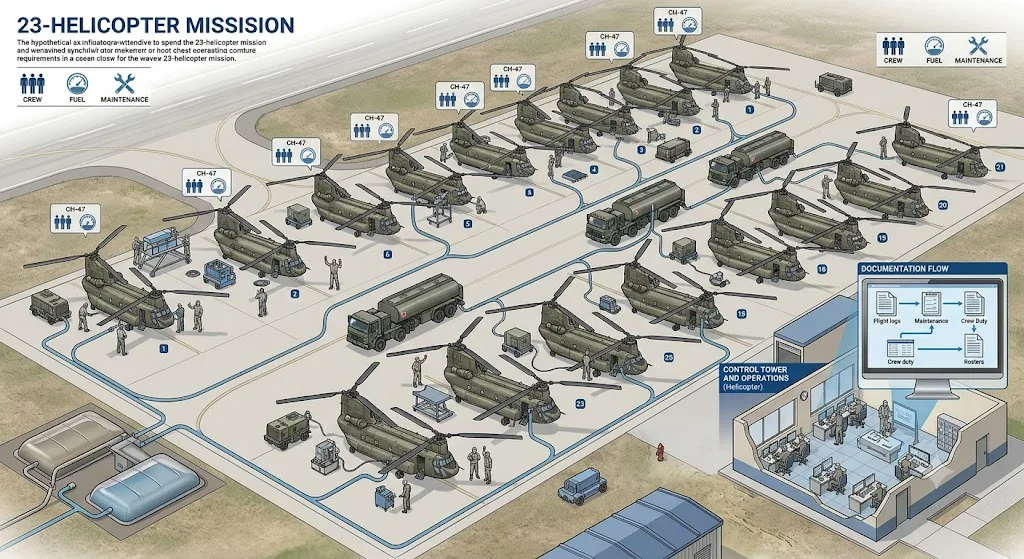
A formation this large would require crews, fuel, maintenance and command support, creating records that investigators expected to find.
On this page
- Aircraft, crews and support personnel
- Fuel, maintenance and departure bases
- Expected records and observable traces
Page outline Jump by section
Introduction
The reported sighting of roughly 23 military-style helicopters is the Cash–Landrum incident’s most demanding logistical claim. A formation of that size could not ordinarily be assembled by a handful of pilots acting informally. It would require serviceable aircraft, qualified crews, fuel, maintenance teams, flight planning, command approval and a suitable departure base. Even a short mission near Houston on 29 December 1980 would probably have involved well over 70 aircrew and a much larger body of ground personnel.
That scale matters because organised military flying normally produces traces in several places at once: aircraft logbooks, maintenance forms, fuel issues, duty rosters, operations-room records and observations around the airfield. The Army Inspector General inquiry reportedly contacted commands and nearby aviation units but found no recorded military helicopter activity matching the witnesses’ account. That failure does not prove that no helicopters were present, but it makes a conventional 23-aircraft military mission difficult to reconcile with the surviving documentary record.[Ufologie]ufologie.patrickgross.orgIn Decemufo - UFOs at close sight: the Cash-Landrum case, 1980, USAF memo 1/4, SarranMay 27, 2003 — ufo - UFOs at close sight: the Cash-L…
How Many Aircraft and People Would Be Involved?
Cash, Landrum and Colby described numerous helicopters surrounding or following the luminous object, with the eventual count commonly given as about 23. Identification was not uniform: some were said to have the distinctive tandem rotors of CH-47 Chinooks, while others may have been different types. The logistical problem therefore begins with a range rather than a confirmed fleet list. Nevertheless, whether all 23 were Chinooks or only a substantial portion were, this would have been a major aviation movement rather than a routine local flight.[Ufologie]ufologie.patrickgross.orgIn Decemufo - UFOs at close sight: the Cash-Landrum case, 1980, USAF memo 1/4, SarranMay 27, 2003 — ufo - UFOs at close sight: the Cash-L…
A modern US Army description gives the Chinook a normal minimum crew of three. Applying that minimum to 23 aircraft produces 69 flying personnel before allowing for additional crew chiefs, observers, mission specialists or commanders. Era-specific operations could use larger crews, particularly when aircraft carried door gunners or required extra personnel for complex loading and recovery tasks. The safest conclusion is therefore not that exactly 69 people were involved, but that the airborne contingent alone would probably have numbered at least several dozen and potentially more than 100.[Army]army.milTroop capacity: 36 (33 troops plus three crew membersCH-47 CHINOOK HELICOPTER | Article | The United States ArmyNovember 4, 2014 — The CH-47F aircraft has a suite of improved features su…
The ground organisation would have been larger still. Heavy helicopters require personnel to inspect them before flight, rectify faults, service engines and transmissions, manage fuel, control tools and parts, communicate with crews and release aircraft as airworthy. A mission assembled from more than one unit would also need liaison between commands and a common plan covering routes, timings, radio procedures, formation positions and emergency actions. Army technical publications treat maintenance and test flying as formal, documented processes rather than incidental work performed only when an aircraft breaks down.[Internet Archive]archive.orgInternet ArchiveTM 55-1520-240-MTFMarch 8, 1996 — and 2-40 2-45 and 2-46 2-45 and 2-46 2-46.1/(2-46.2 2-46.1 blank) and 2-46.2 TM 55-1520…
The number of aircraft reported also creates an availability problem. An aviation unit may possess a certain number of helicopters without having every one ready to fly simultaneously. Some aircraft will normally be undergoing inspections, awaiting parts or reserved for other duties. Launching 23 serviceable heavy-lift helicopters would therefore imply either a particularly large parent formation or the concentration of aircraft from several units. That concentration would increase the number of planners, maintainers and movements needed before the formation even reached the Huffman area.
Fuel, Maintenance and Departure Bases
A Chinook is not an aircraft that can be dispatched in large numbers without a substantial fuel operation. Boeing’s current specifications list a fuel capacity of roughly 1,034 to 1,080 US gallons, depending on the model and configuration. The exact figures for the CH-47 variants operating in 1980 differed, but they were still large twin-engine helicopters whose fuel demands were measured in thousands of pounds per aircraft for extended missions.[Boeing]boeing.comH-47 Chinook### CH-47F Chinook Block II Specifications… Fuel Capacity | 1,080 gallons (4,088 liters)…
A US Army performance handbook for the CH-47C illustrates the scale. In one planning example, an empty aircraft flying at 20,000 pounds gross weight and 70 knots consumes approximately 1,342 pounds of fuel during one hour of flight; a heavily loaded leg uses considerably more. The same handbook calculates fuel for ground idling, loading periods and every route segment, demonstrating that even an uncomplicated resupply flight required a written fuel profile rather than an improvised estimate.[Chinook Helicopter]wvvw.chinook-helicopter.comOpen source on chinook-helicopter.com.
Using the handbook’s relatively modest one-hour figure only as an illustration, 23 aircraft would consume more than 30,000 pounds of fuel in an hour of airborne operation. That is approximately 4,500 to 4,700 US gallons of aviation fuel, depending on fuel density, without allowing for start-up, idling, reserves, higher power settings or travel from a distant base. A mission involving hovering, low-altitude manoeuvring or escorting a slow-moving object could use more than a straightforward cruise profile.
Fuel demand would leave several possible traces. Aircraft could be filled from permanent airfield systems, tanker vehicles or fuel bladders, but each method involves recorded stock movements and trained handlers. A sudden requirement to refuel more than 20 helicopters would also be physically conspicuous: aircraft would have to be parked, marshalled and serviced in sequence unless an unusually large number of fuel points was available.
Maintenance requirements would begin before take-off and continue after landing. Each aircraft would need a pre-flight inspection and a determination that faults recorded on previous flights had been corrected or formally deferred. After the mission, crews would report defects and maintainers would inspect systems exposed to unusual loads, prolonged hovering or other demanding conditions. If the helicopters had operated near the intense heat source described by the witnesses, additional inspections of rotor, engine, electrical and airframe components would have been a predictable precaution.
The nearest plausible military aviation facilities were therefore central to the investigation. Lieutenant Colonel George Sarran’s Army Inspector General inquiry reportedly coordinated with Major Dennis Haire, commander of a Texas National Guard element operating eight Chinooks at Ellington, south of Houston. It also contacted an Army Reserve unit operating seven Hueys from Tomball, Fort Hood authorities, Army aviation organisations and the Corpus Christi repair facility. According to Sarran’s memorandum, checks of known flying in the relevant area produced negative results.[Ufologie]ufologie.patrickgross.orgIn Decemufo - UFOs at close sight: the Cash-Landrum case, 1980, USAF memo 1/4, SarranMay 27, 2003 — ufo - UFOs at close sight: the Cash-L…
Those numbers reveal an important difficulty. The Ellington element reportedly had only eight Chinooks, far fewer than the total formation claimed. Even if all eight had been available and launched together, another 15 aircraft would have had to come from elsewhere if every reported helicopter was a Chinook. If the formation was mixed, the shortfall would be smaller, but combining aircraft from different locations would still require coordinated departure times, rendezvous procedures and common command arrangements.
Fort Hood, now Fort Cavazos, was a logical location to examine because of its large Army presence and aviation resources, but it lies much farther from Huffman than Ellington or Tomball. Aircraft coming from a distant installation would have added transit time, fuel consumption and opportunities for observation. A hidden operation might conceal its purpose, yet it would still have to manage the practical effects of moving aircraft and crews over hundreds of kilometres.
Timing compounds the problem. Sarran recorded that the alleged operation occurred between approximately 9 and 9.30 pm on Monday, 29 December 1980, during the Christmas and New Year period. He noted that Army units traditionally conducted limited operations under holiday schedules and that no manoeuvres were scheduled in the area. A genuine emergency could override a reduced schedule, but recalling enough personnel to launch a large formation would itself have involved an unusual sequence of telephone calls, duty changes and command decisions.[Ufologie]ufologie.patrickgross.orgIn Decemufo - UFOs at close sight: the Cash-Landrum case, 1980, USAF memo 1/4, SarranMay 27, 2003 — ufo - UFOs at close sight: the Cash-L…
What Records Should Have Existed?
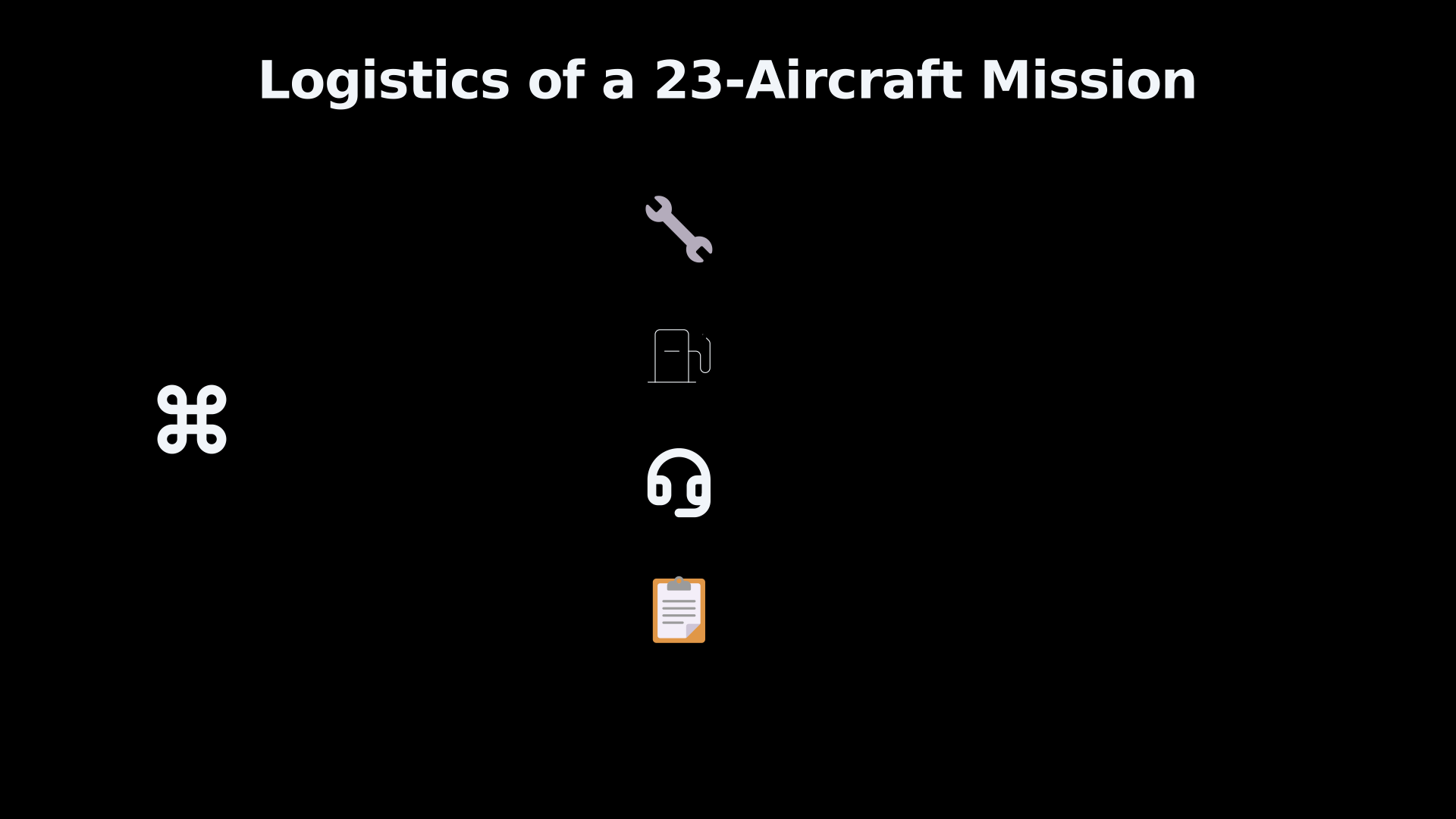
A conventional mission of this scale would not depend upon a single master document whose absence could erase the entire operation. It would create overlapping records held by different offices and sometimes by different units. The exact forms and retention periods have changed, but the underlying categories are persistent in military aviation:
- Aircraft records: flight time, crew assignments, discrepancies, component usage and maintenance status.
- Operations records: mission requests, flight schedules, route information, briefings, radio frequencies and command approvals.
- Personnel records: duty rosters, call-outs and crew-rest calculations.
- Fuel and supply records: quantities issued, tanker activity, oils, parts and other consumables.
- Airfield records: departures, arrivals, parking arrangements and contact with tower or flight-following services.
- Maintenance records: inspections before and after flight, faults reported by crews and repair work needed to return aircraft to service.
A mission could be classified without becoming administratively invisible. Classification restricts who can see records; it does not normally remove the need for airworthiness control, fuel accountability, crew qualification or command responsibility. Sensitive units can use cover descriptions, restricted channels or compartmented orders, but the aircraft still accumulate flying hours, consume parts and require qualified people to sign technical documents.
The possibility of incomplete record retention must be taken seriously. Routine schedules, temporary notes and local communications from 1980 may have been destroyed under normal retention rules long before researchers sought them. Records can also be misfiled, transferred or indexed under unit names unknown to outside investigators. The absence of material available today is therefore weaker evidence than a complete, contemporary examination of original records would have been.
Sarran’s investigation was reasonably close to the event, however, and reportedly asked relevant commands and local units to check their flight records. His memorandum states that the responses were negative, not merely that no documents could be found decades later. This is more significant than a modern unsuccessful archive search, although the surviving account does not demonstrate that every conceivable US military, intelligence or civilian operator was independently audited.[Ufologie]ufologie.patrickgross.orgIn Decemufo - UFOs at close sight: the Cash-Landrum case, 1980, USAF memo 1/4, SarranMay 27, 2003 — ufo - UFOs at close sight: the Cash-L…
The investigation also appears to have focused narrowly on whether Army, Army National Guard or Army Reserve helicopters had participated. That was a rational starting point because the Army operated most US military Chinooks. Sarran nevertheless made enquiries across a broad group of Army commands, test organisations and support facilities. Later summaries indicate that other services denied relevant operations as the witnesses pursued their claim against the federal government.[Ufologie]ufologie.patrickgross.orgIn Decemufo - UFOs at close sight: the Cash-Landrum case, 1980, USAF memo 1/4, SarranMay 27, 2003 — ufo - UFOs at close sight: the Cash-L…
The eventual court decision did not establish that the formation was imaginary. It found that the plaintiffs had not shown that the alleged aircraft belonged to or were operated by the federal government. That distinction is important: a legal failure to prove ownership is not the same as an affirmative reconstruction of what witnesses saw. Equally, the witnesses’ description cannot itself substitute for aircraft logs or named crews.[AnomalyDesk]anomalydesk.comcash landrum incidentcash landrum incident

What People on the Ground Would Notice
Twenty-three large helicopters flying together would produce an acoustic and visual footprint extending well beyond the immediate road. Chinooks are nearly 100 feet long with rotors turning, and their tandem-rotor layout creates a distinctive silhouette and powerful low-frequency noise. Boeing lists a rotor diameter of 60 feet and an operating length of almost 99 feet, making each aircraft a substantial object even before it is placed in formation.[Boeing]boeing.comSelect ProductsTechnical Specifications Rotor diameter | 18.29 m (60 ft) — | — Technical Specifications Length with rotors oper…
Recent incidents show how difficult even a smaller Chinook formation can be to overlook. When eight Chinooks flew over San Antonio during a 2026 training exercise, residents reported severe noise, rattling windows and widespread attention. The Army publicly acknowledged the exercise and identified its connection to training around Lackland Air Force Base. The comparison does not prove what happened in 1980, but it demonstrates the observable footprint created by only about one-third of the Cash–Landrum helicopter count.[San Antonio Express-News]expressnews.comOpen source on expressnews.com.
The Huffman and Dayton area was less densely populated in 1980, and a night route over woods could reduce the number of observers. Yet a formation travelling between a military base and the encounter site would still cross roads, settlements and industrial areas. Its noise would precede and outlast its passage, while navigation lights or illuminated cabins could be visible from several directions. Low flight, as described in some accounts, would make the formation louder rather than less noticeable.
There were later claims of additional witnesses. Dayton police officer Lamar Walker and his wife were reported to have seen approximately 12 tandem-rotor helicopters in the broader area that night. Their account is potentially relevant because it would place a conspicuous formation outside the three principal witnesses’ testimony. However, the statement was collected well after the event, and available summaries do not establish a precise synchronisation of location, route and time with the roadside encounter. It therefore offers possible corroboration of helicopter activity, not confirmation of a 23-aircraft escort.[Wikipedia]WikipediaLandrum decided to take him to the spot where the helicopter had landed with the hope that it would seem less frightening on the ground…
The absence of a larger group of securely documented contemporary reports remains consequential. A formation could pass through a sparsely populated corridor without generating newspaper coverage, particularly before mobile phones and consumer video cameras. Even so, the combination of aircraft size, noise and reported low altitude suggests that investigators should have expected more observations along the approach and departure routes if all 23 helicopters travelled together.
Could the Mission Have Been Concealed?
A classified operation is the most common response to the missing-record problem. It is plausible in the limited sense that the military conducts missions whose objectives, routes or participating organisations are not disclosed publicly. The United States also possessed specialist aviation units capable of unusual training and contingency operations. Secrecy could therefore explain why ordinary public-affairs channels did not recognise a mission.
It is less capable of explaining the complete logistical gap. A classified label would not eliminate the need for crews, aircraft release, fuel, maintenance and recovery. Concealment would become harder as the number of participating helicopters increased because each additional aircraft introduced another crew, another maintenance history and another set of support requirements. Bringing together aircraft from several bases would expand the number of personnel who knew at least that an unusual movement had occurred, even if most did not know its purpose.
Records could have been compartmented or entered under a misleading mission description. Yet this hypothesis requires more than routine secrecy: it requires either that Sarran’s enquiries failed to reach the controlling organisation or that contacted organisations withheld relevant activity from an Army Inspector General investigation. Neither possibility can be ruled out from public documents, but no released order, crew testimony, fuel record or unit history has emerged to demonstrate that this happened.
Another possibility is that the witnesses overestimated the number of aircraft. Counting moving lights at night is difficult, particularly when aircraft circle, disappear behind trees and re-enter view. A smaller formation repeatedly crossing the line of sight could be perceived as a larger one. This would substantially reduce the logistical burden: four to eight helicopters could plausibly come from one local element, require fewer than two dozen minimum aircrew and leave a less extensive trail than 23.
Misidentification of helicopter type could also matter. Tandem-rotor Chinooks are visually distinctive, but night-time viewing conditions may prevent reliable classification of every aircraft. If only several were Chinooks and the remainder were smaller helicopters, the mission would require less fuel and could draw on a broader range of nearby organisations. It would still be an organised operation, however, and it would not explain why contemporary checks reportedly found no matching flights.
Civilian ownership is an even poorer fit for a formation dominated by Chinooks. Heavy military helicopters were rare outside government service in 1980, and assembling more than 20 privately operated examples near Houston would have presented essentially the same problems of crews, maintenance, fuel and records. A non-military operator might complicate jurisdictional searches, but it would not make the aviation activity logistically trivial.
The Logistical Evidence Cuts Both Ways
The helicopter claim has often been treated as evidence that the witnesses encountered a government project: ordinary civilians were unlikely to invent the specific image of tandem-rotor aircraft, and a large escort would appear to place an organised authority at the scene. From that perspective, the helicopters are not incidental scenery but the mechanism that connects the unidentified object to a military recovery or control operation.
Logistics produce the opposite pressure. The more accurately the count of 23 represents distinct large helicopters, the harder it becomes to explain the lack of operational evidence. Such a mission would have required a sizeable pool of aircraft, dozens of aircrew, substantial fuel and maintenance support, probably involving more than one unit. Sarran’s finding that the local National Guard had eight Chinooks makes a single nearby source insufficient for an all-Chinook formation.[Ufologie]ufologie.patrickgross.orgIn Decemufo - UFOs at close sight: the Cash-Landrum case, 1980, USAF memo 1/4, SarranMay 27, 2003 — ufo - UFOs at close sight: the Cash-L…
This does not reduce the case to a simple choice between a fully documented military operation and deliberate fabrication. Witnesses may accurately have perceived helicopter activity while misjudging its number, distance, type or relationship to the luminous object. Separate flights could have been mentally grouped into one formation, or later questioning and repeated retelling could have fixed an initially approximate count into the familiar figure of 23.
The strongest conclusion is narrower. A genuine 23-helicopter military mission near Huffman would have been a substantial coordinated undertaking with many potential documentary and human traces. Contemporary Army enquiries reportedly found none, and no later release has supplied the missing crews, aircraft or departure records. The helicopter testimony remains one of the incident’s most striking features, but the logistics make the largest version of that testimony the version most in need of independent proof.
Amazon book picks
Further Reading
Books and field guides related to What Would a 23 Helicopter Mission Require?. Use these as the next step if you want deeper reading beyond the article.
Supplying War: Logistics from Wallenstein to Patton
Why did Napoleon succeed in 1805 but fail in 1812? Were the railways vital to Prussia's victory over France in 1870? Was the famous Schli...

Moving Mountains: Lessons in Leadership and Logistics from th...
Business Week described the Gulf War as "the largest military logistics operation in history." It entailed an unprecedented deployment of...
The Dream Machine: The Untold History of the Notorious V-22 O...
A fascinating and authoritative narrative history of the V-22 Osprey, revealing the inside story of the most controversial piece of milit...
Night Stalkers
From the New York Times bestselling authors of In the Company of Heroes comes a thrilling account of military aviation for history buffs...
eBay marketplace picks
Marketplace Samples
Live-tested eBay searches with available results related to this page.
Selected frommilitary helicopter poster oneBay.co.uk.
Current eBay listing
ARMY HELICOPTER WAR POSTER MILITARY FANTASY ART PRINT - A3 A4 SIZE

Current eBay listing
ARMY HELICOPTER WAR POSTER MILITARY FANTASY ART PRINT A3 A4 SIZE
Endnotes
1.
Source: Wikipedia
Link:https://en.wikipedia.org/wiki/Cash%E2%80%93Landrum_incident
Source snippet
Landrum decided to take him to the spot where the helicopter had landed with the hope that it would seem less frightening on the ground...
2.
Source: army.mil
Title: Troop capacity: 36 (33 troops plus three crew members)
Link:https://www.army.mil/article/137584/ch_47_chinook_helicopter
Source snippet
CH-47 CHINOOK HELICOPTER | Article | The United States ArmyNovember 4, 2014 — The CH-47F aircraft has a suite of improved features su...
Published: November 4, 2014
3.
Source: archive.org
Link:https://archive.org/download/manualzilla-id-5778420/5778420.pdf
Source snippet
Internet ArchiveTM 55-1520-240-MTFMarch 8, 1996 — and 2-40 2-45 and 2-46 2-45 and 2-46 2-46.1/(2-46.2 2-46.1 blank) and 2-46.2 TM 55-1520...
Published: March 8, 1996
4.
Source: w.chinook-helicopter.com
Link:https://w.chinook-helicopter.com/Publications/CH-47D_Technical_Publications/23_Series/TM_55-1520-240-23-1.pdf
Source snippet
Saturated clothing should be removed immediately. Areas in which cleaning solventsare used shoul...
5.
Source: boeing.com
Link:https://www.boeing.com/defense/military-rotorcraft/h-47-chinook
Source snippet
H-47 Chinook### CH-47F Chinook Block II Specifications... Fuel Capacity | 1,080 gallons (4,088 liters)...
6.
Source: boeing.com
Link:https://www.boeing.com/content/dam/boeing/boeingdotcom/history/pdf/Boeing_Products.pdf
Source snippet
Select ProductsTechnical Specifications Rotor diameter | 18.29 m (60 ft) --- | --- Technical Specifications Length with rotors oper...
7.
Source: wvvw.chinook-helicopter.com
Link:https://www.wvvw.chinook-helicopter.com/Technical_Reports/Flight_Profile_Performance_Handbook_CH-47C.pdf
8.
Source: anomalydesk.com
Title: cash landrum incident
Link:https://anomalydesk.com/cash-landrum-incident
9.
Source: boeing.com
Title: Chinook shows its might and maneuvers at Farnborough
Link:https://www.boeing.com/features/2026/07/chinook-shows-its-might-and-maneuvers-at-farnborough
10.
Source: boeing.com
Title: , Lufthansa Technik announce Chinook sustainment plan
Link:https://www.boeing.com/features/2026/07/boeing-lufthansa-technik-announce-chinook-sustainment-plan
11.
Source: boeing.com
Title: Beyond the dials: Finding the feel for a test aircraft
Link:https://www.boeing.com/features/2026/07/beyond-the-dials-finding-the-feel-for-a-test-aircraft
12.
Source: jobs.boeing.com
Title: senior mechanical structures technical officer
Link:https://jobs.boeing.com/en/job/enoggera/senior-mechanical-structures-technical-officer/185/97831445728
13.
Source: jobs.boeing.com
Title: senior avionics technical officer
Link:https://jobs.boeing.com/job/enoggera/senior-avionics-technical-officer/185/97831445760
14.
Source: jobs.boeing.com
Title: principal mechanical structures technical officer
Link:https://jobs.boeing.com/job/enoggera/principal-mechanical-structures-technical-officer/185/97831445696
15.
Source: Wikipedia
Title: org2nd Battalion, 227th Aviation Regiment
Link:https://en.wikipedia.org/wiki/2nd_Battalion%2C_227th_Aviation_Regiment
16.
Source: anomalydesk.com
Title: cash landrum incident
Link:https://anomalydesk.com/cash-landrum-incident.html
17.
Source: boeing.com
Title: Next for Chinook: Smarter controls, plug-and-play tech
Link:https://www.boeing.com/features/2026/04/next-for-chinook-smarter-controls-plug-and-play-tech
18.
Source: boeing.com
Title: U S Army orders 6 more Boeing Chinook helicopters
Link:https://www.boeing.com/features/2026/04/us-army-orders-6-more-boeing-chinook-helicopters
19.
Source: boeing.com
Title: C H-47F Chinook completes first supervised-autonomy landing in flight tests
Link:https://www.boeing.com/features/2026/04/ch-47f-chinook-completes-first-supervised-autonomy-landing
20.
Source: Wikipedia
Title: org3rd Aviation Regiment (United States)
Link:https://en.wikipedia.org/wiki/3rd_Aviation_Regiment_%28United_States%29
21.
Source: boeing.com
Title: Watch: Chinook takes ‘heavy lift’ to the next level
Link:https://www.boeing.com/features/2025/10/watch–chinook-takes–heavy-lift–to-the-next-level
22.
Source: army.mil
Link:https://www.army.mil/article/288833/army_accelerates_capability_to_the_force_with_a_rapid_fielding_effort_for_chinook_block_ii
23.
Source: boeing.com
Title: U K Chinook helicopter’s pioneering drone deployment
Link:https://www.boeing.com/content/theboeingcompany/us/en/features/2025/07/–uk-chinook-helicopter-s-pioneering-drone-deployment-.html
24.
Source: army.mil
Link:https://www.army.mil/article/280555/ch_47_crew_89b_students_conduct_september_sling_load_training_at_fort_mccoy
25.
Source: army.mil
Link:https://www.army.mil/article-amp/279207/ch_47_chinook_helicopters_play_big_part_in_supporting_86th_training_divisions_cstx
26.
Source: army.mil
Link:https://www.army.mil/article/279207/ch_47_chinook_helicopters_play_big_part_in_supporting_86th_training_divisions_cstx
27.
Source: archive.org
Title: to-1-c-47-1-flight-manual-usaf-series-c-47 directory listing
Link:https://archive.org/download/to-1-c-47-1-flight-manual-usaf-series-c-47
28.
Source: army.mil
Link:https://www.army.mil/article/267285/
29.
Source: army.mil
Link:https://www.army.mil/article-amp/245224/army_investigation_into_june_1st_d_c_national_guard_helicopter_usage_uncovered_organizational_resource_and_oversight_shortcomings
30.
Source: army.mil
Link:https://www.army.mil/article/235500/ny_army_national_guard_helicopter_crews_conduct_water_bucket_training
31.
Source: army.mil
Link:https://www.army.mil/article/232661/aviation_brigade_practices_fat_cow_fueling_operation
32.
Source: army.mil
Title: Forward Arming and Refueling Point | Article | The United States Army
Link:https://www.army.mil/article/232527/forward_arming_and_refueling_point
33.
Source: chinook-helicopter.com
Link:https://www.chinook-helicopter.com/history/aircraft/C_Models/70-15009/70-15009.html
34.
Source: chinook-helicopter.com
Title: C H-47 Chinook helicopter
Link:https://www.chinook-helicopter.com/Publications/Publications.html
35.
Source: army.mil
Title: helicopters aid stranded oil rig | Article | The United States Army
Link:https://www.army.mil/article/94329/army_helicopters_aid_stranded_oil_rig
36.
Source: army.mil
Title: Jump-FARP fuels monumental outcome | Article | The United States Army
Link:https://www.army.mil/article/86189/Jump_FARP_fuels_monumental_outcome/
37.
Source: army.mil
Link:https://www.army.mil/article/65273/25th_cab_and_hng_introduce_ch_47f_chinooks_helicopters_to_their_fleet
38.
Source: archive.org
Title: Microsoft Word
Link:https://archive.org/download/ost-military-doctrine-fm3_04x300c1/fm3_04x300c1.pdf
39.
Source: wvvw.chinook-helicopter.com
Link:https://wvvw.chinook-helicopter.com/Publications/CH-47D_Technical_Publications/23_Series/TM_55-1520-240-23-1.pdf
40.
Source: ww.chinook-helicopter.com
Link:https://ww.chinook-helicopter.com/Publications/CH-47D_Technical_Publications/23_Series/TM_55-1520-240-23-1.pdf
41.
Source: history.army.mil
Title: mil History of Tables of Distribution and Allowances (TDA) Units
Link:https://history.army.mil/Unit-History/Force-Structure-Support/History-of-Tables-of-Distribution-and-Allowances-TDA-Units/
42.
Source: history.army.mil
Title: JCIT INTERVIEW 097Z
Link:https://history.army.mil/Research/Series-and-Collections/Oral-History-Collections/JTF-South-Interviews/JCIT-INTERVIEW-097Z/
43.
Source: history.army.mil
Title: JCIT INTERVIEW 020
Link:https://history.army.mil/Research/Series-and-Collections/Oral-History-Collections/JTF-South-Interviews/JCIT-INTERVIEW-020/
44.
Source: history.army.mil
Title: JCIT INTERVIEW 016
Link:https://history.army.mil/Research/Series-and-Collections/Oral-History-Collections/JTF-South-Interviews/JCIT-INTERVIEW-016/
45.
Source: history.army.mil
Title: JCIT INTERVIEW 017
Link:https://history.army.mil/Research/Series-and-Collections/Oral-History-Collections/JTF-South-Interviews/JCIT-INTERVIEW-017/
46.
Source: history.army.mil
Title: VNI 249
Link:https://history.army.mil/Research/Series-and-Collections/Oral-History-Collections/Selections-From-the-Vietnam-Interview-Collection/VNI-249/
47.
Source: ig.army.mil
Link:https://ig.army.mil/FOIA/
48.
Source: history.army.mil
Title: Vietnam War
Link:https://history.army.mil/Army-Museum-Enterprise/Find-an-Army-Museum/US-Army-Transportation-Museum/Gallery/Vietnam-War/
49.
Source: history.army.mil
Link:https://history.army.mil/Unit-History/Lineage-and-Honors-Information/Ordnance-Maintenance/
50.
Source: history.army.mil
Link:https://history.army.mil/Unit-History/Using-History-for-a-Better-Force-Structure/
51.
Source: history.army.mil
Link:https://history.army.mil/Research/Frequently-Asked-Questions/
52.
Source: history.army.mil
Link:https://history.army.mil/Unit-History/
53.
Source: history.army.mil
Link:https://history.army.mil/Unit-History/MFRC/
54.
Source: armypubs.army.mil
Title: arn8111 a2408 final
Link:https://armypubs.army.mil/pub/eforms/dr_a/pdf/arn8111_a2408%20final.pdf
55.
Source: armypubs.army.mil
Link:https://armypubs.army.mil/pub/eforms/DR_a/pdf/A2408_12.pdf
56.
Source: armypubs.army.mil
Link:https://armypubs.army.mil/pub/eforms/DR_a/pdf/A2408_5.pdf
57.
Source: armypubs.army.mil
Link:https://armypubs.army.mil/eforms/pdf/a2408_13_1.pdf
58.
Source: armypubs.army.mil
Link:https://armypubs.army.mil/pub/eforms/DR_a/pdf/A2408_13_2.pdf
59.
Source: chinook-helicopter.com
Link:https://chinook-helicopter.com/Technical_Reports/Flight_Profile_Performance_Handbook_CH-47C.pdf
60.
Source: chinook-helicopter.com
Title: C H-47 Chinook helicopter
Link:https://chinook-helicopter.com/Publications/Publications_2.html
61.
Source: chinook-helicopter.com
Title: Boeing Chinook helicopter (H-47)
Link:https://chinook-helicopter.com/
62.
Source: ww.w.chinook-helicopter.com
Title: Flight Profile Performance Handbook CH 47C
Link:https://ww.w.chinook-helicopter.com/Technical_Reports/Flight_Profile_Performance_Handbook_CH-47C.pdf
64.
Source: youtube.com
Link:https://www.youtube.com/watch?v=KiCgBn-Kbho
Source snippet
The Cash–Landrum Incident | The Night the Sky Burned Over Texas — And What It Did to Them...
65.
Source: youtube.com
Link:https://www.youtube.com/watch?v=iZ3siEPUpA8
Source snippet
Cash Landrum UFO helicopters CH-47 Chinook military Cash–Landrum incident: The UFO That Left Burns - Narrated Wikipedia Article...
66.
Source: ufologie.patrickgross.org
Title: In Decem
Link:https://ufologie.patrickgross.org/htm/cashlandrumsarran01.htm
Source snippet
ufo - UFOs at close sight: the Cash-Landrum case, 1980, USAF memo 1/4, SarranMay 27, 2003 — ufo - UFOs at close sight: the Cash-L...
Published: May 27, 2003
67.
Source: expressnews.com
Link:https://www.expressnews.com/news/article/military-helicopters-chinooks-iran-war-san-antonio-21954992.php
68.
Source: media.defense.gov
Title: DOPSR 2024 0263 AARO HISTORICAL RECORD REPORT VOLUME 1 2024
Link:https://media.defense.gov/2024/Mar/08/2003409233/-1/-1/0/DOPSR-2024-0263-AARO-HISTORICAL-RECORD-REPORT-VOLUME-1-2024.PDF
69.
Source: helis.com
Title: Boeing-Vertol CH-47 Chinook in US Army Aviation · Helis
Link:https://www.helis.com/database/modelorg/US-Army-CH-47-Chinook/
70.
Source: flight-manuals-online.com
Title: BOEIN G VERTOL CH-47 CHINOOK
Link:https://www.flight-manuals-online.com/product/boeing-vertol-ch-47-chinook/
71.
Source: ufologie.patrickgross.org
Link:https://www.ufologie.patrickgross.org/htm/cashlandrumint01.htm
73.
Source: ufology.patrickgross.org
Link:https://ufology.patrickgross.org/htm/cashlandrumsarran01.htm
74.
Source: militaryhistorybooks.com
Title: Boeing CH-47 Chinook Operating Manual/ 720 Page & Added Value Pack/ Download
Link:https://www.militaryhistorybooks.com/en-GB/helicopters-rotary-aircraft/boeing-ch-47-chinook-operating-manual-720-page-added-value-pack-download/prod_11540
75.
Source: airwingmedia.com
Title: boeing ch47 chinook pdf ebook flight manuals
Link:https://airwingmedia.com/downloads/boeing-ch47-chinook-pdf-ebook-flight-manuals/
Additional References
76.
Source: youtube.com
Link:https://www.youtube.com/watch?v=GjByxf7XOU0
Source snippet
The Cash-Landrum incident: traumatized & physically ill after terrifying UFO encounter, Dec 29, 1980...
77.
Source: youtube.com
Title: The Cash-Landrum Incident: 23 Helicopters and a Deadly UFO
Link:https://www.youtube.com/watch?v=0r5par-v67w
Source snippet
Cash-Landrum 1980, Close Encounter UFO Incident - One Of the Most Important UFO Cases in History...
78.
Source: youtube.com
Link:https://www.youtube.com/watch?v=9YOEakuCxvA
Source snippet
The Cash-Landrum Incident: 23 Helicopters and a Deadly UFO...
79.
Source: blueblurrylines.com
Link:https://www.blueblurrylines.com/2013/11/the-daig-investigation-of-cash-landrum.html
80.
Source: nowdeclassified.com
Link:https://www.nowdeclassified.com/incidents/cash-landrum-1980
81.
Source: nightstalkerfoundation.org
Link:https://nightstalkerfoundation.org/about/history
82.
Source: asomf.org
Link:https://www.asomf.org/operation-eagle-claw/
83.
Source: aaro.mil
Link:https://www.aaro.mil/Portals/136/PDFs/AARO_Historical_Record_Report_Vol_1_2024.pdf
84.
Source: armyreal.com
Link:https://www.armyreal.com/forms/pdf/A2408_4.PDF
85.
Source: wikidisc.org
Link:https://www.wikidisc.org/wiki/Cash%E2%80%93Landrum_incident