Within Secret Aircraft
Could Aircraft Exhaust Produce That Much Heat?
The claimed heat implies an enormous energy output that should also have damaged vegetation, pavement or nearby equipment.
On this page
- Radiant heat needed to affect a car and occupants
- What a downward exhaust plume should leave behind
- Why the missing burn zone matters
Page outline Jump by section
Introduction
One proposed explanation for the Cash–Landrum incident is that the reported heat came from the exhaust of a secret military aircraft experiencing propulsion problems. At first glance, this appears more plausible than invoking an unknown energy source because high-performance engines and rocket-like propulsion systems can generate enormous temperatures. The difficulty is not that aircraft exhaust is incapable of producing extreme heat, but that it produces heat in very specific ways. If the witnesses experienced the intense radiant heating they described while the object hovered at low altitude over a road, the surrounding environment should also have displayed distinctive signs of exposure. Those expected effects are largely absent from the documented case, making conventional exhaust a technically difficult fit for the reported observations.[Wikipedia]WikipediaCash–Landrum incidentCash–Landrum incident
Radiant heat needed to affect a car and its occupants
The witnesses described heat strong enough to make a vehicle painful to touch, force them away from the object, and allegedly soften the car’s vinyl dashboard while Betty Cash reportedly needed a coat to touch the door handle. They also claimed immediate skin discomfort while standing outside the vehicle.[Wikipedia]WikipediaCash–Landrum incidentCash–Landrum incident
These details matter because there is an important distinction between hot exhaust gases and intense radiant heat.
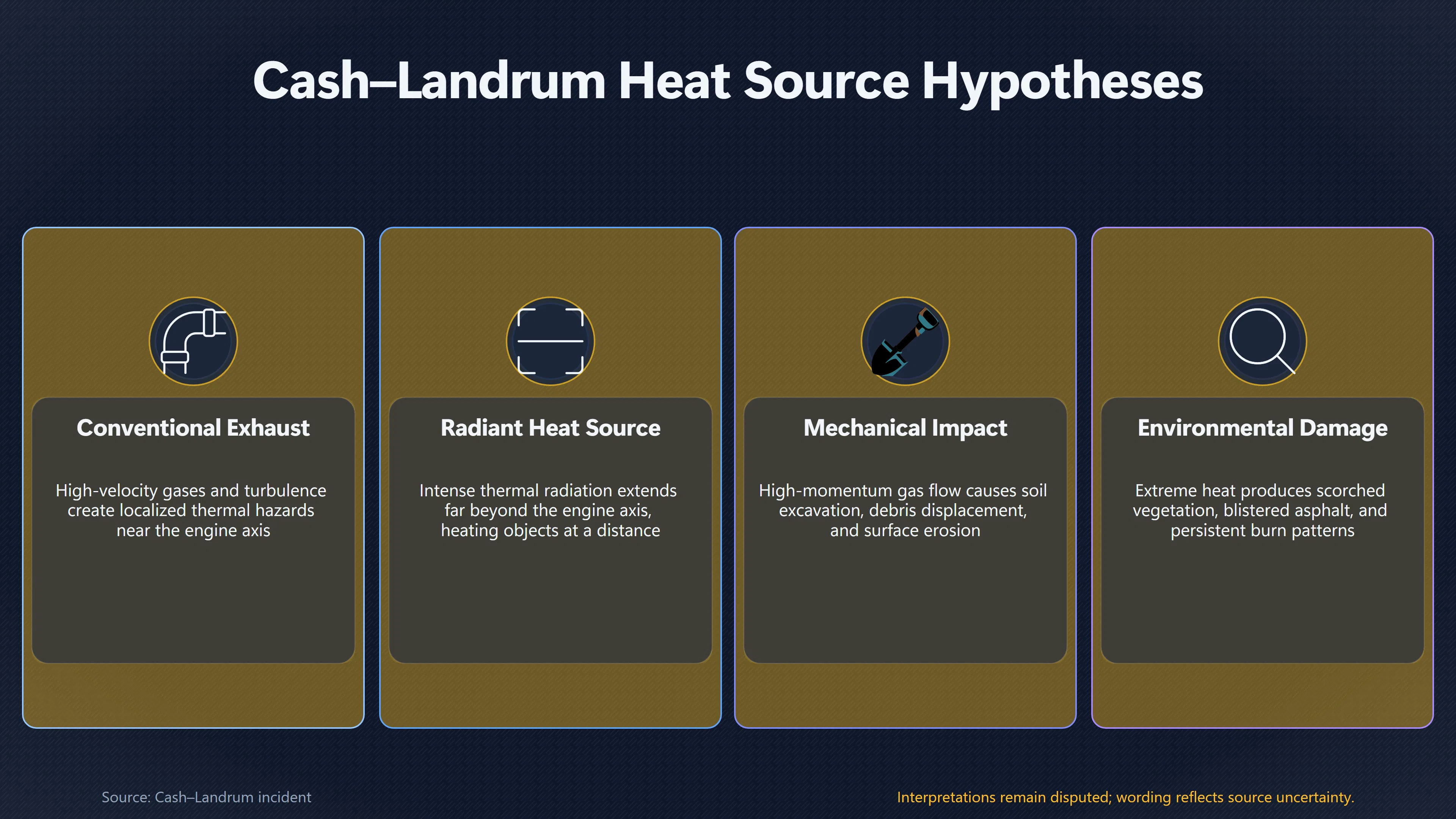
Aircraft engines primarily transfer energy through:
- high-velocity exhaust gases;[tarmacview.com]tarmacview.comSource details in endnotes.
- turbulence and convection;
- acoustic energy;
- infrared radiation from very hot engine components and exhaust.
A person standing some distance from a jet engine can certainly be endangered by blast and heat, but the dominant hazard is normally the powerful exhaust stream itself. The farther one moves away from the engine axis, the more rapidly both temperature and gas velocity decrease because the plume entrains surrounding air.
The Cash–Landrum description is different. The witnesses did not simply describe being struck by a violent blast of exhaust. Instead, they consistently described a powerful sensation of heat radiating outward from the object while it hovered above the road. That requires an exceptionally large thermal power output extending well beyond the immediate exhaust column.[Wikipedia]WikipediaCash–Landrum incidentCash–Landrum incident
If a propulsion system were generating enough thermal radiation to heat a nearby vehicle body and produce immediate skin discomfort over several minutes, it would imply an energy release far greater than that associated with ordinary helicopter or jet operations.
What a downward exhaust plume should leave behind
The aircraft-exhaust theory also has to explain what happens beneath a hovering propulsion system.
Any engine directing extremely energetic exhaust downward produces several predictable effects:
- violent air movement;
- debris and dust displacement;
- vegetation scorching or stripping;
- localised heating of the ground;
- possible pavement damage if temperatures are sufficiently high.
Rocket engineering provides an especially useful comparison. Even short-duration rocket plumes excavate soil, throw debris outward and erode the surface beneath them because the combination of heat and extremely fast gas flow transfers enormous momentum into the ground. Modern research into lunar landings devotes considerable effort to modelling exactly these erosion effects because they present a serious engineering hazard.[arXiv]arxiv.orgCratering of Soil by Impinging Jets of Gas, with Application to Landing Rockets on Planetary SurfacesApril 12, 2021…
Although no one suggests the Cash–Landrum object was necessarily a rocket, the same physical principle applies: if downward-directed exhaust is energetic enough to produce extraordinary heating, it should also produce conspicuous mechanical effects on the surface below.
The witness descriptions instead focus almost entirely on heat and flame. There are no well-documented reports of a blast zone with stripped trees, excavated soil, blown debris or melted road surfaces that would normally accompany a propulsion plume powerful enough to account for the claimed heating.

Why the missing burn zone matters
This absence is one of the strongest technical objections to an exhaust-based explanation.
If the object remained at relatively low altitude while emitting repeated downward bursts of flame, investigators would reasonably expect evidence such as:
- scorched roadside vegetation;
- damaged tree branches directly beneath the object;
- blistered or softened asphalt;
- persistent burn patterns;
- obvious thermal damage extending beyond the witnesses’ vehicle.
Instead, subsequent discussion centred largely on the witnesses’ medical complaints and the condition of the car rather than documented environmental destruction at the location itself. Investigators also reported finding no residual radioactive contamination despite later speculation that radiation had been involved.[Wikipedia]WikipediaCash–Landrum incidentCash–Landrum incident
The lack of a clearly documented burn zone does not prove that the witnesses were mistaken about feeling intense heat. It does, however, create a mismatch between the reported thermal effects on people and vehicle versus the comparatively limited environmental evidence expected from an exhaust plume capable of producing those conditions.
Could an experimental propulsion system behave differently?
Supporters of the secret-aircraft hypothesis sometimes argue that an unknown propulsion technology might avoid these problems.
That argument has an important limitation. Once the explanation relies on an entirely unknown propulsion mechanism, the discussion moves beyond conventional aircraft exhaust into speculation about technology for which there is no publicly documented engineering evidence.
By contrast, if the proposed craft used recognisable jet, turbofan, turbojet, ramjet or rocket propulsion, established fluid dynamics predict significant exhaust interaction with the surrounding environment. Extremely hot gases cannot simply disappear after heating nearby observers while leaving little trace beneath the vehicle.
This is why many analysts conclude that the exhaust explanation requires either:
- witness estimates of distance, duration or heat intensity to have been substantially inaccurate; or
- a propulsion mechanism unlike any publicly known aircraft engine.
Neither option is impossible, but both require additional assumptions beyond the basic claim that the witnesses encountered a malfunctioning secret aircraft.

Technical assessment
Viewed purely as a heat-transfer problem, conventional aircraft exhaust explains only part of the Cash–Landrum account.
It readily explains the presence of flame, high temperatures and the possibility of an aircraft experiencing propulsion trouble. It does not naturally explain intense radiant heating over a broad area without equally conspicuous blast effects or environmental damage. Nor does it explain why an exhaust plume apparently capable of making a car painfully hot left no well-documented scorch zone, damaged vegetation or pavement consistent with such an enormous thermal output.
For that reason, the reported heat remains one of the more difficult aspects of the secret-aircraft hypothesis. The theory is physically more plausible than many exotic alternatives because real aircraft engines do generate immense heat, but the specific pattern of reported effects does not closely resemble what conventional high-energy exhaust would normally leave behind.
Amazon book picks
Further Reading
Books and field guides related to Could Aircraft Exhaust Produce That Much Heat?. Use these as the next step if you want deeper reading beyond the article.
Fundamentals of Heat and Mass Transfer
Fundamentals of Heat and Mass Transfer 8th Edition has been the gold standard of heat transfer pedagogy for many decades, with a commitme...
Introduction to Heat Transfer
Completely updated, the sixth edition provides engineers with an in-depth look at the key concepts in the field. It incorporates new disc...
Aircraft Propulsion
Updated edition of the successful textbook exploring cutting-edge developments in the field and Net-Zero aviation goals of 2050 Maintaini...
Jet Propulsion: A Simple Guide to the Aerodynamic and Thermod...
This book is an introduction to the design of modern civil and military jet engines using engine design projects.
eBay marketplace picks
Marketplace Samples
Live-tested eBay searches with available results related to this page.
Selected fromVTOL aircraft model oneBay.co.uk.

Current eBay listing
Harrier VTOL Fighter MOC Aircraft 37cm Brick Model Unassembled Kit


Current eBay listing
Planet Models 266 1:72 Short SC-1 'First British VTOL Aircraft'
Endnotes
1.
Source: Wikipedia
Title: Cash–Landrum incident
Link:https://en.wikipedia.org/wiki/Cash%E2%80%93Landrum_incident
2.
Source: arxiv.org
Link:https://arxiv.org/abs/2104.05195
Source snippet
Cratering of Soil by Impinging Jets of Gas, with Application to Landing Rockets on Planetary SurfacesApril 12, 2021...
Published: April 12, 2021
3.
Source: arxiv.org
Link:https://arxiv.org/abs/2104.10038
4.
Source: youtube.com
Title: The Cash
Link:https://www.youtube.com/watch?v=t6sV0LIy7GI
Source snippet
LANDRUM INCIDENT | MOST CREDIBLE UFO CASE IN HISTORY...
Additional References
5.
Source: thisunexplaineduniverse.com
Link:https://www.thisunexplaineduniverse.com/articles/cash-landrum-incident
Source snippet
The Cash-Landrum Incident: The UFO That Left [Medical Records]({{ 'medical-record/' | relative_url }}) | This Unexplained UniverseJuly 28, 2026 — UFOs & UAPs THE CASH-LANDRUM INCI...
Published: July 28, 2026
6.
Source: unsolvedreport.com
Title: cash landrum incident 1980
Link:https://www.unsolvedreport.com/en/cash-landrum-incident-1980/
Source snippet
Cash-Landrum Incident 1980: The UFO That Left Real Burns | Unsolved ReportJune 1, 2026 — CASH-LANDRUM INCIDENT 1980: THE UFO THAT LEFT RE...
Published: June 1, 2026
7.
Source: youtube.com
Title: Did Aliens Cause This Family Health Problems? | Cash-Landrum Incident
Link:https://www.youtube.com/watch?v=cFz7hXTJDkU
Source snippet
The UFO Cases Governments Couldn't Explain | Close Encounters 103...
8.
Source: youtube.com
Title: THE CASH LANDRUM INCIDENT | MOST CREDIBLE UFO CASE IN HISTORY
Link:https://www.youtube.com/watch?v=UzoOTCOUMKA
Source snippet
Did Aliens Cause This Family Health Problems? | Cash-Landrum Incident...
9.
Source: epa.gov
Link:https://www.epa.gov/regulations-emissions-vehicles-and-engines/Contrails
Source snippet
CO is carbon monoxide. HC is hydrocarbon. NO_{x} is nitrogen oxides. SO_{x} is sulfur oxides. This page provides...
10.
Source: researchgate.net
Link:https://www.researchgate.net/publication/263703804_IDENTIFICATION_AND_MODELLING_PROCESS_OF_DEFINING_TEMPERATURE_GRADIENT_IN_AIRPORT_PAVEMENT
11.
Source: tarmacview.com
Link:https://www.tarmacview.com/glossary/blast-erosion/
12.
Source: projectblackecho.com
Link:https://www.projectblackecho.com/incidents/close-encounters/cash-landrum-close-encounter
13.
Source: tarmacview.com
Link:https://www.tarmacview.com/glossary/jet-blast/
14.
Source: thegalacticmind.com
Link:https://www.thegalacticmind.com/the-cash-landrum-encounter-1980-dayton-huffman-texas/