Within Misidentification
Could a Head On Aircraft Look Like It Hovered?
A distant aircraft approaching almost directly can appear stationary while its landing light grows brighter and seems much closer.
On this page
- Why head on motion is hard to detect at night
- How landing lights distort distance and speed
- Testing the flight path fit with the witness route
Page outline Jump by section
Introduction
One of the simplest conventional explanations considered in discussions of the Cash–Landrum incident is that the witnesses initially saw an aircraft approaching almost directly towards them. Under night-time conditions, a head-on aircraft can appear to remain almost motionless while its landing lights steadily brighten, creating the impression of a hovering object that is much closer than it really is. This is a well-recognised consequence of perspective rather than an unusual property of the aircraft itself.
The mechanism is relevant because the Cash–Landrum witnesses themselves reportedly first assumed the distant light was an aeroplane heading towards the Houston area before later concluding that it was a nearby, extraordinary object. That sequence does not prove the source was an aircraft, but it demonstrates that an ordinary aviation explanation was consistent with their earliest interpretation before their perception of distance and motion changed.[Wikipedia]WikipediaCash–Landrum incidentCash–Landrum incident
Could a Head-On Aircraft Look Like It Hovered?
Why head-on motion is hard to detect at night
Human vision estimates movement primarily from sideways, or angular, motion across the background. When an aircraft flies almost directly towards an observer, very little sideways movement is visible. Instead, the aircraft occupies nearly the same point in the sky while gradually growing larger.
During daylight, surrounding terrain, cloud layers and the aircraft’s shape provide additional clues that reveal forward motion. At night, those cues are greatly reduced. If only one or two bright lights are visible against a dark background, the brain has little information from which to judge speed or distance. The result is a familiar perceptual effect: an aircraft travelling hundreds of kilometres per hour may appear to hover or creep forward very slowly.
This is not unique to aircraft. Drivers sometimes experience the same illusion when an oncoming vehicle appears stationary until it suddenly seems to arrive much faster than expected because its angular motion increases only near the point of passing.
The Federal Aviation Administration (FAA) warns pilots that darkness, limited visual references and isolated lights can produce significant errors in judging distance and relative position. The same visual limitations affect observers on the ground.[Federal Aviation Administration]faa.gov12 afh ch11Federal Aviation AdministrationAirplane Flying Handbook (FAA-H-8083-3C)…
How landing lights distort distance and speed
Landing lights are designed to be exceptionally bright so that aircraft are visible over long distances during take-off and landing. At night, these lights can dominate everything else about the aircraft.
Several effects combine:
- The aircraft’s outline disappears. The observer may see only an intense white light instead of the fuselage or wings.
- Brightness increases continuously. As the aircraft approaches, the light becomes dramatically brighter, encouraging the impression that the object is moving closer even though its position changes little.
- Distance is underestimated. Without nearby visual references, observers often interpret increasing brightness as indicating a nearby object rather than a distant one.
- Size becomes ambiguous. A powerful light source makes it difficult to estimate the dimensions of the aircraft behind it.
The FAA also notes that bright lighting systems against otherwise dark surroundings can distort perception of distance. Although these publications are written for pilots, they describe fundamental characteristics of human night vision rather than effects limited to people in the cockpit.[Federal Aviation Administration]faa.gov12 afh ch11Federal Aviation AdministrationAirplane Flying Handbook (FAA-H-8083-3C)…
An additional complication is that multiple lights on an aircraft may merge into a single luminous source at long range. Until the aircraft turns enough to reveal its navigation lights or silhouette, observers may perceive only one brilliant object rather than a recognisable aeroplane.[Federal Aviation Administration]faa.gov12 afh ch11Federal Aviation AdministrationAirplane Flying Handbook (FAA-H-8083-3C)…
Testing the Flight-Path Fit with the Witness Route
The aircraft hypothesis gains some support from the earliest stage of the witnesses’ account. According to published summaries and interview material, Betty Cash and Vickie Landrum initially believed the distant light was an ordinary aircraft approaching the Houston area. Only after continuing along the winding road did they conclude that the light had become unusually close and stationary.[Wikipedia]WikipediaCash–Landrum incidentCash–Landrum incident
That sequence is compatible with a changing viewing geometry.
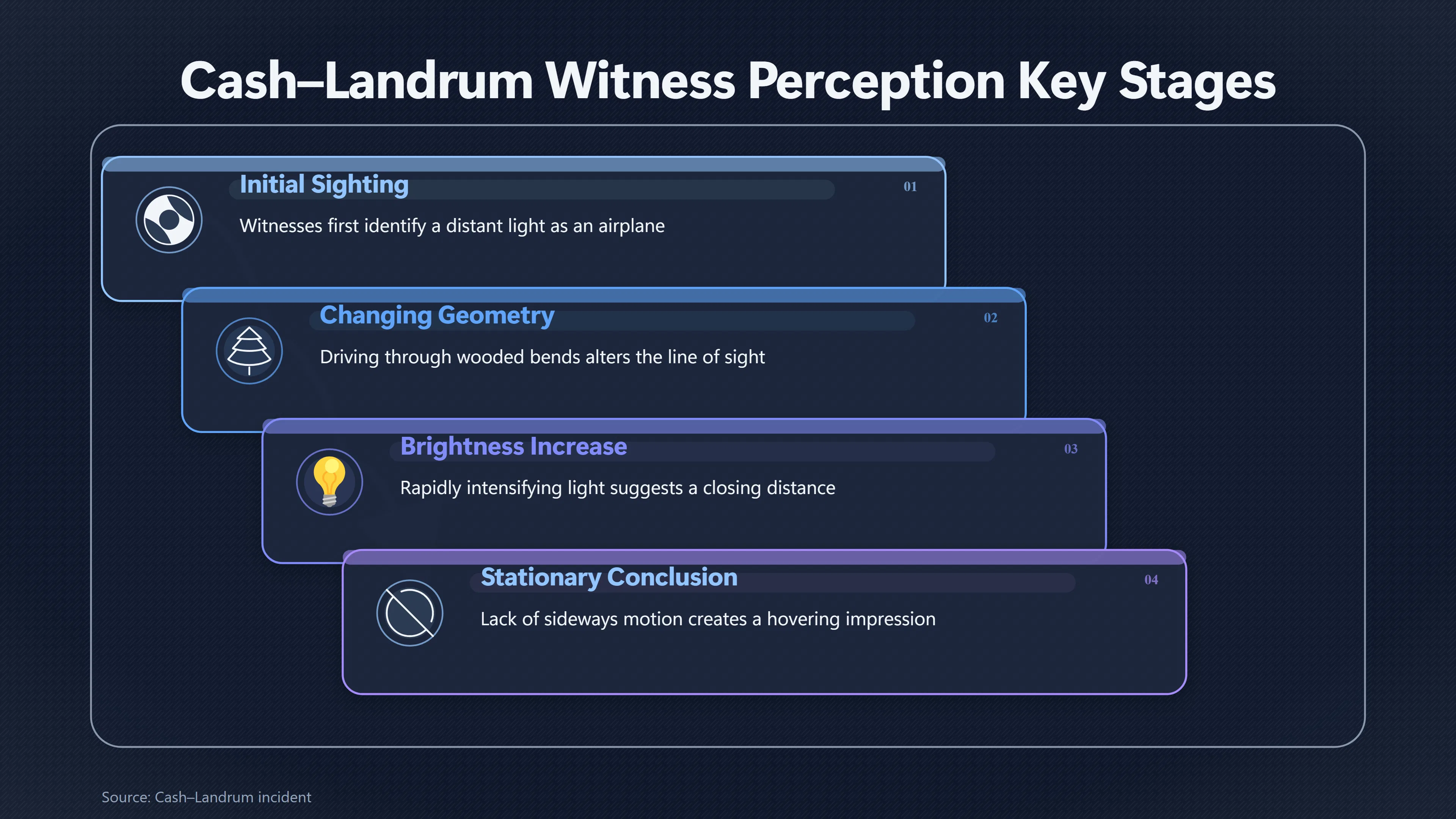
As the car travelled through wooded bends:
- trees repeatedly blocked and revealed the light;
- each new opening changed the apparent line of sight;
- the aircraft’s increasing brightness suggested rapid closing distance;
- the lack of sideways motion encouraged the impression that the object was hovering.
Small changes in the aircraft’s own course could further reinforce the illusion. A conventional turn by an approaching aircraft can suddenly introduce sideways movement after several minutes of apparent stillness, making the object seem to lurch or change position rather than simply continue along a normal flight path.
This mechanism requires no unusual atmospheric conditions. It follows directly from perspective and the geometry of an object approaching close to the observer’s line of sight.
Where the Explanation Stops Working
Although the hovering-light mechanism is well established in aviation and human perception, it explains only a limited part of the Cash–Landrum narrative.
It provides a plausible account of why the witnesses may initially have mistaken the light for an approaching aircraft and why that light could appear nearly stationary despite forward motion. It also offers a conventional explanation for the apparent transition from “distant aircraft” to “bright hovering light” as viewing conditions changed.
However, the mechanism does not by itself account for the later parts of the witnesses’ description, including a low-altitude diamond-shaped object, prolonged stationary behaviour, intense heat, flame-like emissions beneath the object or the reported presence of numerous helicopters. Those aspects require additional explanations if the entire encounter is to be interpreted as a conventional aviation event.
For that reason, the head-on aircraft hypothesis is best understood as a possible explanation for the earliest visual stage of the encounter rather than a complete explanation for every reported feature.[Wikipedia]WikipediaCash–Landrum incidentCash–Landrum incident

Amazon book picks
Further Reading
Books and field guides related to Could a Head On Aircraft Look Like It Hovered?. Use these as the next step if you want deeper reading beyond the article.
Human Factors in Aviation
Fully updated and expanded, the second edition of Human Factors in Aviation serves the needs of the widespread aviation community - stude...
Stick and Rudder: An Explanation of the Art of Flying
In the early 1940's, Wolfgang Langewiesche wrote a series of articles in Air Facts analyzing the various aspects of piloting techniques....
Aviation Psychology and Human Factors
This book covers the application of psychological principles and techniques to situations and problems of aviation. It offers an overview...
The Invisible Gorilla: How Our Intuitions Deceive Us
NEW YORK TIMES BESTSELLER • Our minds don’t work the way we think they do. Two renowned psychologists explain how and why our intuitions...
eBay marketplace picks
Marketplace Samples
Live-tested eBay searches with available results related to this page.
Selected fromaviation wall art oneBay.co.uk.


Endnotes
1.
Source: Wikipedia
Title: Cash–Landrum incident
Link:https://en.wikipedia.org/wiki/Cash%E2%80%93Landrum_incident
2.
Source: faa.gov
Title: 12 afh ch11
Link:https://www.faa.gov/sites/faa.gov/files/regulations_policies/handbooks_manuals/aviation/airplane_handbook/12_afh_ch11.pdf
Source snippet
Federal Aviation AdministrationAirplane Flying Handbook (FAA-H-8083-3C)...
3.
Source: faa.gov
Title: Federal Aviation Administration Chapter 8. Medical Facts for Pilots
Link:https://www.faa.gov/Air_traffic/publications/atpubs/aim_html/chap8_section_1.html
4.
Source: faa.gov
Title: Chapter 8. Medical Facts for Pilots
Link:https://www.faa.gov/air_traffic/publications/atpubs/aim/aim0801.html
5.
Source: faa.gov
Link:https://www.faa.gov/Air_traffic/publications/atpubs/aim_html/chap2_section_1.html
6.
Source: faa.gov
Link:https://www.faa.gov/air_traffic/publications/atpubs/aip_html/chap8_section_1.html
7.
Source: faa.gov
Link:https://www.faa.gov/data_research/research/med_humanfacs/oamtechreports/1980s/1982/198206
8.
Source: faa.gov
Link:https://www.faa.gov/air_traffic/publications/atpubs/aip_html/chap7_section_6.html
9.
Source: faa.gov
Link:https://www.faa.gov/air_traffic/publications/atpubs/aip_html/chap2_section_1.html
10.
Source: wikidisc.org
Title: Cash–Landrum incident | Wiki Disc
Link:https://www.wikidisc.org/wiki/Cash%E2%80%93Landrum_incident
Source snippet
Cash–Landrum incident | WikiDiscJuly 1, 2026 — INCIDENT DETAILS[EDIT | EDIT SOURCE] INITIAL SIGHTING[EDIT | EDIT SOURCE] At approximately...
Published: July 1, 2026
Additional References
11.
Source: thisunexplaineduniverse.com
Link:https://www.thisunexplaineduniverse.com/articles/cash-landrum-incident
Source snippet
At a distance they took it for an airplane on approach, maybe a jet coming down toward one of the airfields around Housto...
12.
Source: ufouap.net
Title: Aircraft Lights Mistaken for UFOs: Night Guide | Global UFO Archive
Link:https://www.ufouap.net/en/explainers/aircraft-lights-mistaken-for-ufos
Source snippet
July 16, 2026 — Skywatching / Updated 2026-07-16 / 7 min read AIRCRAFT LIGHTS MISTAKEN FOR UFOS: A NIGHT IDENTIFICATION GUIDE An aircraft...
Published: July 16, 2026
13.
Source: grunge.com
Title: The Terrifying True Story Of The [Cash-Landrum UFO Incident]({{ ‘cash-landrum-ufo-incident/’ | relative_url }})
Link:https://www.grunge.com/299546/the-terrifying-true-story-of-the-cash-landrum-ufo-incident/
Source snippet
It just felt like I was burning from the inside out. I was horrified.... The only thing I was thinking was, 'Are we going to get out of...
14.
Source: debatepolitics.com
Title: the cash landrum incident in 1980.521372
Link:https://debatepolitics.com/threads/the-cash-landrum-incident-in-1980.521372/
Source snippet
"......On the evening of December 29, 1980.............while driving on an isolated two-lane road in dense woods, they saw a light abov...
Published: December 29, 1980
15.
Source: youtube.com
Title: 3 Ways your BRAIN Tricks You into Thinking AIRPLANES HOVER!
Link:https://www.youtube.com/watch?v=3osSwf7dgUI
Source snippet
What Pilots See at Night That Passengers Never Notice...
16.
Source: podscripts.co
Title: So Supernatural
Link:https://podscripts.co/podcasts/so-supernatural/alien-the-cash-landrum-incident
Source snippet
Around 8.30 p.m., they pay their bill and hit the road for home, ready to call it a night. Betty's behind the wheel of...
17.
Source: youtube.com
Title: What Pilots See at Night That Passengers Never Notice
Link:https://www.youtube.com/watch?v=H3jtXItenTQ
Source snippet
Night Illusions (Private Pilot Lesson 15d)...
18.
Source: youtube.com
Title: Day 7: Runway Optical Illusions
Link:https://www.youtube.com/watch?v=ELvFqyw_AmI
Source snippet
3 Ways your BRAIN Tricks You into Thinking AIRPLANES HOVER...
19.
Source: youtube.com
Title: Night Illusions (Private Pilot Lesson 15d)
Link:https://www.youtube.com/watch?v=y_HvgmQ3NJs
Source snippet
PPGS Lesson 14.2 | Aeromedical: Illusions...
20.
Source: faasafety.gov
Title: Learning Center Library Contents
Link:https://www.faasafety.gov/gslac/ALC/libview_printerfriendly.aspx?id=6580