Within Cash Landrum
Why the Car Could Have Been Crucial Evidence
The witnesses' vehicle could have tested claims of heat and radiation, but it was never secured as a reliable long-term evidence object.
On this page
- Reported damage to doors and dashboard
- Testing that was not preserved or disclosed
- Lessons from the broken chain of custody
Page outline Jump by section
Introduction
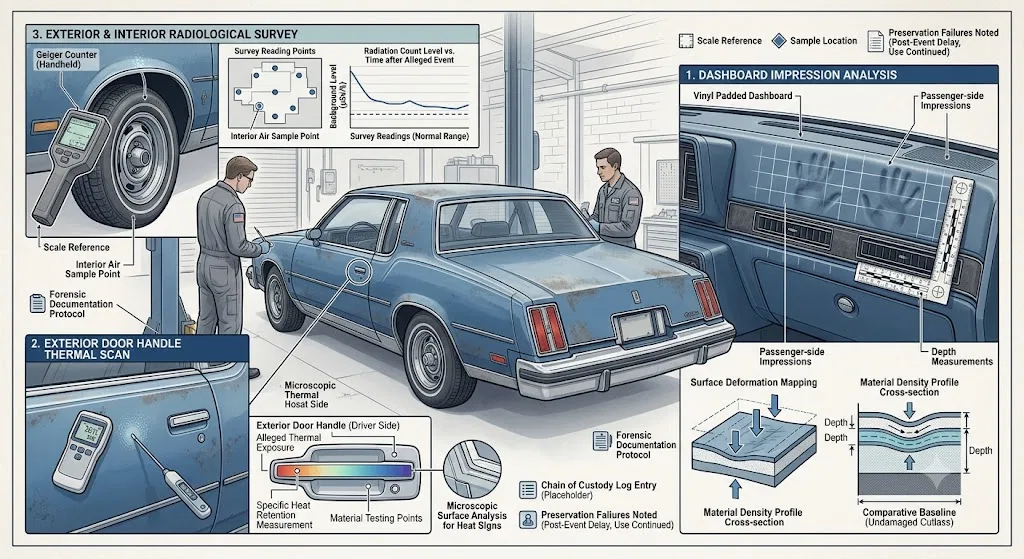
The car used by Betty Cash, Vickie Landrum and Colby Landrum could have been the most important physical evidence in the Cash–Landrum UFO incident. The witnesses claimed that intense heat made the exterior door handle painful to touch, softened the padded dashboard beneath Landrum’s hands and affected the vehicle’s electrical or mechanical systems. Unlike memories or medical symptoms, those alleged changes could potentially have been photographed, measured, sampled and compared with an undamaged 1980 Oldsmobile Cutlass.
That opportunity was largely lost. The vehicle was not immediately secured, professionally documented or stored under controlled conditions. Its first recorded inspection came nearly eight weeks after the encounter and consisted mainly of visual examination, a handheld radiation survey and a crude magnetic-field check. Components were reportedly removed or saved for testing, but no complete laboratory reports, custody records or retained samples are publicly available. Cash continued driving the car for years, and its later whereabouts became uncertain. The result is not proof that the reported damage was imaginary; it is a preservation failure that prevents the strongest versions of the claim from being tested reliably.
What the witnesses said the heat did
During an interview at Bergstrom Air Force Base on 17 August 1981, Cash identified the vehicle as a two-door 1980 Oldsmobile Cutlass. She said that after standing outside near the reported object, she found the door handle too hot to grasp and used part of her leather jacket to open it. She also claimed that the dashboard had softened where Landrum placed her hands, leaving impressions that remained visible months later.[Cufon]cufon.orgBergstrom AFB Interview of Betty Cash, Vickie & Colby Landrum, Part 1 of 2Bergstrom AFB Interview of Betty Cash, Vickie & Colby Landrum, Part 1 of 2…
These were unusually specific physical claims. A hot metal handle would show that heat had reached the car’s exterior, while permanent deformation of the dashboard would suggest heating or mechanical pressure sufficient to alter its padded surface. The vehicle could therefore have helped answer several basic questions:
- Were the dashboard marks genuine deformations rather than ordinary dents, wear or manufacturing irregularities?
- Had the vinyl, foam or adhesive undergone heat-related chemical change?
- Did exterior paint, plastic trim, glazing, wiring or weather seals show a consistent direction and intensity of heating?
- Were there residues, unusual particles or radioactive contaminants on or inside the car?
- Could the marks be reproduced by normal pressure on an undamaged dashboard of the same model?
Those questions were never resolved through a documented, independent programme of testing.
The surviving photographs apparently show finger-like impressions on the passenger side of the dashboard, but photographs alone cannot establish when or how they were made. Later descriptions also became more dramatic than the visible marks. Cash spoke of fingerprints “imbedded” in a melted dashboard, while investigator John Schuessler described the padded area moulding around Landrum’s fingers. A critical review of the available images characterises the actual impressions as less striking than those descriptions might suggest.[Blue Blurry Lines]blueblurrylines.comBlue Blurry Lines Blue Blurry Lines: March 2014…
That distinction matters. An impression in padded automotive trim is not automatically evidence of exceptional heat. Its value depends on the material’s composition, age, prior condition, ambient temperature and the force applied. Without measurements or comparison experiments, the dashboard could support the witnesses’ account only as an observed anomaly, not as a calibrated record of thermal exposure.
The first examination came too late
Schuessler first interviewed Cash and examined the Cutlass on 22 February 1981, approximately 55 days after the reported encounter. His initial account described the car as clean and generally in good condition. He found no obvious damage to the exterior paint, plastic parts or tyres; the principal visible anomaly was a set of hand-shaped impressions in the padded dashboard. A Geiger counter survey reportedly found no readings above background level, and a handheld compass revealed no unusually strong magnetic field. The engine was said to run somewhat roughly.[Blue Blurry Lines]blueblurrylines.comBlue Blurry Lines Blue Blurry Lines: March 2014…
This inspection was useful as an early observation, but it was not a comprehensive forensic examination. There is no publicly available record of the Geiger counter’s model, calibration, sensitivity, counting interval, survey geometry or background measurements. Nor is there a complete map showing exactly where readings were taken. The compass test was still more limited: it could reveal only a strong residual magnetic effect, not subtle changes in individual components or transient electromagnetic interference during the incident.
A negative radiation reading also answered a narrower question than later retellings sometimes imply. It indicated that the instrument did not detect above-background radioactivity on the vehicle at the time of the survey. It did not establish that the car had never been exposed to radiation. Exposure and radioactive contamination are different: a person or object may be irradiated by an external source without becoming radioactive or retaining detectable material afterwards.[REMM]remm.hhs.govREMMDifferences between Contamination and/or ExposureRadiation Emergency Medical ManagementDifferences between Contamination and/or Exposure - Radiation Emergency Medical Management Guidance…
Conversely, the result provided no positive support for radioactive contamination. Any claim that the car remained measurably radioactive is contradicted by the reported survey. The defensible conclusion is therefore limited: no residual radiation above background was reported during the February examination, but the test cannot determine whether an earlier, non-contaminating exposure occurred.
The delay also created ordinary evidential problems. For almost two months the car remained in use and outside controlled storage. It could have been washed, repaired, exposed to weather, handled by numerous people or contaminated by road dirt, fuel, cleaning products and workshop materials. Even without deliberate alteration, such changes make it difficult to attribute a later observation uniquely to one night in December.
Testing that was never preserved or disclosed
Several vehicle-related items were reportedly collected or retained, yet none developed into a publicly reviewable body of laboratory evidence.
An April 1981 report attributed to investigator Allan Hendry stated that a lens cover appearing to have been affected by heat was removed for further testing. No subsequent analysis of that component has been identified in the published case literature. Without a report describing its condition, sampling procedure, laboratory, methods and result, the removal has little evidential value. It also means that a potentially useful part was separated from the vehicle without a surviving, documented chain connecting the original location to any later examination.[Blue Blurry Lines]blueblurrylines.comBlue Blurry Lines Blue Blurry Lines: March 2014…
Other stories concerned the steering wheel and windscreen. Cash reportedly said that plastic on the steering wheel later crumbled, leaving its metal frame, and that she retained the fragments for study. During a television recreation several years later, the windscreen was said to shatter when a powerful light was directed at the car; pieces were reportedly saved. No traceable laboratory findings for either material have been published.[Blue Blurry Lines]blueblurrylines.comBlue Blurry Lines Blue Blurry Lines: March 2014…
These anecdotes cannot simply be added together as cumulative physical proof. Each alleged change would require its own documentation and controls. Steering-wheel deterioration might result from heat, ageing, ultraviolet light, chemical exposure or manufacturing defects. Windscreen breakage might involve pre-existing chips, mounting stress, temperature gradients or impact. A credible analysis would need the fragments, photographs taken before removal, vehicle-service history, comparison materials and evidence that the samples had not been substituted or altered.
The dashboard itself presented the clearest missed opportunity. Investigators could have documented the impressions through scaled photography, surface moulding, depth measurements and material sampling. A laboratory could then have compared its thermal and mechanical properties with equivalent trim from another Cutlass. No such published study is known. Later claims that the handprints proved extraordinary heating therefore go beyond the available evidence.
Why ordinary use destroyed the evidential baseline
Cash did not place the Cutlass in storage. She continued driving it for years, reportedly into the period when the witnesses’ legal claim against the federal government was active. Continued use was understandable: the car was personal property and apparently necessary for transport. From an evidential perspective, however, every journey weakened its value.
Road vibration, sunlight, summer heat, humidity and routine cleaning could alter padded vinyl, adhesives, plastics and paint. Mechanical faults could arise through normal wear. Repairs or replacement parts could erase original conditions. Mileage and use also destroyed the possibility of establishing whether a rough-running engine or failed radio was a sudden consequence of the encounter rather than an ordinary fault in a working vehicle.
The car’s pre-incident condition was equally important. It was reportedly a recent model and still under warranty, but “nearly new” is not the same as forensically documented. No inspection record made immediately before 29 December 1980 is available to demonstrate that the dashboard was unmarked, the radio and clock operated consistently, or every plastic component was undamaged. In the absence of that baseline, investigators had to rely on Cash’s recollection of what had changed.
Accounts concerning the engine illustrate the problem. Schuessler’s earliest report said the witnesses stopped the car and that it did not fail by itself. Cash later told Air Force interviewers that she had placed the transmission in park without switching off the engine, after which the car and radio went dead. The first examiner noted only that the engine ran a little roughly in February. These statements do not provide a stable, instrument-supported record of an electromagnetic effect.[Blue Blurry Lines]blueblurrylines.comBlue Blurry Lines Blue Blurry Lines: March 2014…
The car eventually became a missing object
By the late 1990s, investigator Ken Storch reportedly traced the Cutlass to southern Mississippi but lacked funding to pursue an examination. The car was not recovered into an archive or identified through a publicly documented vehicle-history trail, and its present location is unknown.[Blue Blurry Lines]blueblurrylines.comBlue Blurry Lines Blue Blurry Lines: March 2014…
Even had it been retrieved then, its evidential potential would already have been severely reduced. Nearly two decades of driving, ownership changes, repairs and environmental exposure would have made subtle chemical or radiological findings almost impossible to connect confidently with the 1980 incident. A late examination might still have documented the dashboard impressions or identified original components, but it could not restore the missing baseline or reconstruct the intervening custody history.
The disappearance also prevents modern re-examination. Contemporary laboratories could analyse polymers, coatings and glass with techniques more discriminating than a visual inspection and handheld Geiger counter. Yet better instruments cannot compensate for an unknown object history. Without proof that a component is original and substantially unchanged, a precise laboratory result may describe only what happened to the car during the decades after the encounter.
Lessons from the broken chain of custody
Modern forensic guidance defines chain of custody as a chronological record of an item’s handling and storage from collection to final disposition. It also requires evidence to be documented, protected from contamination, securely stored and uniquely identified. These standards were not devised specifically for UFO investigations, and it would be unfair to demand that civilian witnesses in 1980 immediately operate like a professional evidence unit. They nevertheless show why the Cutlass can no longer bear the weight later placed upon it.[NIST]nist.govThe latest edition of the referenced document (including any amendments) applies for undated references. OSAC 2021‐N‐0015, Guiding Princi…
A defensible preservation process would have required several actions soon after the report:
- Secure the whole vehicle. The Cutlass should have been parked in a controlled, dry location and its use suspended until an initial examination was complete.
- Record its original condition. Investigators should have photographed every surface with scales, documented mileage and fuel level, tested all electrical systems and recorded any faults before repairs or cleaning.
- Use qualified specialists. Automotive-materials engineers, radiological surveyors and fire or heat-damage investigators could have examined the car independently of the UFO organisations promoting the case.
- Collect comparison materials. Dashboard vinyl and other components from the same model and production period could have been tested to determine whether similar impressions formed under normal pressure, sunlight or specified temperatures.
- Preserve samples and paperwork. Any removed lens, plastic, glass or upholstery should have been sealed, labelled and accompanied by records showing who collected, transported, tested and stored it.
- Publish negative as well as positive findings. Instrument settings, photographs, raw readings and laboratory reports should have been made available regardless of whether they supported an extraordinary explanation.
None of this would necessarily have identified the object. It could, however, have separated genuine thermal damage from ordinary wear, established whether any contamination was present and prevented later accounts from growing more precise than the underlying evidence.
What the car can—and cannot—support
The surviving record supports three modest conclusions. First, the witnesses consistently placed the car at the centre of their heat-exposure account. Second, an examiner photographed and described hand-shaped impressions in the passenger-side dashboard several weeks later. Third, the February survey found no obvious exterior heat damage and no radiation above background, while noting a slightly rough-running engine.[Blue Blurry Lines]blueblurrylines.comBlue Blurry Lines Blue Blurry Lines: March 2014…
The record does not establish that the dashboard was melted by the reported object, that the car suffered radiation damage, or that its mechanical problems were produced by an electromagnetic field. No preserved laboratory analysis connects any vehicle component to a specific temperature, radiation source or unusual material. Reports of removed or saved fragments lack the documentation required to evaluate them.
The lost Cutlass is therefore important less as proof of the encounter than as an example of how potentially decisive evidence can become unusable. Had the vehicle been secured in January 1981, it might have provided the case’s clearest objective test. Because it remained an ordinary working car, was only lightly examined and eventually disappeared from traceable custody, it now preserves an unresolved claim rather than a reproducible physical finding.
Amazon book picks
Further Reading
Books and field guides related to Why the Car Could Have Been Crucial Evidence. Use these as the next step if you want deeper reading beyond the article.
Techniques of Crime Scene Investigation
In print since the original English edition published in 1964, this premier text is fully updated to reflected the latest technology and...
Forensic Science: An Introduction to Scientific and Investiga...
Covering a range of fundamental topics essential to modern forensic investigation, the fourth edition of the landmark text Forensic Scien...
An Introduction to Crime Scene Investigation
Criminal Investigations & Forensic Science
Autopsy of a Crime Lab
This book exposes the dangerously imperfect forensic evidence that we rely on for criminal convictions. "That's not my fingerprint, your...
eBay marketplace picks
Marketplace Samples
Live-tested eBay searches with available results related to this page.
Selected fromOldsmobile Cutlass model oneBay.co.uk.
![Listing image for AMT 1969 Hurst Oldsmobile Cutlass 1/25 Scale Model Kit [New Toy]](/assets/images/marketplace-covers/5102c571a69779d23ce0.jpg)
Current eBay listing
AMT 1969 Hurst Oldsmobile Cutlass 1/25 Scale Model Kit [New Toy]
Current eBay listing
NewRay Oldsmobile Cutlass 4-4-2 1966 1:43 Scale Diecast Model Car
Endnotes
1.
Source: cufon.org
Title: Bergstrom AFB Interview of [Betty Cash]({{ ‘betty-cash/’ | relative_url }}), Vickie & [Colby Landrum]({{ ‘colby-landrum/’ | relative_url }}), Part 1 of 2
Link:https://www.cufon.org/cufon/cashlani.htm
Source snippet
Bergstrom AFB Interview of Betty Cash, Vickie & Colby Landrum, Part 1 of 2...
2.
Source: remm.hhs.gov
Title: REMMDifferences between Contamination and/or Exposure
Link:https://remm.hhs.gov/diff_contam_exp.htm
Source snippet
Radiation Emergency Medical ManagementDifferences between Contamination and/or Exposure - Radiation Emergency Medical Management Guidance...
3.
Source: nist.gov
Link:https://www.nist.gov/system/files/documents/2024/02/05/OSAC%202021-N-0018%20Standard%20for%20On-Scene%20Collection%20and%20Preservation%20of%20Physical%20Evidence%20Version%202.0_0.pdf
Source snippet
The latest edition of the referenced document (including any amendments) applies for undated references. OSAC 2021‐N‐0015, Guiding Princi...
4.
Source: nist.gov
Title: new report reveals evidence handlers common practices makes recommendations
Link:https://www.nist.gov/news-events/news/2025/12/new-report-reveals-evidence-handlers-common-practices-makes-recommendations
5.
Source: nist.gov
Title: evidence management steering committee report opportunities strengthen evidence
Link:https://www.nist.gov/publications/evidence-management-steering-committee-report-opportunities-strengthen-evidence
6.
Source: nist.gov
Link:https://www.nist.gov/document/osac-2021-n-0018-standard-scene-collection-and-preservation-physical-evidence-version-20
7.
Source: nist.gov
Title: OSAC 2021 N 0015 Guiding Principles for CSI FINAL OSAC PROPOSED FOR REGISTRY
Link:https://www.nist.gov/system/files/documents/2021/09/02/OSAC%202021-N-0015%20Guiding%20Principles%20for%20CSI_FINAL%20OSAC%20PROPOSED%20FOR%20REGISTRY.pdf
8.
Source: nist.gov
Link:https://www.nist.gov/system/files/documents/2021/04/07/2021-N-0018_Standard%20for%20On-Scene%20Collection%20and%20Preservation%20of%20Physical%20Evidence_DRAFT%20OSAC%20PROPOSEDv2.pdf
9.
Source: nist.gov
Link:https://www.nist.gov/system/files/documents/2021/04/01/2021-N-0018_Standard%20for%20On-Scene%20Collection%20and%20Preservation%20of%20Physical%20Evidence_DRAFT%20OSAC%20PROPOSED.pdf
10.
Source: nist.gov
Title: evidence management
Link:https://www.nist.gov/forensic-science/interdisciplinary-topics/evidence-management
11.
Source: nist.gov
Title: Trace Evidence Recovery Guidelines
Link:https://www.nist.gov/document/traceevidencerecoveryguidelinespdf
12.
Source: cufon.org
Title: Socorro, NM
Link:https://www.cufon.org/contributors/chrisl/socorro.htm
13.
Source: cufon.org
Title: cia 52 1
Link:https://cufon.org/cufon/cia-52-1.htm
14.
Source: cufon.org
Link:https://www.cufon.org/CRG/memo/18521.html
15.
Source: cufon.org
Title: cia 52 2
Link:https://www.cufon.org/cufon/cia-52-2.htm
16.
Source: cufon.org
Link:https://www.cufon.org/cufon/afu.htm
17.
Source: cufon.org
Title: The Ice Documents Press Conference
Link:https://www.cufon.org/cufon/presconf.htm
18.
Source: cufon.org
Title: Research paper: SHOULD THE USAF REOPEN PROJECT BLUE BOOK?
Link:https://cufon.org/cufon/afrstdy1.htm
19.
Source: cufon.org
Title: cufon o
Link:https://cufon.org/cufon/cufon-o.htm
20.
Source: cufon.org
Link:https://www.cufon.org/cufon/cashlani2.htm
21.
Source: cufon.org
Title: cufon o C
Link:https://www.cufon.org/cufon/cufon-o-C.htm
22.
Source: cufon.org
Link:https://www.cufon.org/cufon/tp_britufo.htm
23.
Source: blueblurrylines.com
Link:https://www.blueblurrylines.com/2014/03/
Source snippet
Blue Blurry Lines Blue Blurry Lines: March 2014...
Published: March 2014
24.
Source: wikidisc.org
Title: Betty Cash | Wiki Disc
Link:https://www.wikidisc.org/wiki/Betty_Cash
25.
Source: blueblurrylines.com
Title: Blue Blurry Lines: Betty Cash
Link:https://www.blueblurrylines.com/search/label/Betty%20Cash
26.
Source: blueblurrylines.com
Link:https://www.blueblurrylines.com/2018/02/
27.
Source: blueblurrylines.com
Title: Blue Blurry Lines: Car
Link:https://www.blueblurrylines.com/search/label/Car
28.
Source: blueblurrylines.com
Title: cash landrum john schuesslers first
Link:https://www.blueblurrylines.com/2013/12/cash-landrum-john-schuesslers-first.html
29.
Source: blueblurrylines.com
Title: Blue Blurry Lines
Link:https://www.blueblurrylines.com/search?by-date=false&max-results=9&start=93&updated-max=2013-11-17T13%3A21%3A00-08%3A00
30.
Source: assets.publishing.service.gov.uk
Link:https://assets.publishing.service.gov.uk/media/5fce4131d3bf7f5d0ec46059/RFI3171-_Annex_G-_Radiation_Walkover_Survey_Report.pdf
31.
Source: remm.hhs.gov
Link:https://remm.hhs.gov/exposurecontam.htm
Additional References
32.
Source: epa.gov
Title: multi agency radiation survey and site investigation manual marssim
Link:https://www.epa.gov/radiation/multi-agency-radiation-survey-and-site-investigation-manual-marssim
Source snippet
Multi-Agency Radiation Survey and Site Investigation Manual (MARSSIM) | US EPAJuly 30, 2026 — Multi-Agency Radiation Survey and Site Inve...
Published: July 30, 2026
33.
Source: youtube.com
Link:https://www.youtube.com/watch?v=euP0SnHKfg8
Source snippet
The Cash-Landrum incident: traumatized & physically ill after terrifying UFO encounter, Dec 29, 1980...
34.
Source: magnetforensics.com
Title: Vehicle forensics: a practical guide
Link:https://www.magnetforensics.com/blog/vehicle-forensics-a-practical-guide/
Source snippet
Method Typical use Advantages Risks or limits Diagnostic port acquisition EDR download, module queries, diagnostic data Often non-destruc...
35.
Source: youtube.com
Link:https://www.youtube.com/watch?v=KiCgBn-Kbho
Source snippet
Cash-Landrum car Oldsmobile Cutlass 1980-12-29: The Cash-Landrum UFO Incident...
36.
Source: Wikipedia
Title: Cash–Landrum incident
Link:https://en.wikipedia.org/wiki/Cash%E2%80%93Landrum_incident
Source snippet
Cash–Landrum incident - WikipediaAugust 1, 2026 — Cash–Landrum incident - Wikipedia Cash–Landrum incident Part of a series on the Para...
Published: August 1, 2026
37.
Source: cdc.gov
Link:https://www.cdc.gov/radiation-emergencies/media/pdfs/2024/04/GM_DetectorsJobAid.pdf
38.
Source: epa.gov
Link:https://www.epa.gov/system/files/documents/2026-07/marssim-revision-2-volume-1-july-2026.pdf
39.
Source: youtube.com
Link:https://www.youtube.com/watch?v=uJR6RepzUvk
Source snippet
Rare interview with researcher John F. Schuessler on the 1980 Cash-Landrum UFO incident...
40.
Source: youtube.com
Title: The Cash-Landrum UFO Mystery
Link:https://www.youtube.com/watch?v=P2HsOUTzyWA
Source snippet
The Cash-Landrum Incident: A UFO Burned 3 People in Texas. The Government Said It Never Happened...
41.
Source: nrc.gov
Title: Control of Radioactively Contaminated Material | Nuclear Regulatory Commission
Link:https://www.nrc.gov/about-nrc/radiation/protects-you/hppos/hppos071