Within Radiation Claim
Where Is the Dose That Proves Radiation Injury?
No measured or reconstructed dose has been published to show that the witnesses received enough radiation to cause acute radiation syndrome.
On this page
- Dose levels associated with acute illness
- What exposure details were never established
- Why symptoms alone cannot supply a dose
Page outline Jump by section
Introduction
One of the central weaknesses in the claim that the Cash–Landrum witnesses suffered acute radiation syndrome is not simply the absence of a confirmed radiation source. It is the absence of any published radiation dose. In radiation medicine, symptoms alone are not enough to diagnose an acute radiation injury. Clinicians normally establish, or at least estimate, how much ionising radiation reached the body, how quickly it was delivered, what parts of the body were exposed, and whether laboratory findings match the expected biological response. In the Cash–Landrum case, no publicly available medical or scientific record provides such a dose estimate, dose reconstruction, or validated biodosimetry. As a result, the radiation hypothesis remains an unverified explanation rather than a medically demonstrated conclusion.[CDC]cdc.govAcute Radiation Syndrome: Information for Clinicians | Radiation Emergencies | CDCApril 23, 2024…
What radiation sickness diagnosis normally requires
Acute radiation syndrome (ARS) is one of the most extensively studied forms of radiation injury because it has occurred in nuclear accidents, industrial incidents and a small number of medical and military exposures. Modern clinical guidance does not rely solely on symptoms such as nausea, vomiting or skin redness. Instead, physicians attempt to determine whether the necessary conditions for ARS were actually met.
Those conditions include:
- A sufficiently large absorbed dose, generally above about 0.7 gray (Gy) to produce classical whole-body ARS, although mild early effects may occur at somewhat lower doses.
- Exposure delivered over a short period, usually minutes rather than days.
- Penetrating radiation capable of reaching internal organs.
- Irradiation of the whole body or a substantial fraction of it rather than only a small skin area.
- Supporting laboratory evidence, especially changes in blood lymphocyte counts, together with dose reconstruction where possible.[CDC]cdc.govAcute Radiation Syndrome: Information for Clinicians | Radiation Emergencies | CDCApril 23, 2024…
These criteria exist because many illnesses can imitate parts of ARS. Heat illness, severe infection, chemical exposure, emotional stress and some dermatological conditions can all produce overlapping symptoms.
Dose levels associated with acute illness
Radiation medicine is fundamentally quantitative. Physicians do not simply ask whether someone was exposed; they ask how much radiation was absorbed.
Current clinical guidance provides approximate thresholds:
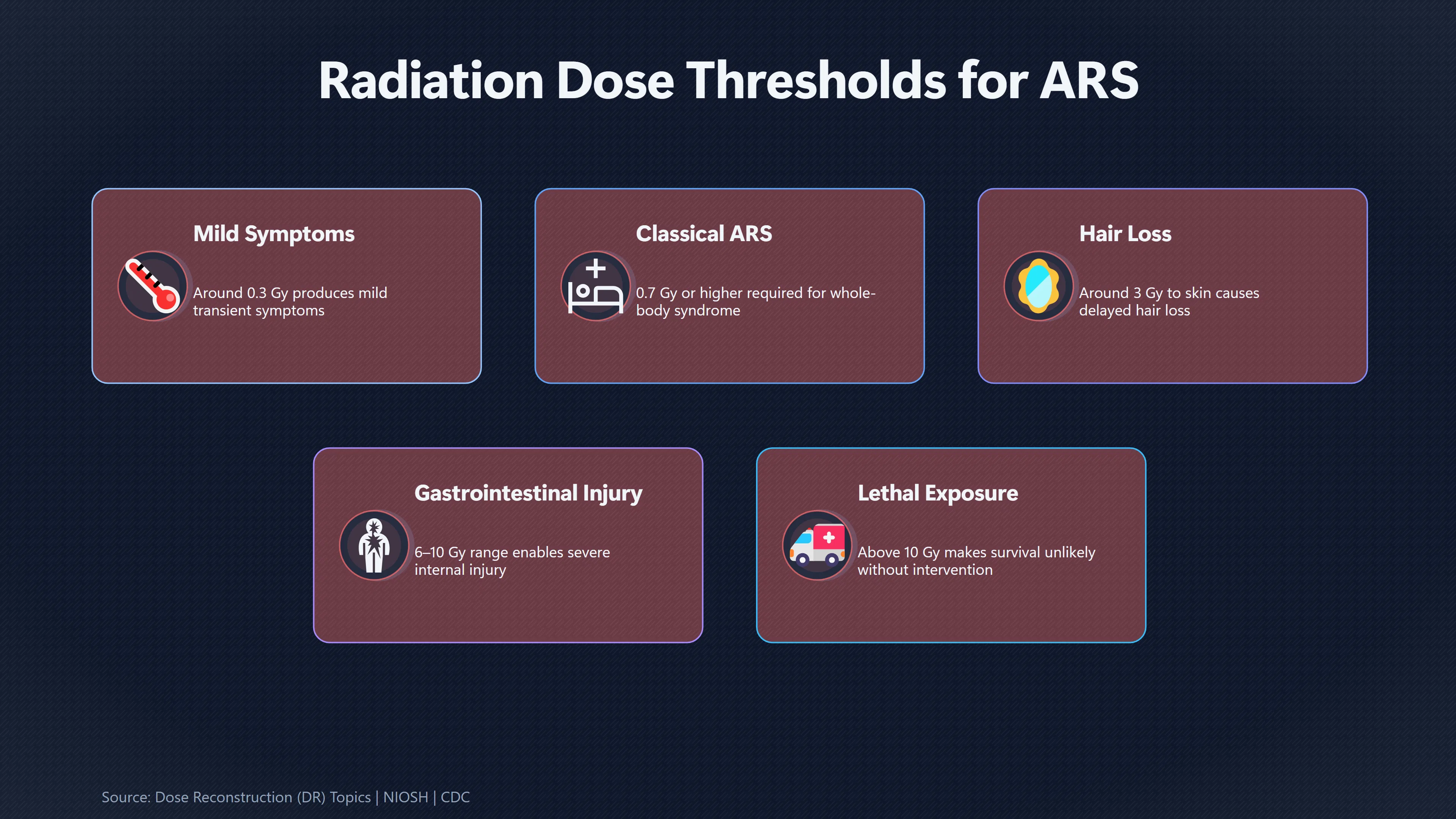
- Around 0.3 Gy may produce mild transient symptoms in some individuals.
- Around 0.7 Gy or higher is generally required before classical whole-body ARS becomes a realistic concern.
- Around 3 Gy to the skin may produce radiation-related hair loss after an expected delay.
- Around 6–10 Gy begins to enter the range where severe gastrointestinal injury becomes possible.
- Above 10 Gy whole-body exposure, survival becomes increasingly unlikely without extraordinary medical intervention.[CDC]cdc.govAcute Radiation Syndrome: Information for Clinicians | Radiation Emergencies | CDCApril 23, 2024…
These values are not rigid cut-offs because individual sensitivity varies. Nevertheless, they provide an essential benchmark against which any claimed radiation exposure is evaluated.
The difficulty in the Cash–Landrum case is that no published estimate places the witnesses anywhere on this scale.

What exposure details were never established
The missing dose is not a minor omission. It represents several missing pieces of evidence that would normally be expected after any suspected radiation accident.
No publicly available investigation has established:
- The radiation type involved (gamma rays, X-rays, neutrons, beta particles or another source).
- The intensity of the radiation field.
- The duration of exposure.
- The distance from the source throughout the encounter.
- Whether the reported exposure involved the whole body or only parts of it.
- Any environmental measurements demonstrating residual radiation.
- Personal dosimeter readings.
- A formal absorbed-dose reconstruction performed by radiation specialists.[CDC]cdc.govDose Reconstruction (DR) Topics | NIOSH | CDCDose Reconstruction (DR) Topics | NIOSH | CDC…
Each unknown makes quantitative assessment progressively more difficult. Together, they prevent any scientifically defensible calculation of absorbed dose.
Why symptoms alone cannot supply a dose
A common misconception is that physicians can infer radiation dose directly from symptoms. In reality, symptoms provide only rough clues and are considered unreliable without supporting evidence.
For example, nausea and vomiting are often discussed as early indicators of radiation exposure. However, they are among the least specific symptoms in medicine and can result from infection, anxiety, dehydration, pain, medications or numerous other conditions. Even when radiation is known to have occurred, the timing of vomiting provides only an approximate estimate and cannot replace dosimetry.[CDC]cdc.govAcute Radiation Syndrome: Information for Clinicians | Radiation Emergencies | CDCApril 23, 2024…
Similarly, skin redness, blistering and hair loss can occur through multiple mechanisms. Radiation burns have characteristic patterns and timelines, but dermatological disorders, infections, thermal injury and chemical irritation may produce similar appearances. Without knowledge of the absorbed dose, clinicians cannot reliably distinguish these possibilities from symptoms alone.
Modern radiation emergency protocols therefore combine clinical findings with laboratory testing and dose estimation rather than relying on symptom patterns in isolation.[CDC]cdc.govAcute Radiation Syndrome: Information for Clinicians | Radiation Emergencies | CDCApril 23, 2024…
The missing laboratory evidence
Another consequence of the missing dose is the absence of the laboratory evidence normally used to estimate one.
When significant whole-body radiation exposure is suspected today, physicians typically perform serial complete blood counts with particular attention to falling lymphocyte levels. Changes over the first hours and days can provide an early estimate of absorbed dose. If available, specialised biodosimetry—such as chromosome aberration analysis—can later provide a much stronger estimate of exposure.[CDC]cdc.govAcute Radiation Syndrome: Information for Clinicians | Radiation Emergencies | CDCApril 23, 2024…
No published record from the Cash–Landrum case presents this type of quantitative analysis. Public discussions instead rely primarily on reported symptoms and later recollections rather than the standard medical indicators used in documented radiation accidents.
This absence does not prove that radiation exposure did not occur. It means the evidence needed to measure or confirm the exposure has not been published.

Why the missing dose remains the central evidential gap
The lack of a reconstructed radiation dose has important implications for evaluating the illness claim.
If the witnesses truly experienced enough penetrating radiation to produce acute radiation syndrome, investigators would ideally expect at least some combination of measurable environmental contamination, identifiable radiation sources, biological dose estimates, characteristic laboratory findings or a defensible physical reconstruction of the exposure.
Instead, none of these elements has entered the public record in a form that allows independent scientific evaluation. The result is that the radiation hypothesis cannot be tested quantitatively against established medical thresholds.
For this reason, sceptics and many medical commentators regard the missing dose as one of the strongest reasons for caution. The reported symptoms may be genuine, but without a measured or reconstructed absorbed dose linking those symptoms to ionising radiation, the diagnosis of radiation injury remains an unverified interpretation rather than a demonstrated medical finding.[CDC]cdc.govAcute Radiation Syndrome: Information for Clinicians | Radiation Emergencies | CDCApril 23, 2024…
Amazon book picks
Further Reading
Books and field guides related to Where Is the Dose That Proves Radiation Injury?. Use these as the next step if you want deeper reading beyond the article.
Medical Effects of Ionizing Radiation
"The new edition of this monograph features renowned experts who offer the most current information and reliable guidance on all aspects...
Medical Management of Radiation Accidents
Although radiation accidents are rare and often complex in nature, they are of great concern not only to the patient and involved medical...
Radiation Protection and Dosimetry
This text is meant to serve as the basis for a two-course series in the study of radiation protection (a. k. a. “health physics”). The ?r...
eBay marketplace picks
Marketplace Samples
Live-tested eBay searches with available results related to this page.
Selected fromUFO art print oneBay.co.uk.




Endnotes
1.
Source: cdc.gov
Link:https://www.cdc.gov/radiation-emergencies/hcp/clinical-guidance/ars.html
Source snippet
Acute Radiation Syndrome: Information for Clinicians | Radiation Emergencies | CDCApril 23, 2024...
Published: April 23, 2024
2.
Source: cdc.gov
Title: Dose Reconstruction (DR) Topics | NIOSH | CDC
Link:https://www.cdc.gov/niosh/ocas/landing/dr.html
Source snippet
Dose Reconstruction (DR) Topics | NIOSH | CDC...
3.
Source: cdc.gov
Title: Acute Radiation Syndrome | Radiation Emergencies | CDC
Link:https://www.cdc.gov/radiation-emergencies/signs-symptoms/acute-radiation-syndrome.html
Source snippet
Acute Radiation Syndrome | Radiation Emergencies | CDC...
4.
Source: cdc.gov
Title: Radiation Thermometer | Radiation Emergencies | CDC
Link:https://www.cdc.gov/radiation-emergencies/causes/radiation-thermometer.html
Source snippet
Radiation Thermometer | Radiation Emergencies | CDC...
5.
Source: cdc.gov
Link:https://www.cdc.gov/niosh/ocas/ocasdose.html
Source snippet
About the Radiation Dose Reconstruction Program | NIOSH | CDCJune 30, 2025 — ABOUT THE RADIATION DOSE RECONSTRUCTION PROGRAM Print On Thi...
Published: June 30, 2025
6.
Source: cdc.gov
Title: What happens if additional site information b
Link:https://www.cdc.gov/niosh/ocas/faqsdr.html
Source snippet
FAQs: Dose Reconstruction | NIOSH | CDCJune 30, 2025 — Additional information on technical documents used in dose reconstruction can be f...
Published: June 30, 2025
7.
Source: cdc.gov
Link:https://www.cdc.gov/radiation-emergencies/signs-symptoms/index.html
Source snippet
Signs and Symptoms of Radiation Exposure | Radiation Emergencies | CDCJanuary 31, 2025 — January 31, 2025 SIGNS AND SYMPTOMS OF RADIATION...
Published: January 31, 2025
8.
Source: cdc.gov
Title: evaluation and management
Link:https://www.cdc.gov/radiation-emergencies/hcp/nuclear-detonations/evaluation-and-management.html
Source snippet
Emergency Department: Evaluation and Management of Affected Patients | Radiation Emergencies | CDCJanuary 31, 2025 — January 31, 2025 EME...
Published: January 31, 2025
9.
Source: cdc.gov
Title: determining deaths
Link:https://www.cdc.gov/radiation-emergencies/hcp/clinical-guidance/determining-deaths.html
Source snippet
Clinical Guidance for Determining Deaths from a Radiation Emergency | Radiation Emergencies | CDCApril 24, 2024 — April 24, 2024 CLINICAL...
Published: April 24, 2024
10.
Source: archive.cdc.gov
Link:https://archive.cdc.gov/www_cdc_gov/niosh/docs/2005-144/default.html
11.
Source: archive.cdc.gov
Link:https://archive.cdc.gov/www_cdc_gov/niosh/docs/2002-138/default.html
12.
Source: youtube.com
Title: [Cash-Landrum UFO Incident]({{ ‘cash-landrum-ufo-incident/’ | relative_url }})
Link:https://www.youtube.com/watch?v=7V757DZ5Xwk
Source snippet
The Cash - Landrum UFO Encounter...
13.
Source: youtube.com
Title: The Cash
Link:https://www.youtube.com/watch?v=t6sV0LIy7GI
Source snippet
Did Aliens Cause This Family Health Problems? | Cash-Landrum Incident...
Additional References
14.
Source: dceg.cancer.gov
Title: [medical radiation]({{ ‘dose-testing/’ | relative_url }}) workers dose estimation
Link:https://dceg.cancer.gov/research/how-we-study/exposure-assessment/medical-radiation-workers-dose-estimation
15.
Source: youtube.com
Title: Did Aliens Cause This Family Health Problems? | Cash-Landrum Incident
Link:https://www.youtube.com/watch?v=cFz7hXTJDkU
16.
Source: youtube.com
Title: UFO Hunters: Life-Altering Alien Encounter (S2, E8)
Link:https://www.youtube.com/watch?v=UPkW9XBX0fU
Source snippet
The Cash-Landrum UFO Mystery...
17.
Source: ors.od.nih.gov
Title: external monitoring.aspx
Link:https://ors.od.nih.gov/sr/drs/policies/Pages/external-monitoring.aspx
18.
Source: pubmed.ncbi.nlm.nih.gov
Link:https://pubmed.ncbi.nlm.nih.gov/10638843/
19.
Source: pubmed.ncbi.nlm.nih.gov
Link:https://pubmed.ncbi.nlm.nih.gov/1762096/
20.
Source: pubmed.ncbi.nlm.nih.gov
Link:https://pubmed.ncbi.nlm.nih.gov/30789797/
21.
Source: youtube.com
Title: The Cash-Landrum UFO Mystery
Link:https://www.youtube.com/watch?v=P2HsOUTzyWA
Source snippet
Cash-Landrum UFO Incident...
22.
Source: remm.hhs.gov
Link:https://remm.hhs.gov/ars_summary.htm
23.
Source: pmc.ncbi.nlm.nih.gov
Link:https://pmc.ncbi.nlm.nih.gov/articles/PMC3033011/