Within Heat or Radiation
What Skin Timeline Would Radiation Injury Produce?
Radiation skin injury often evolves through delayed redness, hair loss and peeling rather than behaving like a simple immediate burn.
On this page
- Early redness and quiet intervals
- Later swelling hair loss and peeling
- Comparing the expected course with reported injuries
Page outline Jump by section
Introduction
One of the most important distinctions between a thermal burn and an injury caused by ionising radiation is not simply how the skin looks at first, but how it changes over the following days and weeks. A conventional heat burn usually reaches its maximum severity within hours or a few days before beginning to heal. By contrast, cutaneous radiation injury often follows a delayed, cyclical pattern: early redness may fade, creating a deceptively quiet interval before a second wave of inflammation, hair loss, peeling or ulceration develops. This unusual timeline reflects radiation damage to the skin’s dividing cells rather than immediate destruction of the skin surface.[CDC]cdc.govCutaneous Radiation Injury (CRI): Information for Clinicians | Radiation Emergencies | CDCApril 17, 2024…
Within the context of the Cash–Landrum incident, this timing matters because later reports of skin burns and hair loss have frequently been cited as evidence of radiation exposure. The key question is therefore not whether those symptoms can occur after radiation—they can—but whether the reported sequence and medical documentation resemble the well-established progression of radiation skin injury more closely than they resemble severe thermal injury or another cause.
What skin timeline would radiation injury produce?
Radiation damages the basal cells that continually replace the outer layers of skin. Because existing skin cells continue functioning for days or weeks before they are naturally shed, visible injury often appears later than the exposure itself. This biological delay is one of the characteristic features of cutaneous radiation injury.[CDC]cdc.govCutaneous Radiation Injury (CRI): Information for Clinicians | Radiation Emergencies | CDCApril 17, 2024…
Early redness and quiet intervals
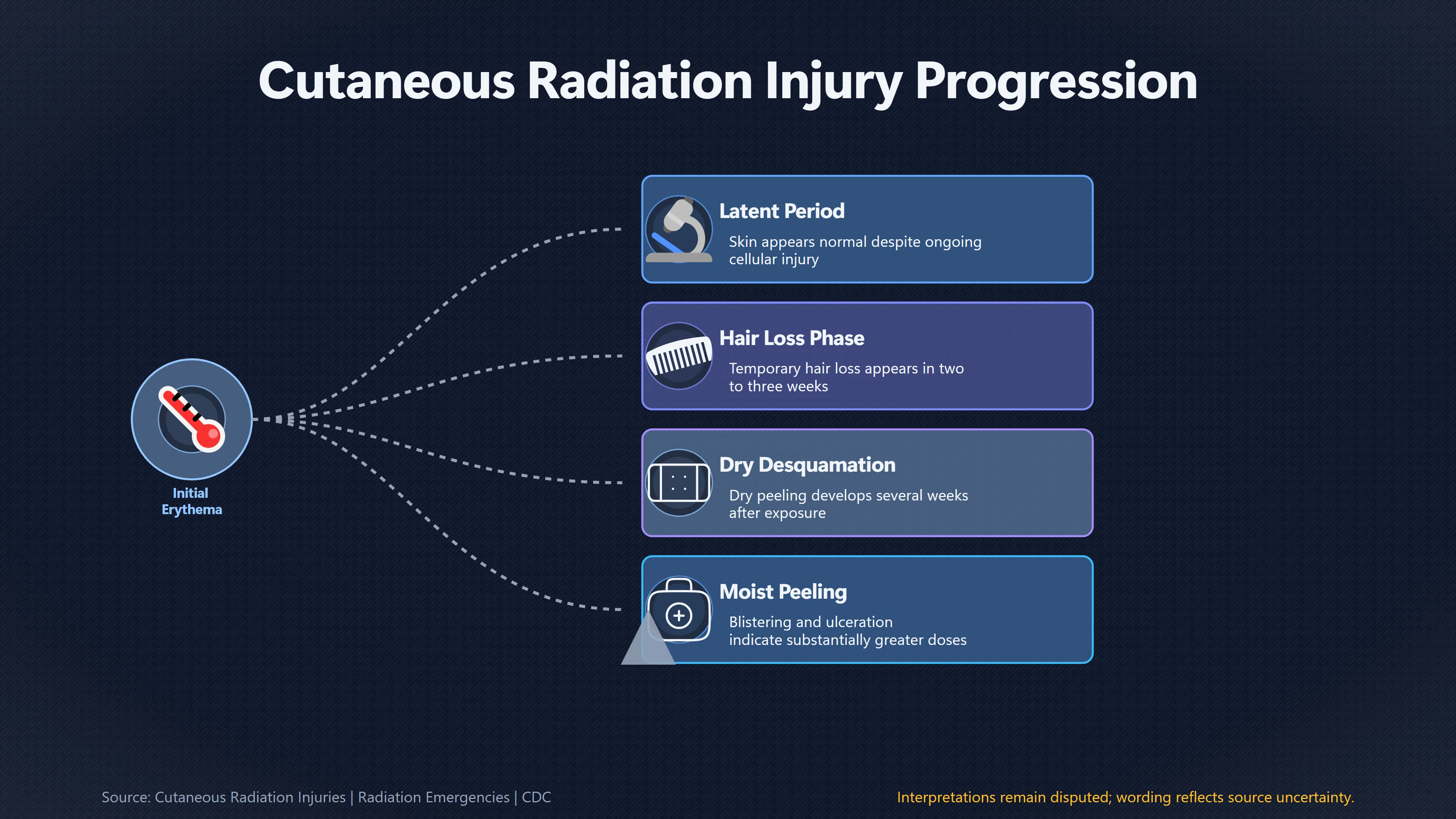
After a sufficiently large local radiation dose, some people develop a brief episode of redness, warmth or tingling within hours. This initial erythema can then partially disappear during a latent period when the skin appears relatively normal despite ongoing cellular injury beneath the surface. Depending on the absorbed dose and the body area involved, this quiet interval may last from a day to several weeks before more obvious damage emerges.[CDC]cdc.govCutaneous Radiation Injury (CRI): Information for Clinicians | Radiation Emergencies | CDCApril 17, 2024…
This latent phase differs from the behaviour of most thermal burns. Although heat burns may deepen over the first day or two, clinicians generally expect the visible injury to evolve continuously rather than apparently improve and then worsen after an extended symptom-free interval.
Later swelling, hair loss and peeling
As damaged stem cells fail to replace the normal turnover of skin, a second phase develops. Typical manifestations include:
- renewed redness (often called the “main erythema”);
- increasing swelling;
- temporary or permanent hair loss within the exposed area;
- dry peeling (dry desquamation);
- in more severe exposures, moist peeling with blistering, ulceration or tissue necrosis.[CDC]cdc.govCutaneous Radiation Injury (CRI): Information for Clinicians | Radiation Emergencies | CDCApril 17, 2024…
The timing of these changes follows reasonably consistent biological patterns:
- Temporary hair loss commonly appears about two to three weeks after a sufficiently high local radiation dose.
- Dry peeling typically develops several weeks after exposure.
- Moist peeling generally occurs later and indicates a substantially greater absorbed dose.
- Some patients experience additional waves of redness or worsening pain months after the original exposure because of delayed injury to small blood vessels.[CDC]cdc.govCutaneous Radiation Injury (CRI): Information for Clinicians | Radiation Emergencies | CDCApril 17, 2024…
These delayed effects occur because radiation progressively depletes the population of dividing cells needed to regenerate normal skin. The visible injury therefore reflects failed tissue renewal rather than the immediate heating of the skin surface.
Comparing the expected course with reported injuries
The Cash–Landrum witnesses reported immediate, intense heat during the encounter itself, followed by skin problems and, according to later accounts, hair loss and prolonged illness. The immediate sensation of painful heat strongly supports the presence of a thermal exposure within their own description. Ionising radiation, by itself, is not ordinarily perceived as heat at the moment of exposure.[CDC]cdc.govCutaneous Radiation Injury (CRI): Information for Clinicians | Radiation Emergencies | CDCApril 17, 2024…
Some later-reported features—including hair loss and persistent skin injury—are compatible with recognised manifestations of cutaneous radiation injury. However, compatibility alone is not diagnostic. Radiation specialists emphasise that diagnosis depends on the complete pattern, including:
- precise timing of each skin change;
- whether a latent interval occurred;
- the sharply defined shape of affected skin;
- blood-cell changes;
- chromosome analysis;
- dose reconstruction;
- biopsy findings when appropriate.[CDC]cdc.govCutaneous Radiation Injury (CRI): Information for Clinicians | Radiation Emergencies | CDCApril 17, 2024…
Publicly available records from the Cash–Landrum case do not contain the detailed serial dermatological observations or dosimetric evidence needed to compare the reported injuries rigorously with established radiation injury patterns. Much of the discussion relies on retrospective recollections rather than contemporaneous medical documentation.
Why delayed skin changes are suggestive—but not conclusive
The delayed evolution of radiation injury is one of its most useful distinguishing features. A skin injury that appears mild immediately after exposure, enters a relatively quiet phase, and then progresses over subsequent weeks to hair loss, recurrent redness or peeling is more characteristic of radiation than of an ordinary heat burn. The cyclical nature of the damage reflects continuing injury to regenerating tissues rather than a single episode of thermal destruction.[CDC]cdc.govCutaneous Radiation Injury (CRI): Information for Clinicians | Radiation Emergencies | CDCApril 17, 2024…
Even so, no single delayed skin change proves radiation exposure. Severe burns, infections, medications, autoimmune disorders and some dermatological conditions can also produce prolonged or changing skin lesions. For that reason, modern guidance treats delayed skin findings as one component of a broader diagnostic assessment rather than as independent proof that ionising radiation was the cause.[CDC]cdc.govCutaneous Radiation Injury (CRI): Information for Clinicians | Radiation Emergencies | CDCApril 17, 2024…
Amazon book picks
Further Reading
Books and field guides related to What Skin Timeline Would Radiation Injury Produce?. Use these as the next step if you want deeper reading beyond the article.
Total Burn Care
Recent advances in research have resulted in tremendous changes in burn management. Stay fully up to date with the new edition of Total B...
Radiobiology for the Radiologist
In print since 1972, this seventh edition of Radiobiology for the Radiologist is the most extensively revised to date. It consists of two...
Medical Effects of Ionizing Radiation
"The new edition of this monograph features renowned experts who offer the most current information and reliable guidance on all aspects...
Burns: A Practical Approach to Immediate Treatment and Long-T...
This book emphasizes the fundamental surgical, medical and related procedures involved in each stage of burn care, thus enabling the read...
eBay marketplace picks
Marketplace Samples
Live-tested eBay searches with available results related to this page.
Selected fromUFO poster oneBay.co.uk.




Endnotes
1.
Source: cdc.gov
Link:https://www.cdc.gov/radiation-emergencies/hcp/clinical-guidance/cri.html
Source snippet
Cutaneous Radiation Injury (CRI): Information for Clinicians | Radiation Emergencies | CDCApril 17, 2024...
Published: April 17, 2024
2.
Source: cdc.gov
Title: Cutaneous Radiation Injuries | Radiation Emergencies | CDC
Link:https://www.cdc.gov/radiation-emergencies/signs-symptoms/cutaneous-radiation-injury.html
Source snippet
Cutaneous Radiation Injuries | Radiation Emergencies | CDC...
3.
Source: cdc.gov
Title: Signs and Symptoms of Radiation Exposure | Radiation Emergencies | CDC
Link:https://www.cdc.gov/radiation-emergencies/signs-symptoms/index.html
Source snippet
January 31, 2025 — January 31, 2025 SIGNS AND SYMPTOMS OF RADIATION EXPOSURE KEY POINTS * Short-term health effects of radiation exposure...
Published: January 31, 2025
4.
Source: cdc.gov
Title: evaluation and management
Link:https://www.cdc.gov/radiation-emergencies/hcp/nuclear-detonations/evaluation-and-management.html
Source snippet
Emergency Department: Evaluation and Management of Affected Patients | Radiation Emergencies | CDCJanuary 31, 2025 — January 31, 2025 EME...
Published: January 31, 2025
5.
Source: cdc.gov
Title: lesiones cutaneas por radiacion
Link:https://www.cdc.gov/radiation-emergencies/es/signs-symptoms/lesiones-cutaneas-por-radiacion.html
Source snippet
Lesiones cutáneas por radiación | Radiation Emergencies | CDCSeptember 19, 2024 — 19 de septiembre del 2024 English (US) LESIONES CUTÁNEA...
Published: September 19, 2024
6.
Source: cdc.gov
Title: It includes information about causes
Link:https://www.cdc.gov/radiation-emergencies/hcp/clinical-guidance/ars.html
Source snippet
Acute Radiation Syndrome: Information for Clinicians | Radiation Emergencies | CDCApril 23, 2024 — April 23, 2024 ACUTE RADIATION SYNDROM...
Published: April 23, 2024
7.
Source: cdc.gov
Title: * Community reception centers will che
Link:https://www.cdc.gov/radiation-emergencies/prevention/index.html
Source snippet
About Preventing and Treating Radiation Injuries and Illness | Radiation Emergencies | CDCApril 11, 2024 — April 11, 2024 ABOUT PREVENTIN...
Published: April 11, 2024
8.
Source: cdc.gov
Title: acute radiation syndrome
Link:https://www.cdc.gov/radiation-emergencies/signs-symptoms/acute-radiation-syndrome.html
9.
Source: cdc.gov
Title: health effects of radiation
Link:https://www.cdc.gov/radiation-health/about/health-effects-of-radiation.html
10.
Source: stacks.cdc.gov
Link:https://stacks.cdc.gov/view/cdc/23969/
Additional References
11.
Source: youtube.com
Link:https://www.youtube.com/watch?v=euP0SnHKfg8
Source snippet
Episode 120: Radiation Dermatitis, An Overview | The Future of Dermatology Podcast...
12.
Source: youtube.com
Title: Acute Radiation Syndromes (CNS vs GI vs Hemopoietic)
Link:https://www.youtube.com/watch?v=bk1JUKJle6I
Source snippet
The Cash-Landrum Incident: A UFO Burned 3 People in Texas. The Government Said It Never Happened...
13.
Source: youtube.com
Link:https://www.youtube.com/watch?v=zGBXdLBB08I
Source snippet
Cutaneous Radiation Injury erythema latent phase stages Radiation - Worst Ways to Die...
14.
Source: youtube.com
Title: 12 Things You NEED to Know About Radiation (SAVE YOUR SKIN)
Link:https://www.youtube.com/watch?v=ZDstRvKNM9k
Source snippet
Cash-Landrum UFO Case: Radiation Burns & Alleged Cover-Up...
15.
Source: youtube.com
Title: Cash-Landrum UFO Case: Radiation Burns & Alleged Cover-Up
Link:https://www.youtube.com/watch?v=BlwhZiseyzY
Source snippet
Acute Radiation Syndromes (CNS vs GI vs Hemopoietic)...
16.
Source: pubmed.ncbi.nlm.nih.gov
Link:https://pubmed.ncbi.nlm.nih.gov/24337304/
17.
Source: pmc.ncbi.nlm.nih.gov
Link:https://pmc.ncbi.nlm.nih.gov/articles/PMC4906114/
18.
Source: pmc.ncbi.nlm.nih.gov
Link:https://pmc.ncbi.nlm.nih.gov/articles/PMC5489635/
19.
Source: pmc.ncbi.nlm.nih.gov
Link:https://pmc.ncbi.nlm.nih.gov/articles/PMC8785213/