Within Heat or Radiation
Would Severe Radiation Sickness Alter the Blood?
Repeated lymphocyte, white-cell and platelet counts could have shown whether a severe whole-body radiation injury was developing.
On this page
- Why serial counts matter
- Expected lymphocyte and platelet trends
- What normal later results can and cannot rule out
Page outline Jump by section
Introduction
One of the strongest objective tests for suspected severe whole-body ionising radiation exposure is not a skin lesion or a single symptom, but the pattern of changes in the blood over time. Acute radiation syndrome (ARS) damages rapidly dividing cells in the bone marrow, producing a characteristic sequence of falling blood-cell counts that can be followed with repeated complete blood counts (CBCs). Among these, the earliest and most informative marker is the absolute lymphocyte count, followed later by reductions in neutrophils and platelets. These trends are used internationally to estimate radiation dose, guide treatment and distinguish genuine whole-body radiation injury from illnesses with similar early symptoms.[CDC]cdc.govAcute Radiation Syndrome: Information for Clinicians | Radiation Emergencies | CDCApril 23, 2024…
Within the Cash–Landrum incident, this makes serial blood counts especially important. Reports of nausea, weakness, burns or hair loss are not specific to radiation. By contrast, a documented sequence of lymphocyte depletion followed by broader bone-marrow suppression would provide objective evidence that a significant whole-body radiation injury was developing. Conversely, blood counts that remained normal over the expected period would argue strongly against severe marrow-damaging exposure, although they would not exclude every possible localised or low-dose exposure.[CDC]cdc.govAcute Radiation Syndrome: Information for Clinicians | Radiation Emergencies | CDCApril 23, 2024…
Why serial counts matter
A single blood test provides only a snapshot. Radiation physicians instead look for a dynamic biological pattern because blood cells respond to whole-body irradiation at different rates.
Current guidance from the US Centers for Disease Control and Prevention (CDC) recommends obtaining a CBC with particular attention to the lymphocyte count as soon as significant radiation exposure is suspected. If exposure occurred within the previous several hours, additional CBCs are recommended every two to three hours during the first 8–12 hours, followed by repeated measurements over the next several days. The rate at which lymphocytes disappear from the bloodstream provides an early estimate of absorbed dose before more specialised laboratory tests become available.[cdc.gov]cdc.govAcute Radiation Syndrome: Information for Clinicians | Radiation Emergencies | CDCApril 23, 2024…
This approach exists because lymphocytes are among the most radiosensitive cells in the human body. Their decline often begins within the first day after substantial whole-body exposure, well before many other laboratory abnormalities appear. International emergency medicine systems therefore use “lymphocyte depletion kinetics”—the speed and depth of lymphocyte loss—as an important form of biological dosimetry when physical dose measurements are unavailable.[REMM]remm.hhs.govREMMAbout Lymphocyte Depletion KineticsRadiation Emergency Medical Management…
Expected lymphocyte and platelet trends
If someone had received a radiation dose large enough to produce clinically significant ARS, clinicians would expect an interconnected sequence rather than isolated abnormalities.
Typical progression includes:
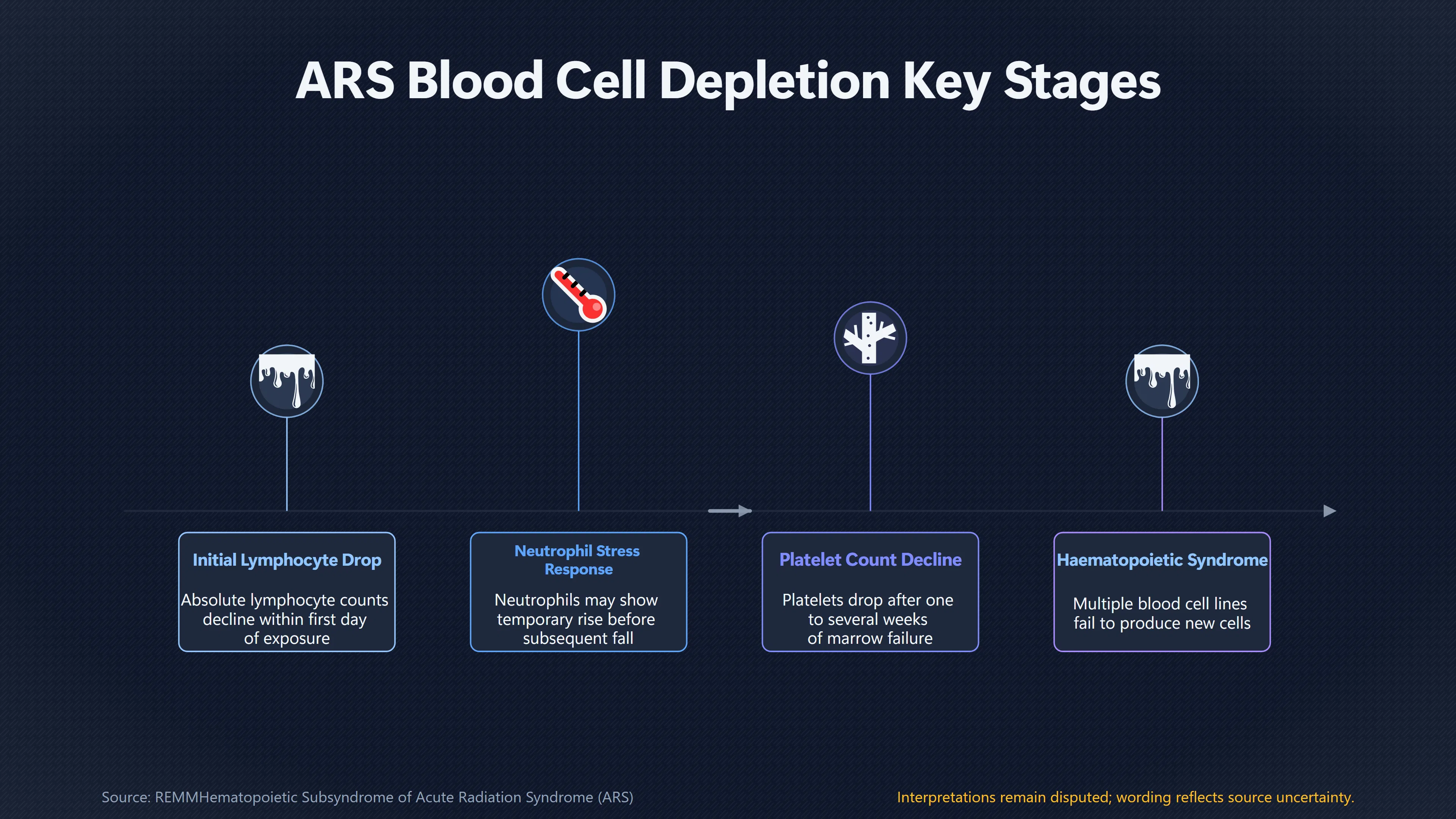
- Within hours to one day: the absolute lymphocyte count begins to decline, with faster and deeper falls indicating higher radiation doses.
- Following days: neutrophils may initially show a temporary rise because of stress responses before subsequently falling as bone marrow damage becomes evident.
- Approximately one to several weeks: platelet counts decline as bone marrow production fails, increasing the risk of bruising and bleeding.
- Later: reductions across multiple blood-cell lines (white cells, platelets and eventually red-cell production) reflect the haematopoietic syndrome of ARS.[REMM]remm.hhs.govREMMManaging Acute Radiation Syndrome (ARSRadiation Emergency Medical Management…
The precise timing depends on dose, radiation type, dose rate and whether exposure affected the entire body or only part of it. Higher doses generally produce more rapid lymphocyte depletion, earlier platelet decline and more severe marrow failure. Lower doses may cause only modest or transient abnormalities.[REMM]remm.hhs.govREMMAbout Lymphocyte Depletion KineticsRadiation Emergency Medical Management…
For this reason, clinicians do not interpret a low platelet count or white-cell count in isolation. They assess whether the changes fit the expected temporal sequence of radiation injury together with the clinical history, physical findings and other dose-estimation methods such as chromosome aberration testing.[CDC]cdc.govAcute Radiation Syndrome: Information for Clinicians | Radiation Emergencies | CDCApril 23, 2024…
What normal later results can and cannot rule out
Normal serial blood counts during the period when marrow suppression would be expected substantially weaken the hypothesis that a person experienced severe whole-body radiation exposure sufficient to produce classic ARS.
If an individual truly received a dose capable of causing clinically important bone-marrow syndrome, experts would expect measurable lymphocyte depletion followed by broader haematological changes. Persistently normal lymphocyte and platelet counts over the relevant interval would therefore argue strongly against severe whole-body irradiation as the cause of subsequent illness.[CDC]cdc.govAcute Radiation Syndrome: Information for Clinicians | Radiation Emergencies | CDCApril 23, 2024…
However, normal blood counts do not exclude every radiation scenario. They cannot by themselves rule out:
- a low absorbed dose below the threshold for significant marrow injury;
- radiation confined mainly to one part of the body rather than the whole body;
- exposure affecting primarily the skin without substantial bone-marrow dose;
- laboratory testing performed too late, too infrequently or without appropriate serial measurements.[REMM]remm.hhs.govREMMAbout Lymphocyte Depletion KineticsRadiation Emergency Medical Management…
Accordingly, radiation medicine combines serial CBCs with exposure history, physical dosimetry, chromosome analysis and clinical examination rather than relying on any single laboratory result.[CDC]cdc.govAcute Radiation Syndrome: Information for Clinicians | Radiation Emergencies | CDCApril 23, 2024…
Relevance to the Cash–Landrum incident
In assessing claims that the Cash–Landrum witnesses suffered severe whole-body radiation injury, serial blood counts would have been among the most informative objective datasets. A documented progression from early lymphocyte depletion to later reductions in platelets and other blood-cell lines would have supported the diagnosis of significant marrow irradiation. Conversely, repeatedly normal counts during the expected time course would weigh against classic ARS, even if burns, nausea or other symptoms were genuine.
Publicly available accounts of the incident describe illnesses and medical treatment, but they do not provide a complete published series of early CBC results showing the characteristic haematological evolution expected after severe whole-body radiation exposure. As a result, the available record does not demonstrate the distinctive blood-count pattern that radiation specialists rely upon when diagnosing acute radiation syndrome.[CDC]cdc.govAcute Radiation Syndrome: Information for Clinicians | Radiation Emergencies | CDCApril 23, 2024…

Amazon book picks
Further Reading
Books and field guides related to Would Severe Radiation Sickness Alter the Blood?. Use these as the next step if you want deeper reading beyond the article.
Radiobiology for the Radiologist
In print since 1972, this seventh edition of Radiobiology for the Radiologist is the most extensively revised to date. It consists of two...
Medical Effects of Ionizing Radiation
"The new edition of this monograph features renowned experts who offer the most current information and reliable guidance on all aspects...
Medical Management of Radiation Accidents
Although radiation accidents are rare and often complex in nature, they are of great concern not only to the patient and involved medical...

Basic clinical radiobiology
First published 2009. Subjects: Radiotherapy, Radiobiology, Neoplasms, Cell Survival, Radiation effects.
eBay marketplace picks
Marketplace Samples
Live-tested eBay searches with available results related to this page.
Selected fromUFO poster oneBay.co.uk.




Endnotes
1.
Source: cdc.gov
Link:https://www.cdc.gov/radiation-emergencies/hcp/clinical-guidance/ars.html
Source snippet
Acute Radiation Syndrome: Information for Clinicians | Radiation Emergencies | CDCApril 23, 2024...
Published: April 23, 2024
2.
Source: remm.hhs.gov
Title: REMMHematopoietic Subsyndrome of Acute Radiation Syndrome (ARS)
Link:https://www.remm.hhs.gov/hemeguidelines.htm
Source snippet
Radiation Emergency Medical Management...
3.
Source: remm.hhs.gov
Title: REMMManaging Acute Radiation Syndrome (ARS)
Link:https://remm.hhs.gov/ars.htm
Source snippet
Radiation Emergency Medical Management...
4.
Source: remm.hhs.gov
Title: REMMFrequency of Serial CBCs with Differential and Platelet Count
Link:https://remm.hhs.gov/cbc.htm
Source snippet
Radiation Emergency Medical Management...
5.
Source: remm.hhs.gov
Title: REMMAbout Lymphocyte Depletion Kinetics
Link:https://remm.hhs.gov/aboutlymphocytedepletion.htm
Source snippet
Radiation Emergency Medical Management...
6.
Source: remm.hhs.gov
Title: REMMRadiation Effects on Blood Counts (2)
Link:https://remm.hhs.gov/rad_bloodcounts.htm
Source snippet
Illustration - Radiation Emergency Medical Management...
7.
Source: remm.hhs.gov
Title: REMMExposure: Diagnose/Manage Acute Radiation Syndrome (Text Version)
Link:https://remm.hhs.gov/exposurealgotext.htm
Source snippet
Radiation Emergency Medical Management...
8.
Source: cdc.gov
Title: evaluation and management
Link:https://www.cdc.gov/radiation-emergencies/hcp/nuclear-detonations/evaluation-and-management.html
9.
Source: cdc.gov
Link:https://www.cdc.gov/radiation-emergencies/signs-symptoms/index.html
10.
Source: cdc.gov
Title: determining deaths
Link:https://www.cdc.gov/radiation-emergencies/hcp/clinical-guidance/determining-deaths.html
11.
Source: cdc.gov
Title: acute radiation syndrome
Link:https://www.cdc.gov/radiation-emergencies/signs-symptoms/acute-radiation-syndrome.html
12.
Source: youtube.com
Title: Acute Radiation Syndromes (CNS vs GI vs Hemopoietic)
Link:https://www.youtube.com/watch?v=bk1JUKJle6I
Source snippet
REMM - Time and Dose Effects of ARS...
13.
Source: youtube.com
Link:https://www.youtube.com/watch?v=61ijxCd3dVI
Source snippet
How Can We Treat Radiation Poisoning?...
14.
Source: ncbi.nlm.nih.gov
Link:https://www.ncbi.nlm.nih.gov/books/NBK441931/?report=reader
Source snippet
Syndrome - StatPearls - NCBI BookshelfJune 19, 2026 — 19†[15]】 HISTORY AND PHYSICAL The initial care of a patient with acute radiation sy...
Published: June 19, 2026
16.
Source: remm.hhs.gov
Link:https://remm.hhs.gov/exposureonly.htm
17.
Source: remm.hhs.gov
Link:https://remm.hhs.gov/bloodtransfusion.htm
Additional References
18.
Source: pubmed.ncbi.nlm.nih.gov
Link:https://pubmed.ncbi.nlm.nih.gov/41765040/
Source snippet
2026 Mar 2:eRADE-25-00073. doi: 10.1667/RADE-25-00073. Online ahead of print. CHARACTERIZATION OF THE SEQUENCE OF CYTOPENIA AFTER TOTAL-B...
19.
Source: researchgate.net
Link:https://www.researchgate.net/publication/265175172_Management_of_Ionizing_Radiation_Injuries_and_Illnesses_Part_4_Acute_Radiation_Syndrome
20.
Source: researchgate.net
Link:https://www.researchgate.net/publication/50434776_Triage_and_Treatment_Tools_for_Use_in_a_Scarce_Resources-Crisis_Standards_of_Care_Setting_After_a_Nuclear_Detonation
21.
Source: ashpublications.org
Link:https://ashpublications.org/blood/article/126/24/2578/34684/Long-term-survival-and-T-cell-kinetics-in-relapsed
22.
Source: degruyterbrill.com
Link:https://www.degruyterbrill.com/document/doi/10.7556/jaoa.2014.138/pdf
23.
Source: youtube.com
Title: Radiation Biology for Somatic Tissue
Link:https://www.youtube.com/watch?v=a6d7ArOY6D0
Source snippet
UFO Files #8: A Radioactive UFO? The Cash-Landrum Case - 1980...
24.
Source: restoredcdc.org
Title: Emergency Department: Evaluation and Management of Affected Patients
Link:https://restoredcdc.org/www.cdc.gov/radiation-emergencies/hcp/nuclear-detonations/evaluation-and-management.html
25.
Source: youtube.com
Title: UFO Files #8: A Radioactive UFO? The Cash-Landrum Case
Link:https://www.youtube.com/watch?v=CYZDGxptuuo
26.
Source: youtube.com
Title: How Can We Treat Radiation Poisoning?
Link:https://www.youtube.com/watch?v=0o7IxB3WMJ0
Source snippet
Radiation Biology for Somatic Tissue...
27.
Source: pubmed.ncbi.nlm.nih.gov
Link:https://pubmed.ncbi.nlm.nih.gov/17379081/