Within Secrecy Theory
Where Would the Missing Helicopter Records Be?
Flight, maintenance, personnel and unit records may be stored separately and retained for different lengths of time.
On this page
- Which military records a helicopter mission could generate
- How unit, personnel and maintenance files are separated
- Why routine retention rules can create later gaps
Page outline Jump by section
Introduction
One of the central questions raised by the Cash–Landrum incident is why no publicly identified military records have confirmed the helicopter activity reported by the witnesses. That absence is sometimes presented as evidence that records were deliberately removed or hidden. In practice, however, military aviation documentation is rarely stored as a single, unified file. A routine helicopter mission can generate operational, maintenance, personnel, logistics and administrative records that are created by different organisations, retained for different periods and eventually archived—or destroyed—under different rules. As a result, decades later it is entirely possible for some categories of records to survive while others do not. Understanding how military record-keeping works helps explain why apparent documentary gaps can arise without proving either a cover-up or that no operation occurred.
Which military records a helicopter mission could generate
A significant military helicopter mission typically leaves multiple documentary traces rather than one comprehensive mission file. Those records may include:
- Flight authorisations and mission tasking.
- Aircrew flight records and individual flying hours.
- Aircraft maintenance inspections before and after flight.
- Fuel and logistics documentation.
- Operations logs maintained by the unit.
- Airfield movement records.
- Personnel duty rosters.
- Communications records and situation reports.
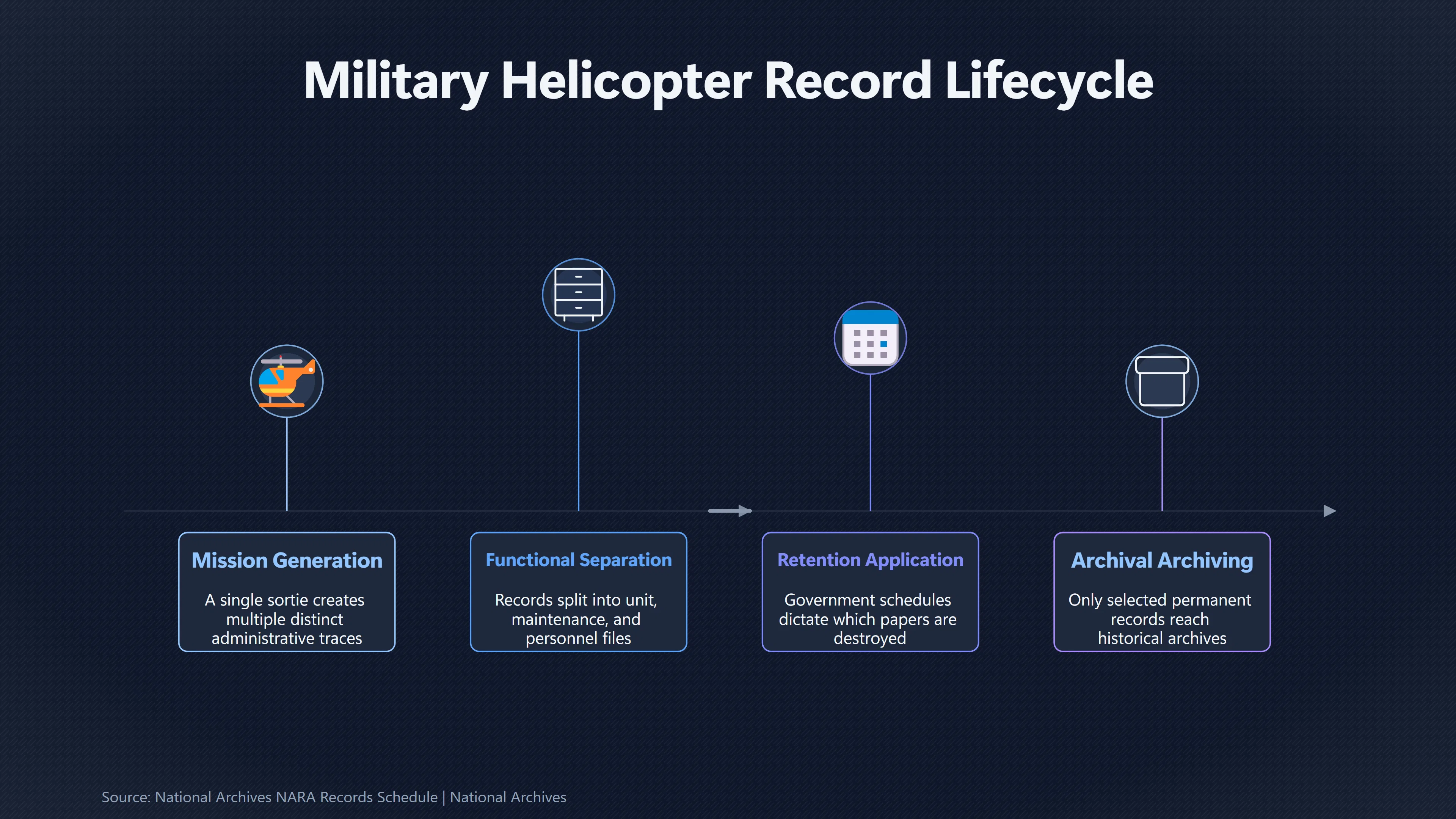
Each category normally belongs to a different office with its own filing system and retention policy. Operational records document what a unit did. Maintenance records track the mechanical condition of specific aircraft. Personnel files record an individual’s qualifications and flying time. Logistics systems account for fuel, spare parts and support activities. These systems exist to meet different administrative needs rather than to create a permanent narrative of a single mission.
Consequently, locating one surviving record does not automatically lead investigators to every other related document.
Why flight, maintenance and personnel files become separated
Military aviation organisations are designed around functional responsibilities rather than historical reconstruction. The same helicopter sortie may therefore appear in several disconnected administrative systems.
Operational records belong to the unit
The operational headquarters or flying unit normally maintains mission schedules, operations logs and summaries of activities. These records describe what the unit accomplished rather than every technical detail of each aircraft.
Historical archives often preserve selected operational records because they document the activities of military units rather than individual machines or crew members. The UK’s National Archives, for example, distinguishes operational unit records from individual service records and explains that researchers frequently need to consult multiple record series to reconstruct events.[National Archives]nationalarchives.gov.ukNational Archives Military and maritime records: an overviewNational ArchivesMilitary and maritime records: an overview - The National Archives…
Maintenance records follow the aircraft
Aircraft maintenance documentation serves a different purpose. Engineers record inspections, component changes, defects and repairs to ensure continuing airworthiness.
These records are organised around individual airframes or maintenance activities rather than specific operations. If an aircraft later transfers to another unit, retires or is scrapped, its technical documentation may follow separate archival and disposal rules from the operational records of the squadron that flew it.
A researcher looking only for unit histories may therefore never encounter maintenance documentation, while someone tracing an aircraft’s engineering history may find little information about why it flew a particular mission.
Personnel records follow the individual
Pilots, crew chiefs and other aircrew accumulate their own service documentation, including qualifications, flying hours and assignments.
These records are maintained primarily for career management and pay, not to reconstruct unit operations. Individual personnel records may survive even when operational files have been destroyed—or the reverse may occur.
Because these record systems have different owners, no central archive necessarily links them together decades later.

Why routine retention rules create later gaps
A common misunderstanding is that every military aviation document is preserved permanently. In reality, governments apply records retention schedules that distinguish between material with long-term historical value and records needed only for temporary administrative purposes.
In both the United States and the United Kingdom, records management policies classify some records as permanent while many others are scheduled for destruction after defined retention periods unless they meet preservation criteria.[archives.gov]archives.govNational Archives NARA Records Schedule | National ArchivesNational ArchivesNARA Records Schedule | National ArchivesOctober 20, 2021…
This means that:
- Daily working paperwork may be destroyed after fulfilling its administrative purpose.
- Permanent operational histories may survive while supporting paperwork does not.
- Temporary logs may disappear long before historians begin investigating an event decades later.
- Different organisations may transfer permanent records to archives at different times.
The result is an uneven documentary landscape rather than a complete chronological record.
A mission does not necessarily leave one searchable archive
Modern researchers often expect records to behave like a searchable digital database. Military archives developed very differently.
Documents may be organised by:
- Unit.
- Installation.
- Aircraft serial number.
- Calendar year.
- Operational theatre.
- Administrative function.
- Individual service member.
Searching only one category can therefore produce misleadingly negative results.
For example, an investigator looking for helicopter operations in late 1980 might search unit histories without examining maintenance files, personnel records or local installation documents. Conversely, maintenance records for a particular aircraft might survive without identifying the operational context in which that aircraft was flown.
Archive catalogues themselves generally reflect the original administrative structure rather than reconstructing relationships between dispersed record series.[National Archives]nationalarchives.gov.ukNational Archives Military and maritime records: an overviewNational ArchivesMilitary and maritime records: an overview - The National Archives…

Classification is only one possible explanation
Within the Cash–Landrum debate, missing records are often interpreted as evidence of classification. Classified operations certainly can involve additional handling restrictions and compartmentalised filing systems.
However, classification is only one mechanism that can reduce documentary visibility.
Other explanations include:[archives.gov]archives.govOther Logs | National ArchivesOther Logs | National Archives
- records scheduled for routine destruction;
- files retained only locally and never transferred to permanent archives;
- unit redesignations or reorganisations that complicate later searches;
- incomplete archive cataloguing;
- records dispersed across multiple services or commands;
- records preserved but not indexed in ways obvious to modern researchers.
None of these possibilities demonstrates that the reported helicopter mission occurred. Equally, the absence of easily located documentation does not by itself demonstrate that records were intentionally removed.
What this means for the Cash–Landrum helicopter question
If a large military helicopter formation actually operated in the area described by the witnesses, investigators might reasonably expect some documentary evidence to have existed at the time. The more aircraft involved, the greater the administrative footprint would likely have been.
Nevertheless, that footprint would probably never have existed as a single file labelled with the event. Instead, it would have been distributed across operational planning, aircraft maintenance, personnel administration, logistics and local command records, each governed by separate retention and archival policies.
For that reason, the inability to locate a complete documentary trail decades later is not, by itself, conclusive evidence either for or against the government secrecy theory. It demonstrates a genuine evidential gap, but one that can arise through ordinary military records management as well as through deliberate secrecy. The historical question therefore remains whether any surviving records from those separate systems can be linked together to corroborate—or contradict—the reported helicopter activity.
Amazon book picks
Further Reading
Books and field guides related to Where Would the Missing Helicopter Records Be?. Use these as the next step if you want deeper reading beyond the article.
The Puzzle Palace: A Report on America's Most Secret Agency
In this remarkable tour de force of investigative reporting, James Bamford exposes the inner workings of America's largest, most secretiv...
Legacy of Ashes: The History of the CIA
All-powerful, brilliant, decisive, ruthlessly effective — this is the image of the CIA as portrayed in countless films and novels. It is...
The Secret Sentry: The Untold History of the National Securit...
A groundbreaking history of America's other, more powerful intelligence agency
The Art of Access: Strategies for Acquiring Public Records
NEW TO THIS EDITION: 40 additional experts and practitioners offer tips and record ideas for opening new doorways into FOI and open data....
eBay marketplace picks
Marketplace Samples
Live-tested eBay searches with available results related to this page.
Selected fromhelicopter squadron patch oneBay.co.uk.


Endnotes
1.
Source: archives.gov
Title: National Archives NARA Records Schedule | National Archives
Link:https://www.archives.gov/about/records-schedule
Source snippet
National ArchivesNARA Records Schedule | National ArchivesOctober 20, 2021...
Published: October 20, 2021
2.
Source: archives.gov
Title: What is an Official Military Personnel File (OMPF)?
Link:https://www.archives.gov/personnel-records-center/ompf-background
Source snippet
National ArchivesJuly 21, 2026 — WHAT IS AN OFFICIAL MILITARY PERSONNEL FILE (OMPF)? HOW CAN I REQUEST OMPFs? Learn more * * * Personne...
Published: July 21, 2026
3.
Source: archives.gov
Title: Other Logs | National Archives
Link:https://www.archives.gov/research/military/logbooks/other-logs
4.
Source: archives.gov
Link:https://www.archives.gov/records-mgmt/rcs/schedules/index.html?dir=%2Fdepartments%2Fdepartment-of-defense%2Fdepartment-of-the-air-force%2Frg-afu
5.
Source: nationalarchives.gov.uk
Title: National Archives Military and maritime records: an overview
Link:https://www.nationalarchives.gov.uk/help-with-your-research/research-guides/wars-overview/
Source snippet
National ArchivesMilitary and maritime records: an overview - The National Archives...
6.
Source: nationalarchives.gov.uk
Title: royal air force operations record books 1911 1963
Link:https://www.nationalarchives.gov.uk/help-with-your-research/research-guides/royal-air-force-operations-record-books-1911-1963/
Source snippet
National ArchivesRoyal Air Force operations record books 1911-1963 - The National Archives...
7.
Source: faa.gov
Link:https://www.faa.gov/about/initiatives/records
Source snippet
Records Management | Federal Aviation AdministrationApril 7, 2026 — RECORDS MANAGEMENT PROGRAM OVERVIEW The FAA Records Management progra...
Published: April 7, 2026
8.
Source: GOV.UK
Title: Records management policy
Link:https://www.gov.uk/government/publications/jsp-441-defence-records-management-policy-and-procedures–2/records-management-policy
Source snippet
Applying for a retention instrument for records older than 20 years in age 2. Capturing digital records 3. Capturing information and...
Additional References
9.
Source: history.navy.mil
Title: Therefore, no records in the Navy
Link:https://www.history.navy.mil/research/histories/naval-aviation-history/naval-aviation-flight-records-crew-and-passenger-manifests.html
Source snippet
Aviation Flight Records: Crew and Passenger ManifestsNovember 15, 2022 — Naval Aviation Flight Records: Crew and Passenger Manifests Flig...
Published: November 15, 2022
10.
Source: youtube.com
Title: Cash–Landrum incident: The UFO That Left Burns
Link:https://www.youtube.com/watch?v=r6w_gEdNcvI
Source snippet
The Cash-Landrum Incident - Real Alien Encounter or Government Project?...
11.
Source: youtube.com
Title: [Cash-Landrum UFO Incident]({{ ‘cash-landrum-ufo-incident/’ | relative_url }})
Link:https://www.youtube.com/watch?v=zNfOAtCgKI4
Source snippet
Cash–Landrum incident: The UFO That Left Burns - Narrated Wikipedia Article...
12.
Source: youtube.com
Title: The Cash-Landrum Incident
Link:https://www.youtube.com/watch?v=SzzYIirmiLg
Source snippet
(1980): The UFO That Burned Its Witnesses...
13.
Source: youtube.com
Title: The Cash-Landrum Incident: [23 Helicopters]({{ ‘23-helicopters/’ | relative_url }}) and a Deadly UFO
Link:https://www.youtube.com/watch?v=0r5par-v67w
Source snippet
Cash-Landrum UFO Incident - UFO, Helicopters, $20 Million Lawsuit...
14.
Source: history.navy.mil
Link:https://www.history.navy.mil/research/archives/Collections/deck-logs.html
15.
Source: youtube.com
Link:https://www.youtube.com/watch?v=Z3Ef72qM-VI
Source snippet
Why is dunking painful for NBA players?...
16.
Source: pclt.defense.gov
Title: nm03760 1
Link:https://pclt.defense.gov/DIRECTORATES/Privacy-and-Civil-Liberties-Directorate/Privacy/SORNsIndex/Article/4010288/nm03760-1/
17.
Source: pclt.defense.gov
Title: nm03760 4
Link:https://pclt.defense.gov/DIRECTORATES/Privacy-and-Civil-Liberties-Directorate/Privacy/SORNsIndex/Article/4010319/nm03760-4/