Within Legal Myths
Why a Tort Case Could Not Solve the Sighting
The law was designed to decide government liability for employee negligence, not to determine the identity, origin or physics of an unexplained object.
On this page
- What the Federal Tort Claims Act requires
- Why causation and government attribution mattered
- Questions the statute was never built to answer
Page outline Jump by section
Introduction
The Cash–Landrum lawsuit is sometimes portrayed as a failed attempt to prove that the United States was hiding the truth about a UFO. In legal terms, however, that was never the question before the court. The case was brought under the Federal Tort Claims Act (FTCA), a statute that allows people to seek compensation for injuries caused by negligent acts of federal employees acting within the scope of their employment. Its purpose is to determine civil liability, not to investigate unexplained aerial phenomena, identify unknown craft or resolve scientific mysteries. As a result, even a perfectly conducted FTCA case could not have answered whether the object reported by the witnesses was extraterrestrial, experimental, natural or something else entirely. The legal framework itself confined the court to a much narrower inquiry: whether the plaintiffs could prove that the United States was legally responsible for their alleged injuries.[Supreme Court]supremecourt.govSupreme CourtSupreme Court of the United StatesNovember 7, 2019…
What the Federal Tort Claims Act Actually Requires
The FTCA is a limited waiver of the federal government’s sovereign immunity. Rather than authorising courts to conduct broad factual inquiries into unusual events, it creates a specific cause of action for negligence and certain other torts committed by federal employees.
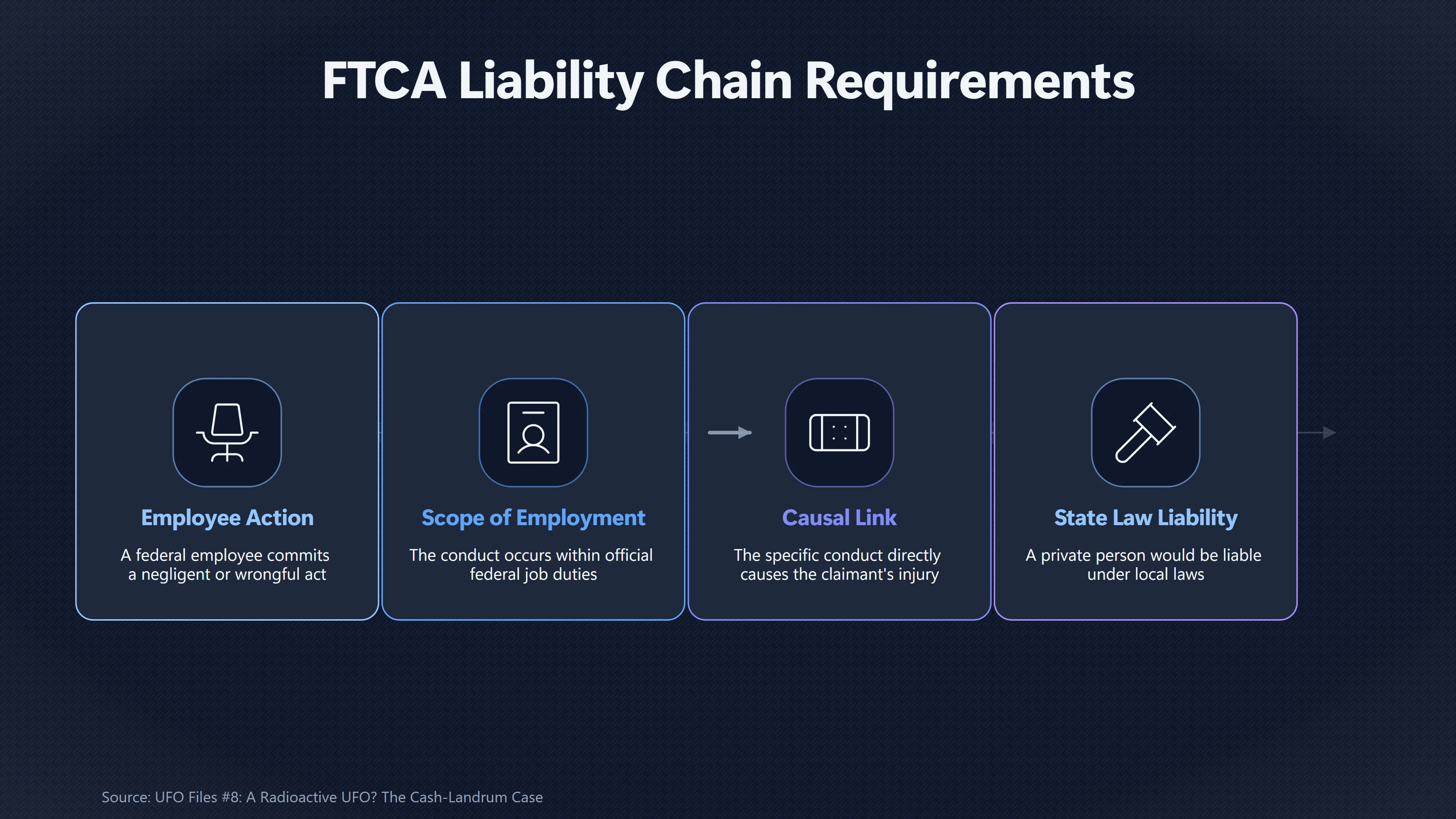
For a claimant to succeed, several linked elements must be established:
- A federal employee committed a negligent or wrongful act.
- The employee was acting within the scope of federal employment.
- That conduct caused the claimant’s injury.
- A comparable private person would be liable under the law of the state where the incident occurred.
These are ordinary civil liability questions. They concern responsibility for injuries, not the ultimate nature of the event that allegedly caused them.[Supreme Court]supremecourt.govSupreme CourtSupreme Court of the United StatesNovember 7, 2019…
That distinction is critical in the Cash–Landrum litigation. The plaintiffs did not merely report seeing an unidentified object. Their legal claim asserted that a hazardous aerial device and accompanying military-style helicopters were operated by or under the control of the United States and that this operation caused their injuries. Without proving that federal connection, the lawsuit could not succeed regardless of how unusual the reported sighting appeared.
Why Government Attribution Was the Central Legal Problem
The most significant obstacle was not whether something extraordinary was observed but whether it could legally be attributed to the federal government.
The witnesses described numerous helicopters that appeared military in character. However, under the FTCA, resemblance is not evidence of government ownership or operation. Military-style aircraft can resemble aircraft operated by different organisations, and eyewitness identification alone does not necessarily establish which agency controlled them.
To establish liability, the plaintiffs needed evidence such as identifiable military units, flight records, operational orders, personnel, maintenance logs or other documentation linking the aircraft—and ultimately the hazardous object itself—to federal employees.
Government agencies denied any involvement, and investigations reported that they found no records showing that military helicopters matching the alleged operation were flying in the relevant area or conducting such a mission. Whatever readers may conclude about those denials, the absence of documentary attribution created a fundamental legal gap. Civil liability cannot rest solely upon the possibility that the government was involved.[Supreme Court]supremecourt.govSupreme CourtSupreme Court of the United StatesNovember 7, 2019…
Importantly, this is different from asking whether the witnesses genuinely believed what they saw. Courts frequently distinguish between witness credibility and proof of legal responsibility. A witness may honestly report an event while still being unable to prove who caused it.
Why Proving Injury Was Not Enough
The plaintiffs alleged serious physical injuries following the encounter, including burns and illnesses that they believed resulted from exposure to the unidentified object.
Even if a court were to accept that the plaintiffs experienced genuine medical problems, the FTCA required another step: proving that those injuries were legally caused by negligent conduct attributable to federal employees.
That means the statute demanded a complete causal chain:
- A federal operation occurred.
- Federal employees were responsible for it.
- Their conduct was negligent or otherwise actionable.
- That conduct caused the plaintiffs’ injuries.
Failure at any point in that chain defeated the claim. The Act did not authorise compensation merely because an unexplained event coincided with illness or because government involvement seemed possible.[Supreme Court]supremecourt.govSupreme CourtSupreme Court of the United StatesNovember 7, 2019…
Questions the Statute Was Never Designed to Answer
The limitations of the FTCA become clearer when comparing legal questions with UFO questions.
The court could consider matters such as:
- Whether federal employees committed a legally actionable tort.
- Whether sufficient evidence connected those employees to the incident.
- Whether negligence caused compensable injuries.
It was not asked—and had no legal mechanism—to determine:
- What the unidentified object actually was.
- Whether the object represented classified technology.
- Whether it originated from another nation.
- Whether it involved extraterrestrial intelligence.
- Whether witnesses accurately interpreted everything they observed.
- Whether the incident deserved classification as a genuine UFO event.
These are investigative, scientific, intelligence or historical questions rather than tort-law questions.
Even if evidence had established that an unidentified craft existed, the FTCA contains no legal standard for identifying unknown aerospace technology or deciding whether an unexplained phenomenon has an extraordinary origin. The statute simply lacks those decision-making tools.
Why the Court Did Not Conduct a UFO Investigation
Popular accounts sometimes imply that the lawsuit became an official investigation into the Cash–Landrum sighting itself. In reality, federal civil litigation operates within procedural rules that narrowly define the issues before the court.
The judge’s role was to determine whether the plaintiffs had presented sufficient evidence to establish government liability under the governing statute. The court was not commissioned to investigate unidentified aerial phenomena, compel scientific analysis of the reported object or issue findings about its identity.
Civil courts generally decide disputes presented by the parties using admissible evidence relevant to recognised legal claims. They do not conduct open-ended inquiries into unresolved mysteries simply because those mysteries form part of the factual background.
Consequently, the dismissal should not be read as an official determination that nothing unusual occurred. Equally, it should not be read as judicial confirmation that a secret government craft existed. The court addressed only the legal claim before it.
The Lasting Legal Lesson
The Cash–Landrum case demonstrates the limits of using tort litigation to resolve extraordinary claims.
The Federal Tort Claims Act is designed to answer a practical question: should the United States compensate someone for injuries caused by negligent conduct of identifiable federal employees? It is not designed to identify mysterious aircraft, evaluate competing UFO hypotheses or determine the origin of unexplained phenomena.
That distinction explains why the lawsuit could neither prove nor disprove the underlying UFO mystery. A failure to establish government liability under the FTCA does not automatically resolve what the witnesses encountered. It establishes only that the plaintiffs did not satisfy the statutory requirements necessary to hold the United States legally responsible for their alleged injuries under that specific compensation framework.[Supreme Court]supremecourt.govSupreme CourtSupreme Court of the United StatesNovember 7, 2019…
Amazon book picks
Further Reading
Books and field guides related to Why a Tort Case Could Not Solve the Sighting. Use these as the next step if you want deeper reading beyond the article.
A Civil Action
This authoritative, in-depth, revealing, and wonderfully-written book tells the true story of an obsessed young lawyer who gave up everyt...
UFOs and Government: A Historical Inquiry
Governments around the world have had to deal with the UFO phenomenon for a good part of a century. How and why they did so is the subjec...
The Rule of Law
'A gem of a book ... Inspiring and timely. Everyone should read it' Independent 'The Rule of Law' is a phrase much used but little examin...
The Legal Analyst: A Toolkit for Thinking About the Law
There are two kinds of knowledge law school teaches: legal rules on the one hand, and tools for thinking about legal problems on the othe...
eBay marketplace picks
Marketplace Samples
Live-tested eBay searches with available results related to this page.
Selected fromUFO poster oneBay.co.uk.
Current eBay listing
VINTAGE UFO FLYING SAUCERS COMIC ADVERTISING A2 POSTER PRINT

Current eBay listing
FS02 VINTAGE UFO FLYING SAUCERS COMIC ADVERTISING A4 POSTER PRINT
Endnotes
1.
Source: supremecourt.gov
Link:https://www.supremecourt.gov/DocketPDF/19/19-596/121686/20191107085647788_20191107-085246-95748780-00000150.pdf
Source snippet
Supreme CourtSupreme Court of the United StatesNovember 7, 2019...
Published: November 7, 2019
2.
Source: youtube.com
Title: UFO Files #8: A Radioactive UFO? The Cash-Landrum Case
Link:https://www.youtube.com/watch?v=CYZDGxptuuo
Source snippet
The Cash - Landrum UFO Encounter | Dark Mysteries...
3.
Source: youtube.com
Title: The Cash
Link:https://www.youtube.com/watch?v=t6sV0LIy7GI
Source snippet
Landrum UFO Mystery...
Additional References
4.
Source: justice.gov
Title: Office of the Solicitor General | Matsushita Elec
Link:https://www.justice.gov/osg/brief/matsushita-elec-co-v-zeigler-opposition
Source snippet
Co. v. Zeigler - Opposition | United States Department of JusticeIndividual federal employees generally may not be held personally liable...
5.
Source: justice.gov
Title: Office of the Solicitor General | Osborn v
Link:https://www.justice.gov/osg/brief/osborn-v-haley-brief-merits
Source snippet
Haley - Brief (Merits) | United States Department of JusticeSeptember 1, 2006 — In 1988, Congress enacted the Federal Employees Liabil it...
Published: September 1, 2006
6.
Source: congress.gov
Title: engaged in conduct beyond the scope of hi
Link:https://www.congress.gov/crs_external_products/R/HTML/R45732.web.html
Source snippet
April 17, 2023 — In such instances, the United States "remain[s] the federal defendant in the action unless and until the [d]istrict [c]o...
Published: April 17, 2023
7.
Source: scribd.com
Title: Federal Tort Claims Act Case
Link:https://www.scribd.com/document/908709170/126065-r
Source snippet
Summary | PDF | Lawsuit | Diseases And Disorders0 ratings 0% found this document useful (0 votes) 54 views 5 pages Federal Tort Claims Ac...
8.
Source: law.resource.org
Title: 860.F2d.181.88 4119
Link:https://law.resource.org/pub/us/case/reporter/F2/860/860.F2d.181.88-4119.html
Source snippet
Improper Defendant 5 We affirm the district court's judgment for OSHA. OSHA is not the proper party to be sued under the FTCA. The lower...
9.
Source: youtube.com
Title: UFO Hunters: Life-Altering Alien Encounter (S2, E8) | Full Episode | History
Link:https://www.youtube.com/watch?v=UPkW9XBX0fU
Source snippet
UFO Files #8: A Radioactive UFO? The Cash-Landrum Case - 1980...
10.
Source: law.cornell.edu
Link:https://www.law.cornell.edu/supct/cert/15-109
Source snippet
Himmelreich | Supreme Court Bulletin | US Law | LII / Legal Information InstituteSIMMONS V. HIMMELREICH LII note: The U.S Supreme Court h...
11.
Source: docs.justia.com
Link:https://docs.justia.com/cases/federal/district-courts/west-virginia/wvsdce/1%3A2011cv00178/68115/83
Source snippet
Lanham et al:: Justia Dockets & FilingsAugust 1, 2016 — Counts III through VII are state law claims for civil conspiracy, invasion of pr...
Published: August 1, 2016
12.
Source: docs.justia.com
Link:https://docs.justia.com/cases/federal/district-courts/louisiana/laedce/2%3A2007cv03064/115496/59
Source snippet
USA:: Justia Dockets & FilingsApril 27, 2009 — v. Catrett, A genuine issue exists if the evidence jury to return a verdict for the 477 U...
Published: April 27, 2009
13.
Source: law.cornell.edu
Title: 89 1646.ZS
Link:https://www.law.cornell.edu/supct/html/89-1646.ZS.html
Source snippet
Smith, 499 U.S. 160 (1991)March 20, 1991 — United States v. Smith (89-1646), 499 U.S. 160 (1991) Opinion | Syllabus Syllabus NOTE: Where...
Published: March 20, 1991