Within Missing Measurements
Could the Car Have Preserved the Missing Radiation Clues?
The Oldsmobile could have trapped particles on its bodywork, upholstery and air filter, but continued use steadily weakened its value as evidence.
On this page
- Where contamination might have collected on the vehicle
- Why the air filter and ventilation system mattered
- How rain, cleaning and repairs degraded the evidence
Page outline Jump by section
Introduction
Could Betty Cash’s Oldsmobile have preserved evidence of radioactive contamination after the Cash–Landrum incident? In principle, yes. If radioactive particles had settled on or entered the vehicle during the reported encounter, the car could have acted as a temporary repository of physical evidence even after the witnesses left the scene. However, no publicly documented radiation survey of the vehicle was carried out immediately after the incident, and the car continued to be driven, exposed to weather and eventually repaired. As a result, what might have been one of the most valuable pieces of physical evidence gradually lost its forensic value. The absence of timely testing means the vehicle cannot now confirm or rule out radioactive contamination.
Where contamination might have collected on the vehicle
If airborne radioactive material had been present, contamination would not have been expected to distribute evenly across the car. Instead, investigators would have focused on locations where particles naturally accumulate or are protected from rapid removal.
Potential collection points include:
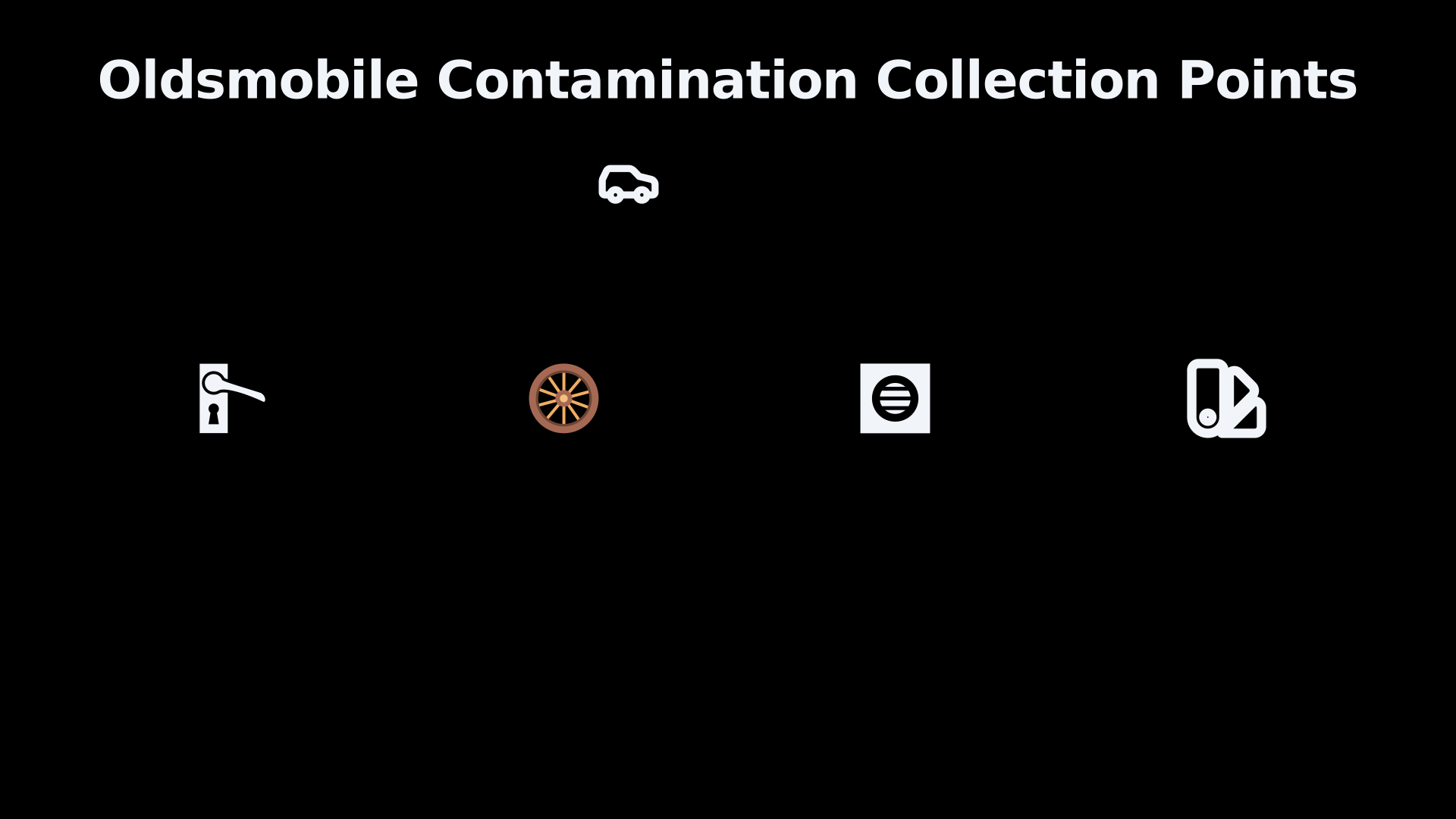
- Horizontal exterior surfaces, such as the bonnet, roof and boot lid, where falling particles could settle.
- Door handles and window seals, where repeated contact and narrow gaps can trap dust.
- Wheel wells and tyres, which collect road debris and fine particles thrown up while driving.
- The engine compartment, especially sheltered corners where airborne dust may lodge.
- The passenger compartment, including seats, carpets and dashboard surfaces if particles entered through open doors or the ventilation system.
- Fabric upholstery, whose fibres can retain fine particulate matter more effectively than smooth plastic or metal.
Modern environmental monitoring following nuclear accidents has repeatedly shown that radioactive particles can adhere to vehicles and remain detectable in protected areas longer than on exposed painted surfaces, provided the vehicles are examined before significant cleaning or prolonged use. Automobile filters have even been used as environmental sampling devices because they accumulate airborne particulates over time.[arXiv]arxiv.orgMeasurements of Fission Products from the Fukushima Daiichi Incident in San Francisco Bay Area Air Filters, Automobile Filters, Rain…
In the Cash–Landrum case, no publicly available records indicate that investigators mapped radiation levels across the Oldsmobile’s exterior or interior using a calibrated survey meter or collected wipe samples for laboratory analysis.
Why the air filter and ventilation system mattered
The ventilation system may have represented the single most informative part of the vehicle.
Unlike exposed bodywork, an air intake continuously concentrates airborne material. If radioactive dust had been suspended around the vehicle, the heating and ventilation system could have drawn particles into:
- the fresh-air intake,
- the cabin air pathway (where applicable),
- the heater box,
- internal ducts,
- and especially the air filter or other filtration surfaces.
This principle is well established in environmental radiation monitoring. Following the Fukushima Daiichi nuclear accident, researchers successfully measured fission products in automobile air filters because vehicles naturally concentrate airborne particles during normal operation. These filters preserved measurable radionuclides even when airborne concentrations themselves were extremely low.[arXiv]arxiv.orgMeasurements of Fission Products from the Fukushima Daiichi Incident in San Francisco Bay Area Air Filters, Automobile Filters, Rain…
For the Cash–Landrum investigation, this matters because the witnesses reported remaining inside the car for much of the encounter. If radioactive particulates had been present in the surrounding air, the ventilation system would have offered an opportunity to determine:
- whether particles actually entered the vehicle,
- whether contamination was primarily external or internal,
- whether any contamination was removable surface dust or embedded residue,
- and potentially whether identifiable radionuclides were present through gamma spectroscopy.
Without preserving and analysing the ventilation components, that opportunity disappeared.
How ordinary use steadily weakened the evidence
Even if contamination had initially been present, a motor vehicle is not a stable evidence container unless it is secured immediately.
Several ordinary processes progressively reduce or redistribute surface contamination:
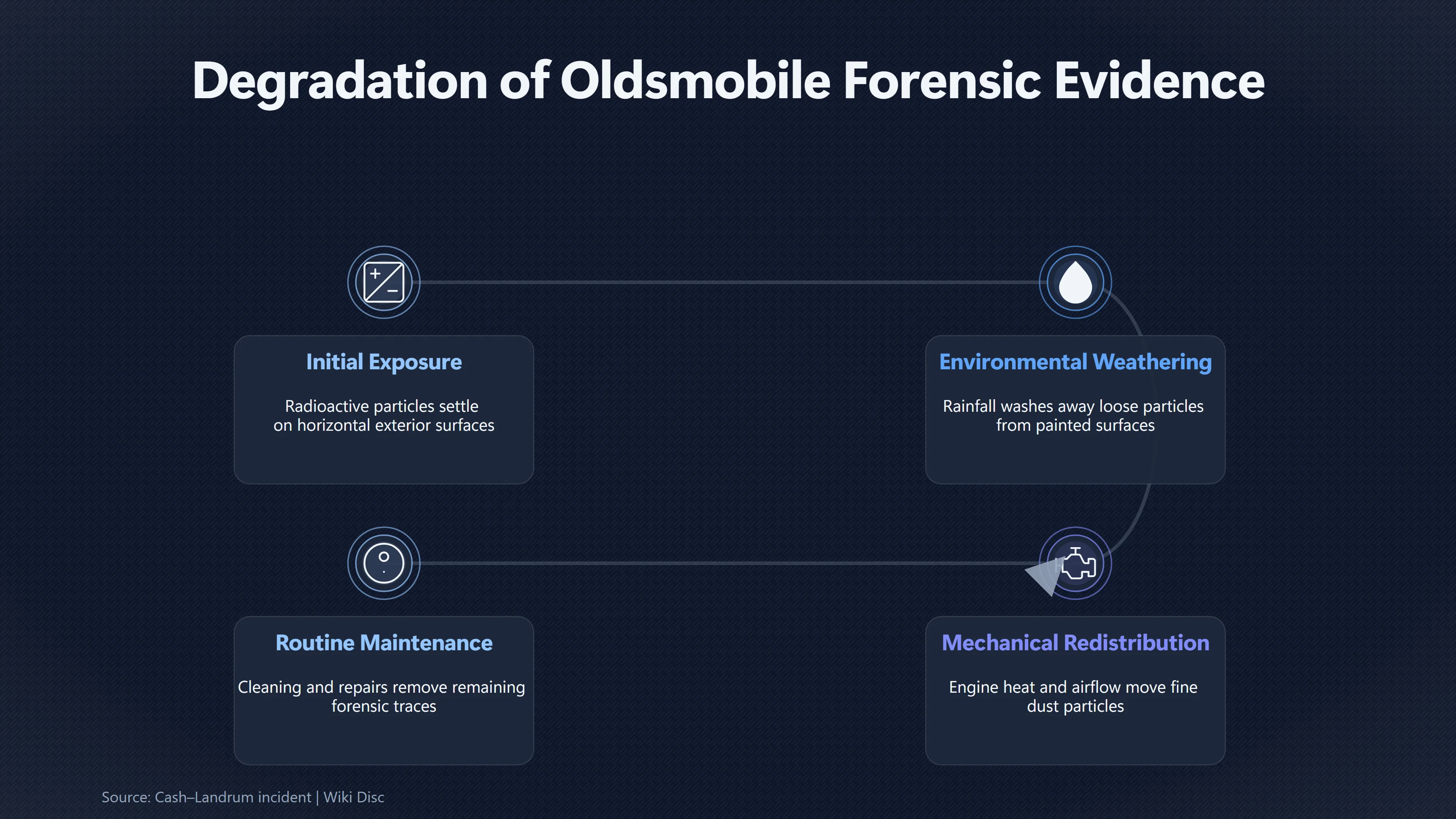
- rainfall washing exposed paintwork;
- repeated opening and closing of doors;
- passengers brushing against seats and carpets;
- vacuuming or interior cleaning;
- servicing, replacement parts or body repairs;
- engine heat and airflow redistributing fine dust;
- continued driving, which removes debris through vibration and wind.
These processes do not necessarily eliminate every radioactive particle, but they make later interpretation increasingly uncertain. Investigators can no longer distinguish between original contamination, later environmental dust and material introduced through routine vehicle use.
The problem is compounded if the contamination consisted only of loose particles rather than chemically bonded deposits. Removable contamination is precisely the type most vulnerable to weathering and handling.
Could the car have provided stronger evidence than the witnesses?
In some respects, yes.
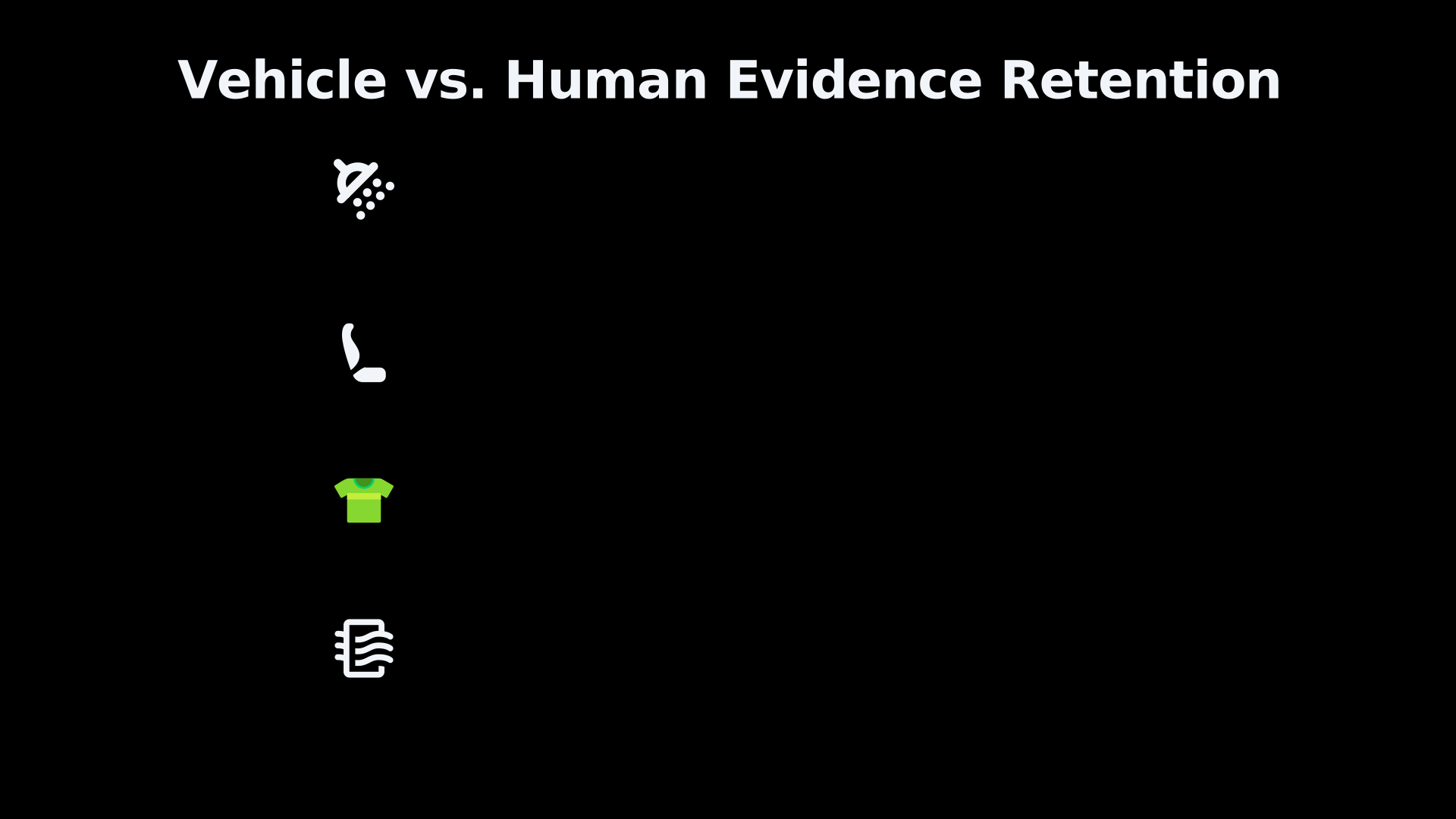
Human bodies change rapidly after a suspected exposure. People bathe, wash their hands, change clothes and naturally eliminate some contaminants. Vehicles, by contrast, may preserve untouched areas that receive little disturbance for days or weeks.
For that reason, emergency radiation investigations commonly treat vehicles as important physical evidence alongside clothing and environmental samples. A complete examination would normally include:
- radiation surveys of the exterior and interior,
- systematic wipe sampling,
- measurement of removable versus fixed contamination,
- examination of the ventilation system,
- laboratory identification of any radionuclides,
- comparison with an uncontaminated control vehicle,
- and careful documentation of instrument calibration and background radiation.
No publicly released documentation shows that Betty Cash’s Oldsmobile underwent such a comprehensive forensic examination.
What the missing car examination means today
The absence of vehicle testing neither proves nor disproves the witnesses’ claims. It simply leaves an evidential gap.
If radioactive contamination had been detected on the Oldsmobile shortly after the reported encounter, investigators could have compared isotope signatures with medical findings, environmental samples and background radiation. Conversely, a carefully documented negative survey performed promptly would have been valuable evidence against contamination.
Instead, the car remained in ordinary use while no publicly documented early radiation survey was performed. By the time later investigations occurred, any transient contamination that might once have existed could have been altered, diluted or entirely removed through normal wear, weather and maintenance.
For the specific question of missing radiation measurements, Betty Cash’s Oldsmobile therefore represents one of the clearest examples of lost forensic opportunity: a potentially informative physical object that was never examined when its evidential value was greatest.
Amazon book picks
Further Reading
Books and field guides related to Could the Car Have Preserved the Missing Radiation Clues?. Use these as the next step if you want deeper reading beyond the article.
Radiation Detection and Measurement
Contains solutions to odd-numbered problems from the textbook by Glenn Knoll, Radiation Detection and Measurement, 4th edition, as well a...
Kirk's Fire Investigation
This best selling book is the leader in arson investigation education. Author John DeHaan uses years of experience as an arson investigat...
Radiobiology for the Radiologist
In print since 1972, this seventh edition of Radiobiology for the Radiologist is the most extensively revised to date. It consists of two...
Forensic Examination of Fibres
In order for forensic fibre examiners to fully utilize fibre and textile evidence during their analysis, they require not only specialise...
eBay marketplace picks
Marketplace Samples
Live-tested eBay searches with available results related to this page.
Selected fromUFO poster oneBay.co.uk.




Endnotes
1.
Source: arxiv.org
Link:https://arxiv.org/abs/1312.7314
Source snippet
Measurements of Fission Products from the Fukushima Daiichi Incident in San Francisco Bay Area Air Filters, Automobile Filters, Rain...
2.
Source: wikidisc.org
Title: Cash–Landrum incident | Wiki Disc
Link:https://www.wikidisc.org/wiki/Cash%E2%80%93Landrum_incident
Source snippet
Cash–Landrum incident | WikiDiscJuly 1, 2026 — INVESTIGATION[EDIT | EDIT SOURCE] INITIAL REPORTING AND MEDICAL RESPONSE[EDIT | EDIT SOURC...
Published: July 1, 2026
3.
Source: zenodo.org
Link:https://zenodo.org/records/10581488
Additional References
4.
Source: pubmed.ncbi.nlm.nih.gov
Link:https://pubmed.ncbi.nlm.nih.gov/36462454/
Source snippet
Ultra-low-level measurements of airborne fission products from the Fukushima Daiichi reactor accident using high volume collection...
5.
Source: dandillman.com
Title: Betty Cash, her friend [Vickie Landrum]({{ ‘vickie-landrum/’ | relative_url }}), and Vick
Link:https://www.dandillman.com/x-files/cash-landrum/
Source snippet
Cash-Landrum 1980 - DanDillman.comJune 2, 2026 — X-FILES CASH-LANDRUM 1980 * Dan Dillman * June 2, 2026 * 12:00 am It was the night of De...
Published: June 2, 2026
6.
Source: epa.gov
Title: radiological fate transport
Link:https://www.epa.gov/emergency-response-research/radiological-fate-transport
Source snippet
Radiological Fate & Transport | US EPAMay 19, 2026 — RADIOLOGICAL FATE & TRANSPORT Image: Radiological contaminants can travel throughout...
Published: May 19, 2026
7.
Source: youtube.com
Link:https://www.youtube.com/watch?v=izTljlO2Css
Source snippet
The Cash-Landrum incident: traumatized & physically ill after terrifying UFO encounter, Dec 29, 1980...
8.
Source: youtube.com
Link:https://www.youtube.com/watch?v=KiCgBn-Kbho
Source snippet
Rare 25-minute interview with Vickie and [Colby Landrum]({{ 'colby-landrum/' | relative_url }}) on the [Cash-Landrum UFO incident]({{ 'cash-landrum-ufo-incident/' | relative_url }}), 1980...
9.
Source: unsolvedreport.com
Title: cash landrum incident 1980
Link:https://www.unsolvedreport.com/en/cash-landrum-incident-1980/
Source snippet
Cash-Landrum Incident 1980: The UFO That Left Real Burns | Unsolved ReportJune 1, 2026 — CASH-LANDRUM INCIDENT 1980: THE UFO THAT LEFT RE...
Published: June 1, 2026
10.
Source: aliencouncil.com
Title: 00027 cash landrum 1980
Link:https://aliencouncil.com/cases/00027-cash-landrum-1980/
Source snippet
Cash–Landrum incident — 29 December 1980 · The CouncilJuly 16, 2026 — CASE #00027 · CASE OF RECORD CASH–LANDRUM INCIDENT — 29 DECEMBER 19...
Published: July 16, 2026
11.
Source: youtube.com
Title: The Cash-Landrum Incident – Physical Evidence the Government Can’t Explain
Link:https://www.youtube.com/watch?v=t5__fA-IvWQ
Source snippet
Rare interview with researcher John F. Schuessler on the 1980 Cash-Landrum UFO incident...
12.
Source: epa.gov
Title: frequent questions air filter testing
Link:https://www.epa.gov/radnet/frequent-questions-air-filter-testing
Source snippet
On this page: * How does EPA analyze air filters? * Where can I find results for beta mo...
13.
Source: youtube.com
Link:https://www.youtube.com/watch?v=TiYo1kdnk8I
Source snippet
1980-12-29: The Cash-Landrum UFO Incident...