Within Court Dismissal
Why the Case Ended Before a Full Trial
The cited rules allowed dismissal on jurisdictional, pleading and evidence grounds without a full trial on the encounter itself.
On this page
- The jurisdiction challenge under Rule 12(b)(1)
- The legal sufficiency issue under Rule 12(b)(6)
- The evidence threshold under Rule 56
Page outline Jump by section
Introduction
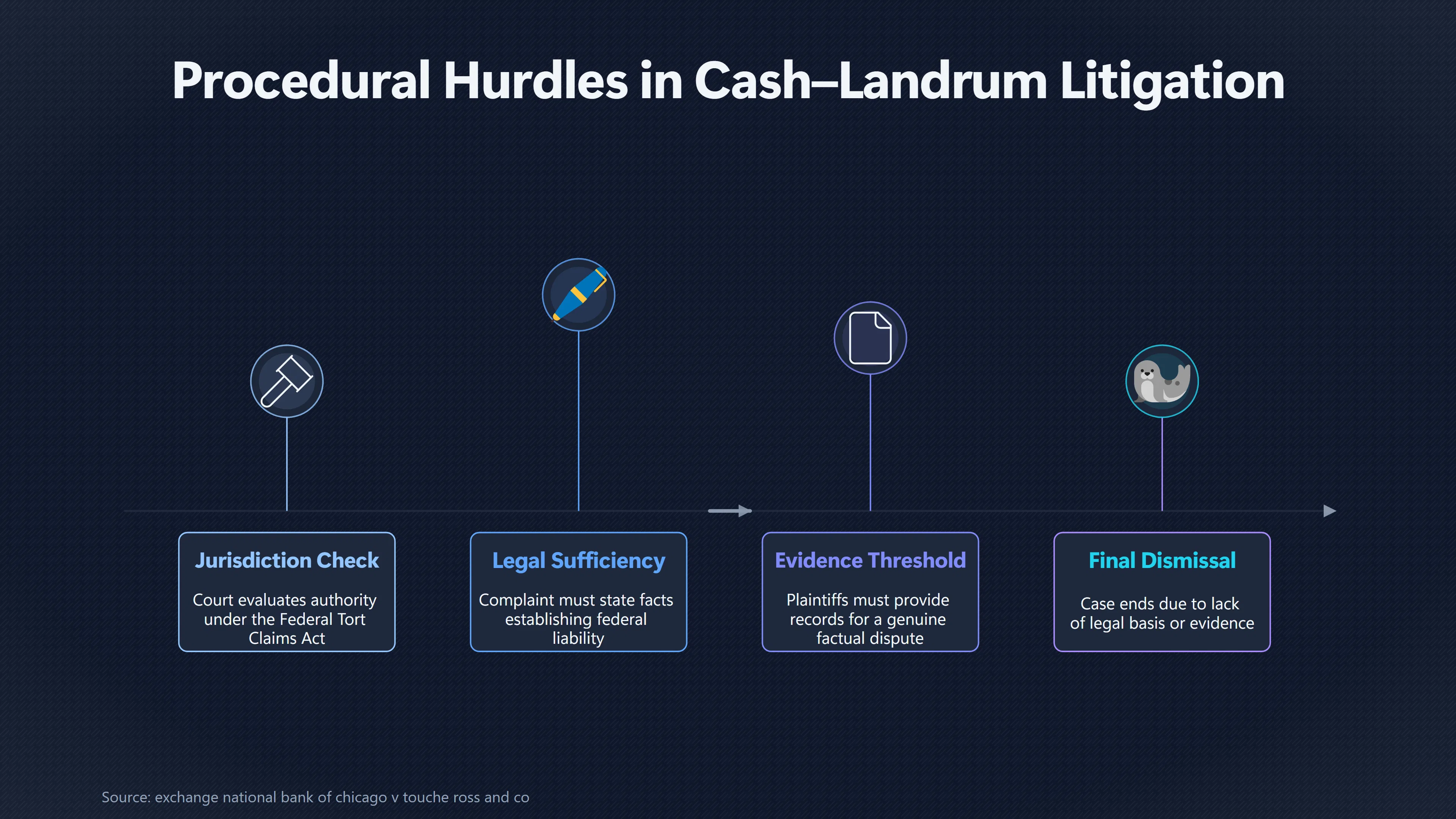
The federal court did not dismiss the Cash–Landrum lawsuit because it reached a definitive conclusion about what the witnesses saw. Instead, Judge Ross N. Sterling ended the case by applying three procedural rules of the Federal Rules of Civil Procedure: Rules 12(b)(1), 12(b)(6) and 56. Together, those rules allowed the court to decide that the plaintiffs had not established a legal basis for suing the United States and had not produced evidence that could justify sending the case to a trial. The ruling therefore addressed legal procedure rather than the truth or falsity of the reported UFO encounter. Contemporary court filings and later reproductions of the dismissal order show that these procedural rules were central to the outcome.[Justia Law]cases.justia.comJustia LawORDER by Judge ARMSTRONG granting 8 Motion to Dismiss (lrc, COURT STAFF) (Filed on 9/5/2008)April 12, 2010…
The jurisdiction challenge under Rule 12(b)(1)
Rule 12(b)(1) allows a federal court to dismiss a lawsuit if it lacks subject-matter jurisdiction—that is, the legal authority to hear the claim. In the Cash–Landrum litigation, this question centred on the Federal Tort Claims Act (FTCA), which waives the United States’ sovereign immunity only for certain injuries caused by federal employees acting within the scope of their employment.
The plaintiffs alleged that a diamond-shaped object and numerous military-style helicopters were part of a United States operation. However, the government argued that no evidence identified any federal agency, employee or military unit as responsible. Without that essential link, the FTCA could not apply, leaving the court without jurisdiction over the claim against the United States.
Unlike an ordinary factual dispute, a Rule 12(b)(1) challenge allows a court to examine evidence bearing on jurisdiction rather than simply accepting the complaint’s allegations as true. Courts have long recognised that when jurisdiction itself is disputed, judges may consider affidavits and other materials to determine whether they possess the authority to hear the case.[Ecases]ecases.usCommodity Futures Trading Commission v. Sterling Trading Group, Inc., District Court, S.D. Florida, US Federal District Court Cases…
In practical terms, Rule 12(b)(1) meant that even if the witnesses sincerely believed they had encountered a government craft, belief alone was insufficient. The plaintiffs needed evidence connecting the alleged conduct to the federal government before the court could proceed.
The legal sufficiency issue under Rule 12(b)(6)
Rule 12(b)(6) addresses a different question: assuming the facts alleged by the plaintiffs are true, do those facts amount to a legally valid claim?
For the Cash–Landrum plaintiffs, this meant showing more than an unexplained aerial encounter followed by illness. Their complaint also had to allege facts that, if proved, would establish liability by the United States under the FTCA. The missing element was identification of a federal actor responsible for the alleged negligence.
At the time of the 1986 dismissal, courts applying Rule 12(b)(6) generally accepted well-pleaded factual allegations as true while asking whether those allegations, if established, entitled the plaintiff to legal relief. Judge Sterling’s dismissal reflected that principle: even treating the plaintiffs’ account seriously, the complaint still failed to bridge the gap between the unidentified object and actionable federal responsibility.[GovInfo]govinfo.govUSCOURTS txsd 4 04 cv 00464 0P:\OpinionsToBeEntered\Rossum.wpdMarch 13, 2014…
This is an important distinction. Rule 12(b)(6) did not require the court to determine whether the reported object existed or whether the plaintiffs became ill. Instead, it required the court to determine whether the complaint, as framed, stated a legally sufficient claim against the defendant that had been sued.

The evidence threshold under Rule 56
Rule 56 governs summary judgment. It allows a court to decide a case without a full trial when there is no genuine dispute over any material fact and one party is entitled to judgment as a matter of law.
The government supported its motion with sworn declarations from officials representing the agencies alleged to have been involved. Those declarations stated that the reported object was not owned or operated by the agencies in question and that no federal aircraft or programme matching the plaintiffs’ allegations had been identified. The plaintiffs, by contrast, relied principally on eyewitness testimony describing the object and accompanying helicopters.
Rule 56 did not require the plaintiffs merely to raise suspicion or speculation. They had to present evidence from which a reasonable fact-finder could conclude that the United States was responsible for the object or aircraft involved. Without documentary records, identified personnel, operational orders, flight records or comparable evidence linking the incident to the federal government, there was no genuine issue for trial on the key factual question that mattered legally.[OpenJurist]m.openjurist.org847 F2d 186 Isquith Isquith v. Middle South Utilities Inc | OpenJuristJune 7, 1988…
The summary judgment mechanism therefore allowed the court to conclude that a trial would not resolve the decisive issue because the evidentiary record lacked proof of federal involvement.
Why these rules ended the case before trial
Taken together, Rules 12(b)(1), 12(b)(6) and 56 addressed three separate legal hurdles:
- Rule 12(b)(1): Did the court have jurisdiction under the Federal Tort Claims Act?
- Rule 12(b)(6): Did the complaint state a legally sufficient claim against the United States?
- Rule 56: Had the plaintiffs produced enough admissible evidence to create a genuine factual dispute requiring a trial?
Judge Sterling’s order invoked all three because each pointed to the same practical conclusion. The plaintiffs had evidence that they believed they experienced an extraordinary event, but they lacked evidence identifying the United States as legally responsible for it. That missing connection defeated jurisdiction, undermined the legal theory of liability and prevented the case from surviving summary judgment.

What the dismissal did—and did not—decide
A common misunderstanding is that the court ruled on whether the Cash–Landrum incident itself occurred. It did not.
The dismissal left unresolved questions about the nature of the reported object, the witnesses’ observations and the cause of their alleged medical problems. Instead, the decision answered a much narrower legal question: whether the available evidence could support a tort claim against the United States.
As a result, the case is often cited as an example of how procedural rules can dispose of litigation before trial. The outcome reflected the plaintiffs’ inability to satisfy the jurisdictional, pleading and evidentiary requirements imposed by the Federal Rules of Civil Procedure, not a judicial finding that the underlying encounter was either genuine or fabricated.[Justia Law]cases.justia.comJustia LawORDER by Judge ARMSTRONG granting 8 Motion to Dismiss (lrc, COURT STAFF) (Filed on 9/5/2008)April 12, 2010…
Amazon book picks
Further Reading
Books and field guides related to Why the Case Ended Before a Full Trial. Use these as the next step if you want deeper reading beyond the article.
Examples & Explanations for Civil Procedure
With this ninth edition of Civil Procedure: Examples & Explanations, Joseph Glannon’s uniquely entertaining style teaches and engages stu...
Civil Procedure
Lively and engaging, Civil Procedure, Second Edition, breaks down the complex principles of Civil Procedure into its constituent parts, a...
Federal Jurisdiction
This premier treatise offers a powerful exploration of the underlying polices and the doctrine of federal jurisdiction. Erwin Chemerinsky...
The Law of Federal Courts
This text offers guidance on all aspects of jurisdiction and procedure in federal court litigation. Some of the topics discussed include:...
eBay marketplace picks
Marketplace Samples
Live-tested eBay searches with available results related to this page.
Selected fromUFO poster oneBay.co.uk.

Current eBay listing
FS02 VINTAGE UFO FLYING SAUCERS COMIC ADVERTISING A4 POSTER PRINT
Current eBay listing
VINTAGE UFO FLYING SAUCERS COMIC ADVERTISING A2 POSTER PRINT
Endnotes
1.
Source: cases.justia.com
Link:https://cases.justia.com/federal/district-courts/california/candce/4%3A2008cv02365/203238/17/0.pdf
Source snippet
Justia LawORDER by Judge ARMSTRONG granting 8 Motion to Dismiss (lrc, COURT STAFF) (Filed on 9/5/2008)April 12, 2010...
Published: April 12, 2010
2.
Source: ecases.us
Link:https://ecases.us/mobile/case/flsd/c2117631/commodity-futures-trading-commission-v-sterling-trading-group-inc
Source snippet
Commodity Futures Trading Commission v. Sterling Trading Group, Inc., District Court, S.D. Florida, US Federal District Court Cases...
3.
Source: openjurist.org
Title: exchange national bank of chicago v touche ross and co
Link:https://openjurist.org/544/f2d/1126/exchange-national-bank-of-chicago-v-touche-ross-and-co
Source snippet
544 F2d 1126 Exchange National Bank of Chicago v. Touche Ross & Co | OpenJurist...
4.
Source: govinfo.gov
Title: USCOURTS txsd 4 04 cv 00464 0
Link:https://www.govinfo.gov/content/pkg/USCOURTS-txsd-4_04-cv-00464/pdf/USCOURTS-txsd-4_04-cv-00464-0.pdf
Source snippet
P:\OpinionsToBeEntered\Rossum.wpdMarch 13, 2014...
Published: March 13, 2014
5.
Source: m.openjurist.org
Link:https://m.openjurist.org/847/f2d/186
Source snippet
847 F2d 186 Isquith Isquith v. Middle South Utilities Inc | OpenJuristJune 7, 1988...
Published: June 7, 1988
6.
Source: law.justia.com
Link:https://law.justia.com/cases/federal/district-courts/virginia/vawdce/4%3A2015cv00037/100195/55/
Source snippet
Smith et al, No. 4:2015cv00037 - Document 55 (W.D. Va. 2016):: JustiaFebruary 17, 2016 — * SEO * Websites * Blogs * Justia Amplify * PPC...
Published: February 17, 2016
7.
Source: law.justia.com
Link:https://law.justia.com/cases/federal/district-courts/district-of-columbia/dcdce/1%3A2007cv00402/124498/40/
Source snippet
WALTON et al, No. 1:2007cv00402 - Document 40 (D.D.C. 2009):: JustiaNovember 10, 2009 — * Justia Elevate * SEO * Websites * Blogs * Just...
Published: November 10, 2009
8.
Source: docs.justia.com
Link:https://docs.justia.com/cases/federal/district-courts/district-of-columbia/dcdce/1%3A2007cv00402/124498/40
Source snippet
WALTON et al:: Justia Dockets & FilingsNovember 4, 2009 — ROSS V. WALTON ET AL FILING 40 MEMORANDUM OPINION & ORDER granting 20 Motion t...
Published: November 4, 2009
9.
Source: openjurist.org
Title: hamilton v davidson
Link:https://openjurist.org/833/f2d/1012/hamilton-v-davidson
Additional References
10.
Source: youtube.com
Link:https://www.youtube.com/watch?v=chfRkCAdZyA
Source snippet
Beating the 12(b)(6) Motion to Dismiss "FAILURE TO STATE A CLAIM". The Key is Showing PLAUSIBILITY...
Published: May 2015
11.
Source: youtube.com
Title: The Cash-Landrum Incident
Link:https://www.youtube.com/watch?v=SzzYIirmiLg
Source snippet
Dispositive and other motions (Rule 12, 56) for the MBE (Professor Nathenson, May 2015)...
Published: May 2015
12.
Source: youtube.com
Link:https://www.youtube.com/watch?v=7oTa5-dBtEY
Source snippet
Motion to Dismiss FRCP12(b) explained by Attorney Steve®...
13.
Source: youtube.com
Title: Motion to Dismiss FRCP12(b) explained by Attorney Steve®
Link:https://www.youtube.com/watch?v=eeW-WrM3ecY
Source snippet
Cash Landrum UFO lawsuit [Cash-Landrum UFO Incident]({{ 'cash-landrum-ufo-incident/' | relative_url }}) - UFO, Helicopters, $20 Million Lawsuit...
14.
Source: youtube.com
Title: Cash-Landrum UFO Incident
Link:https://www.youtube.com/watch?v=zNfOAtCgKI4
Source snippet
The Cash-Landrum Incident - Real Alien Encounter or Government Project?...
15.
Source: law.resource.org
Title: 767.F2d.210.85 4101
Link:https://law.resource.org/pub/us/case/reporter/F2/767/767.F2d.210.85-4101.html
Source snippet
767 F.2d 210...
16.
Source: casemine.com
Link:https://www.casemine.com/judgement/us/5914c164add7b049347b95ce
17.
Source: law.resource.org
Title: 585.F2d.454.77 1374
Link:https://law.resource.org/pub/us/case/reporter/F2/585/585.F2d.454.77-1374.html
18.
Source: law.resource.org
Link:https://law.resource.org/pub/us/case/reporter/F2/922/922.F2d.20.90-1014.90-1013.html
19.
Source: uk.practicallaw.thomsonreuters.com
Title: Full Text
Link:https://uk.practicallaw.thomsonreuters.com/Document/I5ccccac8e7f111d9bf60c1d57ebc853e/View/FullText.html?contextData=%28sc.PracticalLaw%29&needToInjectTerms=False&originationContext=docHeader&transitionType=Document