Within Heat or Radiation
Could Chromosome Tests Have Confirmed a Radiation Dose?
Chromosome abnormalities can estimate absorbed radiation dose, but only when samples, timing and exposure conditions are properly documented.
On this page
- How chromosome damage records exposure
- Limits of late or partial body testing
- Why no dependable dose emerged in this case
Page outline Jump by section
Introduction
One of the strongest ways to investigate whether the Cash–Landrum incident involved significant ionising radiation would have been biological dosimetry using chromosome analysis. Unlike symptoms such as burns, nausea or hair loss, chromosome abnormalities in blood lymphocytes can provide objective evidence that a person received a substantial radiation dose. When performed promptly and interpreted alongside a documented exposure history, these tests can estimate an absorbed dose rather than simply recording that someone became ill.[Nucleus]nucleus.iaea.orgNucleus GSG-7 Occupational Radiation ProtectionGSG-7 Occupational Radiation Protection - Annex: Techniques for Retrospective Dosimetry - Cytogenetic Techniques - Dicentric chrom…
In the Cash–Landrum case, however, no publicly available record demonstrates that comprehensive chromosome biodosimetry was carried out under conditions capable of producing a dependable dose estimate. This missing evidence remains one of the most significant gaps in assessing whether ionising radiation played any role. Without a validated biological dose reconstruction, later discussions have had to rely largely on reported symptoms and retrospective interpretations rather than direct measurement.
Could Chromosome Tests Have Confirmed a Radiation Dose?
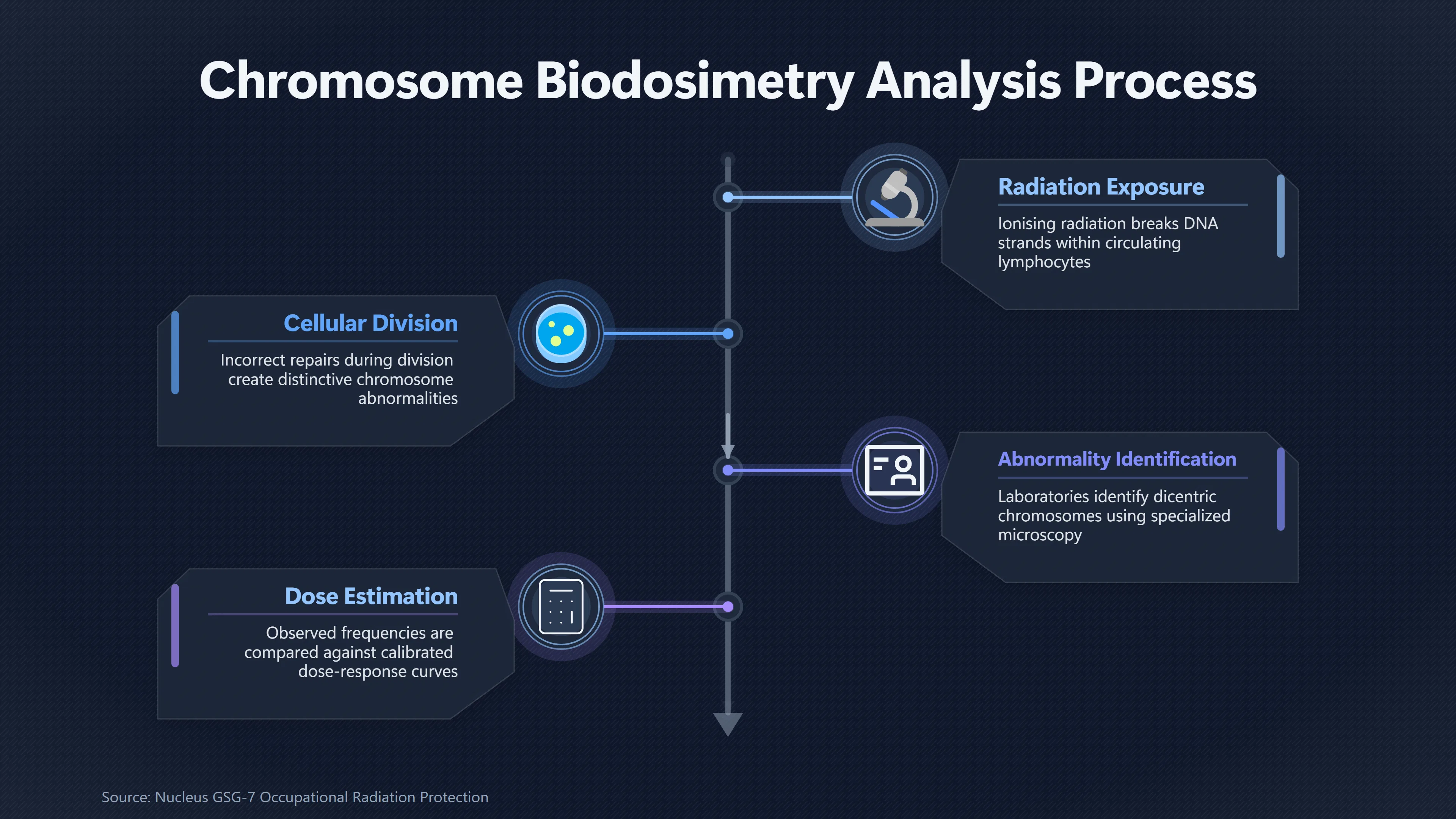
Chromosome biodosimetry is based on a simple principle: ionising radiation can break DNA strands within circulating lymphocytes. During cell division these breaks may be incorrectly repaired, creating distinctive chromosome abnormalities. Some of these abnormalities, particularly dicentric chromosomes (chromosomes with two centromeres), are highly characteristic of radiation exposure and occur only rarely in unexposed people. Because the frequency of these abnormalities increases with absorbed dose, laboratories can compare a patient’s results with calibrated dose–response curves to estimate the likely radiation dose.[iaea.org]nucleus.iaea.orgNucleus GSG-7 Occupational Radiation ProtectionGSG-7 Occupational Radiation Protection - Annex: Techniques for Retrospective Dosimetry - Cytogenetic Techniques - Dicentric chrom…
For decades, the dicentric chromosome assay has been regarded internationally as the reference standard for biological radiation dosimetry following suspected accidental exposure. International Atomic Energy Agency guidance and ISO laboratory standards describe it as the principal cytogenetic method for estimating absorbed dose after radiation accidents.[iaea.org]nucleus.iaea.orgNucleus GSG-7 Occupational Radiation ProtectionGSG-7 Occupational Radiation Protection - Annex: Techniques for Retrospective Dosimetry - Cytogenetic Techniques - Dicentric chrom…
Had suitable blood samples been collected soon after the alleged exposure, chromosome analysis could potentially have answered several important questions:
- whether significant ionising radiation exposure had occurred at all;
- whether the exposure was consistent with whole-body or partial-body irradiation;
- whether the estimated absorbed dose matched the severity of the reported illnesses;
- whether the findings were compatible with acute radiation syndrome or inconsistent with it.
Instead, no verified biological dose estimate entered the public record.
How Chromosome Damage Records Exposure
Chromosome biodosimetry differs fundamentally from measuring environmental radiation. A Geiger counter measures radiation present in the surroundings, whereas chromosome analysis measures biological injury already sustained by the body.
After ionising radiation exposure, lymphocytes circulating in peripheral blood retain chromosome abnormalities that can be identified under a microscope after laboratory culture. The number of dicentric chromosomes observed in hundreds or thousands of cells is then compared with calibration data generated from known radiation exposures. Under favourable conditions, laboratories can estimate whole-body photon doses down to roughly 0.1 Gy, with greater precision as more cells are analysed.[Nucleus]nucleus.iaea.orgNucleus GSG-7 Occupational Radiation ProtectionGSG-7 Occupational Radiation Protection - Annex: Techniques for Retrospective Dosimetry - Cytogenetic Techniques - Dicentric chrom…
This makes chromosome biodosimetry particularly valuable when:
- no personal dosimeter was worn;
- the radiation source is unavailable for measurement;
- exposure circumstances are uncertain or disputed;
- environmental measurements were never performed.
These characteristics make the method especially relevant to unusual historical cases such as Cash–Landrum, where no accepted physical measurement of radiation exists.

Limits of Late or Partial-Body Testing
Although chromosome analysis is powerful, it is not infallible. Reliable dose estimation depends on several conditions that appear difficult to establish in the Cash–Landrum case.
First, timing matters. Dicentric chromosomes are most useful when blood is collected within days after exposure. Although detectable abnormalities may persist for some time, unstable chromosome aberrations gradually decline as damaged lymphocytes disappear from circulation, reducing the accuracy of later estimates.[Nucleus]nucleus.iaea.orgNucleus GSG-7 Occupational Radiation ProtectionGSG-7 Occupational Radiation Protection - Annex: Techniques for Retrospective Dosimetry - Cytogenetic Techniques - Dicentric chrom…
Second, the technique works best when exposure is approximately uniform across the body. If only part of the body receives radiation, some circulating lymphocytes may be heavily irradiated while others remain unaffected. Modern statistical methods can sometimes estimate partial-body exposures, but they require careful sampling and specialised analysis rather than straightforward application of whole-body calibration curves.[UK Health Security Agency]researchportal.ukhsa.gov.ukUK Health Security AgencyEstimating partial-body ionizing radiation exposure by automated cytogenetic biodosimetry - UK Health Security A…
Third, interpretation depends on well-documented clinical information, including:
- the estimated exposure time;
- the suspected radiation type;
- whether exposure was acute or prolonged;
- blood collection dates;
- laboratory quality controls;
- the number of metaphase cells analysed.
Without these details, even genuine chromosome abnormalities become difficult to translate into a reliable absorbed-dose estimate.
Why No Dependable Dose Emerged in This Case
The central problem is not that chromosome biodosimetry is incapable of estimating dose. Rather, the publicly available evidence does not show that the necessary investigation was completed in a manner meeting recognised biodosimetry standards.
No accepted absorbed-dose figure has emerged from the medical record. Likewise, no peer-reviewed cytogenetic report has become part of the public evidence demonstrating a validated dicentric chromosome analysis with sufficient methodological detail to support dose reconstruction.
As a result, several key questions remain unanswered:
- Were blood samples obtained early enough for optimal analysis?
- Were enough cells examined to produce statistically meaningful results?
- Were any chromosome abnormalities compared against established calibration curves?
- Was exposure interpreted as whole-body or partial-body?
- Were laboratory findings independently reviewed?
Without answers to these questions, later claims about radiation dose cannot be independently verified through recognised biological dosimetry methods.

What the Missing Dose Estimate Means for the Radiation Debate
The absence of a dependable chromosome-based dose estimate has important consequences for interpreting the wider evidence.
Supporters of a radiation explanation often point to reported illnesses that resemble aspects of acute radiation exposure. However, symptom patterns alone cannot establish absorbed dose because many reported features—including burns, nausea and hair loss—have alternative medical explanations or overlap with severe thermal injury. A quantified chromosome-based estimate would have provided an objective biological measurement against which those clinical observations could be tested.
Conversely, the lack of such an estimate does not prove that no unusual exposure occurred. It simply means that one of the strongest available biological methods for reconstructing past radiation exposure was either not performed adequately, not preserved, or has not entered the public documentary record.
This leaves the Cash–Landrum incident in an unusual evidential position. The case contains extensive testimony about illness but lacks the validated biodosimetric evidence that modern radiation investigations rely upon to distinguish suspected ionising radiation exposure from other possible causes. That absence remains one of the most significant unresolved limitations when assessing claims that ionising radiation, rather than intense heat or another mechanism, produced the reported injuries.
Amazon book picks
Further Reading
Books and field guides related to Could Chromosome Tests Have Confirmed a Radiation Dose?. Use these as the next step if you want deeper reading beyond the article.
Radiobiology for the Radiologist
In print since 1972, this seventh edition of Radiobiology for the Radiologist is the most extensively revised to date. It consists of two...
Medical Effects of Ionizing Radiation
"The new edition of this monograph features renowned experts who offer the most current information and reliable guidance on all aspects...

Basic clinical radiobiology
First published 2009. Subjects: Radiotherapy, Radiobiology, Neoplasms, Cell Survival, Radiation effects.
Medical Management of Radiation Accidents
Although radiation accidents are rare and often complex in nature, they are of great concern not only to the patient and involved medical...
eBay marketplace picks
Marketplace Samples
Live-tested eBay searches with available results related to this page.
Selected fromUFO art print oneBay.co.uk.


Current eBay listing
UFO ALIEN POSTER ART PRINT - FRAMED OPTIONS - CHOOSE SIZE! B

Current eBay listing
UFO Over Forest Framed Wall Art Poster Canvas Print Picture
Endnotes
1.
Source: iso.org
Link:https://www.iso.org/standard/82295.html
Source snippet
ISO 19238:2023 - Radiological protection — Performance criteria for service laboratories performing biological dosimetry by cytogeneti...
2.
Source: committee.iso.org
Link:https://committee.iso.org/standard/82295.html?browse=tc
3.
Source: iso.org
Link:https://www.iso.org/es/contents/data/standard/08/22/82295.html
4.
Source: youtube.com
Title: ORAU | Cytogenetic Biodosimetry Laboratory
Link:https://www.youtube.com/watch?v=ZCy43kfBxBY
Source snippet
The Cash - Landrum UFO Encounter | Dark Mysteries...
5.
Source: youtube.com
Title: The Cash
Link:https://www.youtube.com/watch?v=t6sV0LIy7GI
Source snippet
Landrum UFO Mystery...
6.
Source: nucleus.iaea.org
Title: Nucleus GSG-7 Occupational Radiation Protection
Link:https://nucleus.iaea.org/sites/nss-oui/Published%20Chunks/m_cf1f9f91-f97c-4467-a9e6-e24560302f61/c_465a704d-72b5-4f55-be33-42757d378fb3__1_0.Html
Source snippet
GSG-7 Occupational Radiation Protection - Annex: Techniques for Retrospective Dosimetry - Cytogenetic Techniques - Dicentric chrom...
7.
Source: researchportal.ukhsa.gov.uk
Link:https://researchportal.ukhsa.gov.uk/en/publications/comparison-of-established-and-emerging-biodosimetry-assays/
Source snippet
UK Health Security AgencyComparison of established and emerging biodosimetry assays - UK Health Security Agency...
8.
Source: researchportal.ukhsa.gov.uk
Link:https://researchportal.ukhsa.gov.uk/en/publications/the-minimum-detectable-dose-by-biodosimetry-in-a-radiation-overex/
Source snippet
UK Health Security AgencyThe minimum detectable dose by biodosimetry in a radiation overexposure - UK Health Security Agency...
9.
Source: researchportal.ukhsa.gov.uk
Link:https://researchportal.ukhsa.gov.uk/en/publications/estimating-partial-body-ionizing-radiation-exposure-by-automated-/
Source snippet
UK Health Security AgencyEstimating partial-body ionizing radiation exposure by automated cytogenetic biodosimetry - UK Health Security A...
10.
Source: researchportal.ukhsa.gov.uk
Title: UK Health Security Agency Dose estimation software for radiation biodosimetry
Link:https://researchportal.ukhsa.gov.uk/en/publications/dose-estimation-software-for-radiation-biodosimetry/
Source snippet
UK Health Security AgencyDose estimation software for radiation biodosimetry - UK Health Security Agency...
11.
Source: GOV.UK
Link:https://www.gov.uk/government/publications/radiation-doses-investigated-by-chromosomal-aberration-analysis-2016-to-2023/doses-in-radiation-accidents-investigated-by-chromosomal-aberration-analysis
12.
Source: inis-temp.iaea.org
Link:https://inis-temp.iaea.org/search/search.aspx?dnavs=inmeta%3APublicationYearRange%3A2011..2015+inmeta%3ADescriptors%3DBIOLOGICAL%2520MATERIALS+inmeta%3AConferenceTitle%3DEPRBioDose%25202010%2520international%2520conference&lang=en-US&login=false&num=10&orig_q=author%3A%22Wilkins%2C+Ruth+C%22&q=+inmeta%3AConferenceTitle%3DEPRBioDose%25202010%2520international%2520conference&search-option=Everywhere&sort=date%3AD%3AS%3Ad1&sortorder=descending&src=ics&user=External
13.
Source: sciencedirect.com
Title: Dicentric Chromosome
Link:https://www.sciencedirect.com/topics/biochemistry-genetics-and-molecular-biology/dicentric-chromosome
Additional References
14.
Source: pubmed.ncbi.nlm.nih.gov
Link:https://pubmed.ncbi.nlm.nih.gov/41530232/
Source snippet
Optimized dicentric chromosome dose-response curves with centromere probes improve low-dose radiation biodosimetry - PubMed...
15.
Source: pubmed.ncbi.nlm.nih.gov
Link:https://pubmed.ncbi.nlm.nih.gov/42044909/
Source snippet
2026 Apr 27:eRADE-25-00180.1. doi: 10.1667/RADE-25-00180.1. Online ahead of print. INTERLABORATORY COMPARISON OF THE DICENTR...
16.
Source: youtube.com
Title: The Cash-Landrum UFO Mystery
Link:https://www.youtube.com/watch?v=P2HsOUTzyWA
Source snippet
This selection provides direct coverage of biological dosimetry tools like [chromosome testing]({{ 'chromosome-test/' | relative_url }}) alongside context on the Cash–Landrum incid...
17.
Source: journals.sagepub.com
Link:https://journals.sagepub.com/doi/abs/10.1177/15593258261435382
Source snippet
sagepub.comHigh-Throughput Automated Construction and Validation of Dicentric Chromosome and Micronucleus Biodosimetry Calibration Curves...
18.
Source: youtube.com
Title: Radiation Biodosimetry: Where We Are and Where We Need to Go
Link:https://www.youtube.com/watch?v=k9tZ5pVb1EA
Source snippet
ORAU | Cytogenetic Biodosimetry Laboratory...
19.
Source: cordis.europa.eu
Link:https://cordis.europa.eu/project/id/241536/reporting/es
20.
Source: jstage.jst.go.jp
Link:https://www.jstage.jst.go.jp/article/radiatenvironmed/12/2/12_121/_article
21.
Source: youtube.com
Link:https://www.youtube.com/watch?v=ANs6fbSbw4s
Source snippet
Radiation Biodosimetry: Where We Are and Where We Need to Go...
22.
Source: cdc.gov
Title: how to measure radiation
Link:https://www.cdc.gov/radiation-health/about/how-to-measure-radiation.html
23.
Source: pubmed.ncbi.nlm.nih.gov
Link:https://pubmed.ncbi.nlm.nih.gov/17443338/